Racing Games: Chinese Checkers, Backgammon, Quoridor, Kamisado and Santorini
Everyone runs the same way on a road they have to share — that alone is enough to make a game.
One of the oldest forms there is
Backgammon is the ancestor here and among the oldest games on this site with solid evidence: Roman tabula of the 1st century is already close to the modern form, and earlier ancestors run back into the Near East. Racing games may well predate chess-type games — after all, “first one home wins” requires inventing no abstraction at all.
But a pure race would be dull. What makes this family work is one shared property: the road is shared. Your pieces and your opponent's occupy the same track, which produces blocking, hitting, borrowing and yielding. The conflict comes from contested space rather than from capture.
From dice to pure strategy
Backgammon lets dice decide how far you go and choice decide how well, then adds the doubling cube, which turns “how likely do I think I am to win” into something you can bet on. It is the only game here with randomness, and the only one with a game-theoretic moment for resigning.
Chinese Checkers (Stern-Halma, Ravensburger, Germany 1892) removes the randomness: move all ten pieces into the opposite camp, with no capture at all. It is really a path-building problem — assemble a chain your own pieces can leap along without building one for your opponent. The name was a marketing invention; the game has no Chinese origin.
Quoridor (1997, Gigamic) promotes blocking from side effect to main action: each turn you either step or place a wall. Walls change paths permanently, limited only by the rule that neither player may be sealed off completely. It becomes an explicit trade — every wall you place is a step you did not take.
Two modern games that redefine arriving
Kamisado (2008, UK) keeps the goal of reaching the far row but takes away the choice: the tower you must move is fixed by the colour of the square your opponent just landed on. The game runs like a chain pulled along by colour — deciding where you go also decides which single piece your opponent may move next.
Santorini (designed 1985, remade by Roxley in 2016) turns the race vertical: move one step, build one level, and win by climbing from level 2 to level 3. The road becomes height and blocking becomes roofing — you can dome the square your opponent needs, putting it out of reach forever. A set of god powers rewrites one basic rule each game.
The 6 games in this family
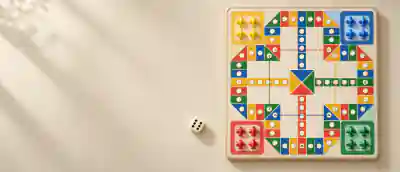
Ludo
South Asia · Early modern
Roll a six to leave the yard, race four tokens home and send rivals back. Classic Ludo or Chinese aeroplane chess, for two to four players.

Backgammon
West Asia & the Mediterranean · Ancient
Use the dice to race, hit, block, and bear off all fifteen checkers.
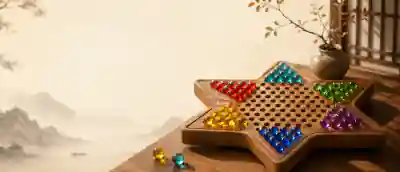
Chinese Checkers
Europe · Early modern
Race your marbles across a star board with long, turning chains of jumps.

Quoridor
Europe · Contemporary
Race to the far side while placing walls that reshape both players' shortest paths.
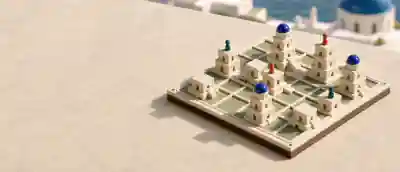
Santorini
The Americas · Contemporary
Move workers, build towers, and win by climbing to the third level.

Kamisado
Europe · Contemporary
Race colored towers forward while each landing square dictates the opponent's next tower.