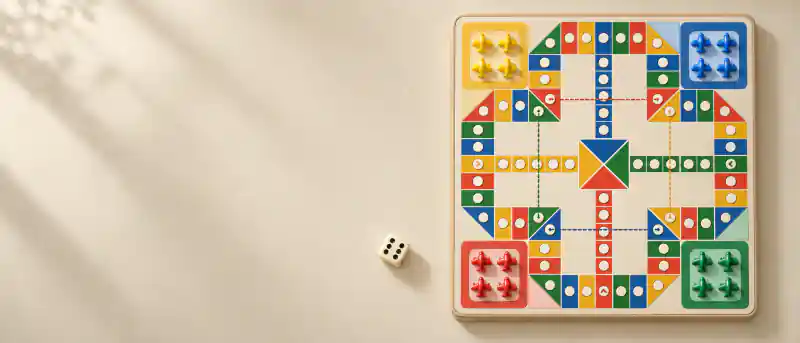
Complete Ludo Rules
Start with what a turn allows and how the game is won.
- Board
- 52-square loop, 5-square home lane
- Players
- 2–4, four tokens each
What do you need to roll to start in Ludo?
You need a 6 to bring a token out of your yard onto your start square, and a 6 also gives you another roll. Aeroplane chess works the same way: a 6 takes a plane off from the hangar.
Can you capture a stack of two tokens in Ludo?
Not in Ludo King style rules: two or more tokens of one colour on the same square are safe, and they do not block, so an opponent can pass them or share the square. In aeroplane chess a stack does block, and landing exactly on it sends both sides home.
- Both gameseach player keeps four tokens in a corner yard. On your turn you roll one die, pick a token and move it the full count clockwise around the loop, then up your own home lane to the centre. One roll moves one token, and if any token can move you must move one.
- Ludo, leaving the yard: only a 6 brings a token out, onto your coloured start square. A 6, a capture or a token reaching the centre each give another roll, but one move never gives more than one. A third 6 in a row in the same turn is void: the turn ends at once, and the moves from the first two 6s stand.
- Ludo, captures and safe squares: landing on a lone opposing token on an ordinary square sends it back to its yard. The four start squares and the four star squares are safe: nobody is captured there and colours can share them. Two or more tokens of one colour on a square are also safe, and they do not block; opponents may pass them or stop on the same square.
- Ludo, reaching the centre: you need the exact number. If the roll is too big, that token cannot move this time and you must move another one.
- Aeroplane chess, take-off: only a 6 moves a plane from the hangar to its take-off pad, and that 6 is used up. Every 6 rolls again, with no penalty for several in a row. Captures and reaching the finish do not give extra rolls.
- Aeroplane chess, jumps: landing on a square of your own colour jumps you straight to the next one, four squares ahead. A jump never chains into another jump.
- Aeroplane chess, flights: landing on your coloured square with the dashed line flies you across the board, and then you jump once more. If a jump lands you on the dashed square, you fly across and stop there. The flight line crosses the third square of another colour's runway, ringed on the board in the line's colour, and a lone opposing plane on that square is sent home as you fly over it.
- Aeroplane chess, captures: whenever your plane comes to rest on a lone opposing plane, whether after walking, jumping or flying, that plane goes back to its hangar.
- Aeroplane chess, stacks: planes of one colour on the same square form a stack, though each still moves on its own. Opponents cannot pass a stack. If you reach it with count left over, you move back by the rest. If you land exactly on it, the stack and your plane all go home. A jump or flight whose path crosses an opposing stack does not happen.
- Aeroplane chess, the finish: you need the exact number, and any extra bounces you back.
- Placingsthe first player with all four tokens home wins, and the others keep playing until only one is left. A two-player game ends when the first player finishes.
How to Play Ludo: Your First Game
Use this order of thought to get through a complete game quickly.
- When you roll a 6, decide whether to bring a new token out or push one already on the board six squares. Getting several tokens out early gives you far more choices on later rolls.
- Check each move in this order: can you capture, can you escape an opponent sitting one to six squares behind you, can you reach a jump, flight or safe square, and only then which token gets furthest.
- In Ludo the star squares and start squares are safe. The few squares just past another player's start square are the most dangerous place on the board, because a freshly released token can hit you from there.
- In aeroplane chess your colour comes up every four squares. If a token sits exactly the right distance from one, spend that roll on it, and landing on the dashed square saves more than a dozen squares.
- When you are unsure, press the master hint and the board marks the suggested token and where it lands.
Ludo Strategy
Move from knowing the rules to playing with a plan.
- Do not race one token alone. You need all four home, and one runner with three tokens still in the yard usually means waiting a long time for 6s.
- An opponent one to six squares behind you has roughly a one-in-six to one-in-three chance of hitting you. Stepping onto a safe square, joining your own token or getting out of range is often worth more than two extra squares.
- In Ludo a capture earns another roll, so taking one is usually right. But if you land in the middle of several opposing tokens, expect to be sent back next round.
- In aeroplane chess a stack is a wall: nobody gets past it, and landing on it exactly costs the attacker a plane too. Parking two planes on an opponent's path can hold up their whole group, but a stack is also a target and you lose two planes if someone lands on it.
- In the last few squares before the home lane, with nobody chasing, there is no hurry. Save the roll for a token that needs it.
- With two players the opponents start half a board apart and captures are rarer, so the game turns on who gets all four tokens out first.
Ludo Winning and Special Rules
Details that are easy to miss but can change the result.
- Two boardsLudo uses the 15×15 cross with safe stars, and aeroplane chess uses the 17×17 plane board with corner hangars, a loop of repeating colours and the dashed flight lines. Switching rules in the settings starts a new game, and the site remembers the one you picked last.
- Finishing quicklyonce you (and any friend on the same device) are all home, the remaining computer seats finish in the background with the same dice and the same computer player, and the placings appear at once. Choose Keep watching to see it play out; the result is the same.
- Diceevery roll in a game comes from one random seed, all seats share the same die, and the computer cannot see upcoming rolls. After the game you can see how many of each number every player rolled.
- Undo takes you back to before your last move. Rolls come from the seed, so rolling again gives the same number; what you can change is which token moves.
- When there is only one way to move, including several tokens whose move would end the same, the token moves by itself. When nothing can move, the reason is shown and the turn passes.
- Two players sit in opposite corners; with three, the bottom-right corner is empty. Any computer seat can be switched to a friend on the same device.
Common Ludo Rules Mistakes
The traps new players fall into most often.
- Expecting a bonus roll for a capture in aeroplane chess. That is a Ludo rule; in aeroplane chess only a 6 rolls again.
- Moving a stack as one piece. In both rule sets on this site, stacked tokens still move one at a time.
- Trying to walk past an opposing stack in aeroplane chess. The stack blocks, and the rest of the count moves your plane backwards.
- Rolling a 5 with a Ludo token two squares from the centre and expecting it to go in. The count must be exact, so that token cannot move this turn.
- Mixing up the triple-six rules: in Ludo a third 6 in a row is void, while in aeroplane chess any number of 6s is fine.
The Story of Ludo
Where it came from, and why it turned out this way.
OriginIndia's Pachisi · patented in England as Ludo in 1896 · aeroplane chess is a 20th-century Chinese offshoot
A cross-shaped cloth
The family begins with Pachisi, played in India on a cross-shaped cloth or board. Four players each hold one arm, throw cowrie shells to decide how far to move, and race around the outside of the cross and back to the centre. It was played across South Asia for centuries, and the Mughal emperor Akbar is said to have laid out a giant board in a palace courtyard with people as the pieces. The Ludo that India now plays on its phones descends directly from that cloth.
Ludo, a Victorian simplification
Late in the nineteenth century Pachisi reached England, where it gained a cubic die, four coloured sets and a fixed rule for leaving the yard. It was patented in 1896 as Ludo, Latin for "I play". Around the same time the game branched out: Parcheesi in America kept two dice, Germany's Mensch ärgere Dich nicht ("don't get annoyed") was in nearly every home by the early twentieth century, and Spanish speakers call it Parchís. The details differ, but the cross, the four colours, the 6 to start and the capture that sends a token home have never changed.
Aeroplane chess: tokens become planes
Aeroplane chess is the Chinese branch. Nobody has a reliable date for its origin, and the physical rule sheets that survive come mostly from the second half of the twentieth century. It turns the tokens into planes and the yards into hangars, and adds things Ludo never had: landing on your own colour jumps you forward, the dashed square flies you straight across the board, and two planes of one colour stacked together block whoever comes behind. Those shortcuts give it a different feel from Ludo, and it became a childhood staple for generations of Chinese children.
From the cardboard box to the phone
In 2016 the Indian studio Gametion released Ludo King. During the 2020 lockdowns it became a national pastime in India, a way for families scattered across cities to sit at one table, and its Google Play installs later passed a billion. It also made "are the dice rigged?" the most common complaint under games of this kind: a single die somehow feels harder to trust on a screen than on a table.
- BoardGameGeek files Ludo, Parcheesi, Mensch ärgere Dich nicht and aeroplane chess under the single entry Pachisi. More than six thousand people have rated it, averaging about 4.5 out of 10: low scores blame pure luck, high scores cite memories of playing with family.
- The rule that a third 6 in a row is void comes from online platforms. In the old English rulebooks a 6 simply rolls again, as many times as it comes up, and Chinese aeroplane chess sheets do not penalise repeated 6s either.
- English speakers often mix up Ludo, Parcheesi and Sorry!. Ludo uses one die, Parcheesi two, and Sorry! replaces the dice with a deck of cards.