Attrition Games: Draughts, Nine Men's Morris, Surakarta, Fanorona, Banqi, SHOBU and TZAAR
The plainest way to win: leave your opponent with nothing to play. For two thousand years people have only been changing how you take.
The oldest thread
The win condition here barely needs explaining: capture everything, or capture until your opponent has no legal move. Nine Men's Morris differs slightly — reducing the enemy to two pieces is enough, since two pieces can never form a mill again.
It also has the richest archaeological record. Merels boards, the ancestor of Nine Men's Morris, are scratched into stone at Roman sites, and medieval European church pews and cloister benches carry grids cut by bored players. Fanorona was recorded in 17th-century Madagascar and belongs to the alquerque family — which is itself the ancestor of draughts.
The real divide is how you capture
Draughts answers with compulsion: if a capture is available you must take it. That one rule turns the whole game into a study in sacrifice — offer a piece, force the capture, then take three back. The 10×10 international version settled in 18th-century Paris, and it is this rule that gives it depth far out of proportion to the board.
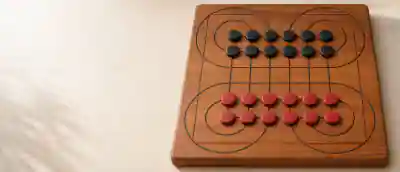
Surakarta, from Java and named after the old city of Solo, answers with loops: a capture must leave the board along a line, travel around one of the corner loops, and re-enter, so capture paths often circle most of the board. There is nothing quite like it anywhere else.
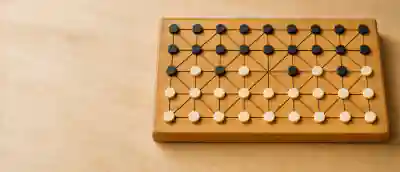
Fanorona answers with direction: capture splits into approach and withdrawal — moving toward a line of enemies takes them, and so does moving away from one. Both often apply to the same move, and you must choose.
Banqi answers with information: every piece starts face down, and you only learn what it is by turning it over. Rank-based capture still applies, but you must decide whether to flip or to take without knowing what you face.
How modern designers rework it
TZAAR (2007, sixth in the GIPF series) turns capture into resource management: a capture requires your stack to be at least as tall as theirs, and taller stacks are stronger but fewer. You must keep all three piece types alive — losing any one type entirely is a loss. A single objective becomes a balancing act.
SHOBU (2019) splits capture across four small boards: a passive push on your own side must be matched by an aggressive push of the same direction and distance on a board of the other colour. One move has to be legal on two boards at once, and clearing any single board wins.
Both make the same point: the old attrition thread is far from exhausted. Change the conditions of capture and an entirely new game grows out of it.
The 7 games in this family

Draughts & Checkers
Europe · Ancient
Master mandatory captures in both English/American checkers and international draughts.

9 Men's Morris
Europe · Ancient
Form mills of three stones, remove enemy pieces, and reduce their mobility.

Banqi
East Asia · Ancient
Banqi, also called Chinese Dark Chess or Half Chess, reveals a hidden army piece by piece on half of a Xiangqi board.
Fanorona
Africa · Ancient
Capture by approaching or withdrawing, then continue through tactical relay sequences.
Surakarta
Southeast Asia · Ancient
Use looping tracks to make sweeping captures on a compact Indonesian board.

SHOBU
The Americas · Contemporary
Make a quiet move on one board, then mirror it with a forceful push on another.

TZAAR
Europe · Contemporary
Capture, strengthen, and preserve all three visible piece types in a tense two-action stacking duel.