Melding and Combination-Scoring Card Games: Gin Rummy, Canasta, Indian Rummy and Cribbage
All four games ask which combinations a card can enter and whether it should stay or go. Only the first three build melds; Cribbage converts combinations directly into points on the road to 121.
The shared spine: combinations must become results
Gin Rummy, Canasta and Indian Rummy organise cards into recognised melds: equal-rank sets, suited runs, or constrained mixtures of the two. A card may sit near several plans, but a final layout assigns it to one legal group, so the chosen partition determines deadwood, declaration rights and the value of the deal.
Cribbage is the boundary member of the family. It never lays cards into melds. Instead, play and show scoring repeatedly recognise fifteens, pairs and runs, and one card may contribute to several distinct scoring combinations. What it shares with the rummy games is the conversion of card relationships into progress, not the same draw-and-discard structure.
Gin Rummy: keep the ending inside ten cards
Gin is a short two-player game with ten-card hands. Each turn draws from the stock or discard top, then discards one card. Cards outside melds count as deadwood. Standard Gin permits a knock at ten deadwood or less and calls zero deadwood gin; the opponent may lay off only after an ordinary knock, never after gin.
An early knock locks in a small total but risks an undercut if the opponent can arrange a lower one. Oklahoma Gin makes the opening up-card set the knock limit and doubles a deal whose up-card is a spade, so the same hand can demand a different stopping decision from the first visible card onward.
Canasta: public melds and a partnership match
Canasta uses two decks plus four jokers, fixed partners, and eleven cards per player. Partners share public melds, while wild-card ratios, the initial meld requirement, red and black threes, and a frozen discard pile govern what can be exposed. Taking the discard means taking the whole pile and immediately using its top card legally.
A team needs at least one seven-card canasta before it can go out. Natural and mixed canastas, cards left in hand, and red threes all enter the deal score, and the match continues to 5,000, so current scoring, discard control, and whether a partner should end the hand belong to one decision.
Indian Rummy: the pure sequence is a declaration gate
This two-player Points Indian Rummy game uses two packs plus printed Jokers and deals thirteen cards each. A legal declaration must place every card in disjoint sequences or sets, include at least two sequences, and keep one of them pure—no wild card may substitute a missing rank in that first life. The random Joker can repair a second sequence or set, but cannot replace the gate itself.
Penalty scoring follows that structure. With no pure sequence, every card counts; with one pure life but no second sequence, only the best pure run is protected; after both lives exist, all other legal groups become safe. The first job is therefore to cross the declaration threshold, and only then to minimise the loose cards around it.
Cribbage: score combinations instead of laying melds
Cribbage deals six cards each and sends two from each player into the dealer's crib. The four kept cards are first played one at a time under a running total of 31, scoring fifteens, thirty-ones, pairs and runs; the same cards are then counted again with a shared starter for fifteens, pairs, runs, flushes and nobs. There is no meld area and no requirement to partition the whole hand.
It belongs here because the discard decision is still a problem of combination value. A five, a pair, or two cards adding to fifteen have opposite expected value when fed to your own crib or the opponent's. Pegging, hand and crib points all move the same markers, and reaching 121 in any phase ends the game immediately.
The 5 games in this family
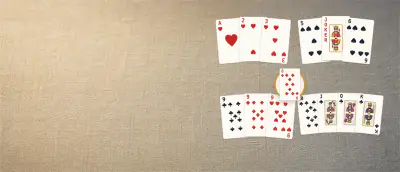
Indian Rummy
South Asia · Early modern · Cards
Build two sequences including one pure sequence, use the wild Joker carefully, and declare all thirteen cards before your opponent in fast two-player Points Rummy.
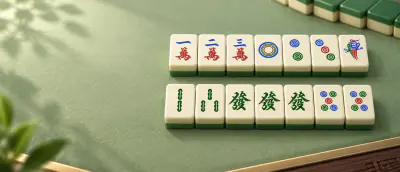
Mahjong
East Asia · Early modern · Cards
Build a winning hand against local AI: Basic 13, Sichuan, four- and three-player riichi, MCR and American mahjong, with rules and hints at the table.
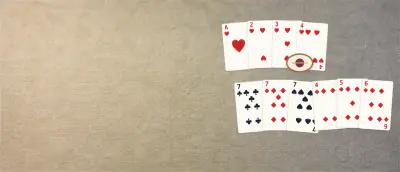
Gin Rummy
The Americas · Early modern · Cards
Draw and discard toward runs and sets, manage deadwood, then knock at the right moment — or press for gin — in the classic two-player rummy game.
Canasta
The Americas · Early modern · Cards
Build same-rank melds with your partner, control the discard pile, complete a seven-card canasta, and reach 5,000 points across successive hands.
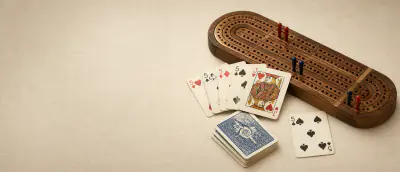
Cribbage
Europe · Ancient · Cards
Discard for hand and crib value, peg through running counts to 31, then count fifteens, pairs and runs in the classic race to 121.