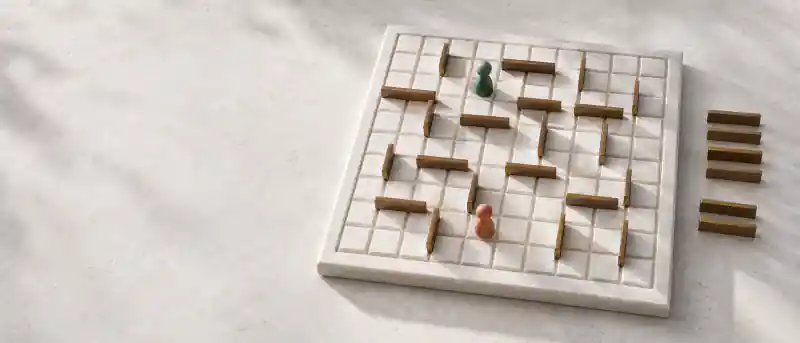
Complete Quoridor Rules
Start with what a turn allows and how the game is won.
- Board
- 9 × 9 squares
- Supply
- 10 walls per player
What Is Quoridor Called in Chinese?
Chinese-language sources commonly call Quoridor 路墙棋 (traditional 路牆棋), often shortened to 墙棋; 步步为营 is a common product name. 围墙棋 is an understandable but less established literal translation. 路障棋 names a different game, Entrapment, and is not a Quoridor alias.
- Winning conditionthe first player to move their pawn onto any square of the opposite edge wins. This is a race — walls cannot capture and cannot kill; their only function is to make your opponent's route longer without lengthening your own.
- Ivory starts at the center of the bottom edge and aims for any of the nine squares along the top edge; Indigo starts at the center of the top edge and aims for the bottom. Ivory moves first.
- Each turn you must act exactly once, and only one kind of action is allowed: move your pawn one square orthogonally, or place a wall from your supply. You may not skip a turn, and once your walls run out, moving the pawn is your only remaining option — so the supply is a resource that runs dry.
- Ordinary pawn moves cannot go diagonally, pass through a wall, leave the board, or land on the square occupied by the opposing pawn.
- Jump, first branch: when the two pawns are orthogonally adjacent with no wall between them, you may jump straight over your opponent onto the square directly behind them. As long as that landing square is on the board and no wall stands between your opponent and it, this direction may be used only as a straight jump and cannot be converted into a diagonal one.
- Jump, second branch: if the square straight behind your opponent is unavailable because of a wall or the board edge, you instead land on the square to your opponent's left or right, meaning the two directions perpendicular to your original jump. That side square must be on the board, empty, and free of a wall between it and your opponent; if both sides are blocked, this direction offers no jump at all.
- A wall always spans the boundary of two adjacent squares — it can never seal just one edge, and it can never span three squares. A horizontal wall sits between two rows and covers two adjacent columns; a vertical wall sits between two columns and covers two adjacent rows. With eight gaps between rows and eight between columns, there are sixty-four wall-slot anchors in total.
- Walls may not overlaptwo horizontal walls in the same row overlap if their anchor column numbers differ by at most one, and the same applies to two vertical walls in the same column with anchor rows. A horizontal and a vertical wall sharing the same central anchor form a cross, which is likewise illegal. Walls that meet end to end, run in a line, or form a T-junction are all permitted.
- Both players must still have a path after a wall is placed: with the candidate wall temporarily inserted, a path search runs from each pawn's current square, and both must be able to reach their own goal edge, or the wall is illegal — the interface will not let you place it and your supply is not reduced. Sealing off only yourself is equally illegal.
- That path check ignores pawn occupancy. Pawns are temporary obstacles that can move and be jumped; what the rules forbid is only permanent sealing by walls.
- The instant either pawn steps onto any square of its goal edge, that player wins and the board locks, accepting no further moves or wall placements.
How to Play Quoridor: Your First Game
Use this order of thought to get through a complete game quickly.
- Walk straight forward for the first few moves. While both shortest paths are roughly equal, the progress you gain from a step is usually worth more than a wall that costs your opponent only two extra steps.
- Before considering any wall, count two numbers: your shortest distance to your goal edge and your opponent's shortest distance to theirs. A good wall makes their number clearly larger while leaving yours essentially unchanged.
- To place a wall, first switch the turn action panel to horizontal or vertical wall placement, then click a slot. Only anchors legal for the current orientation are clickable, and any anchor that would overlap, cross, or seal a path simply will not respond.
- Do not stack walls one after another directly in front of your opponent — they just step sideways and walk around. Effective blocking staggers each new wall against existing walls and the board edges, forcing a long zigzag detour.
- When you end up face to face with the other pawn, look carefully at the square behind it: if it is empty you get a straight jump and advance two squares at once; if a wall blocks it, or your opponent is already against the edge, you can only take one of the two diagonal squares beside them.
Quoridor Strategy
Move from knowing the rules to playing with a plan.
- Measure every wall by the shortest-path differential: your opponent's path increase minus your own. The gap has to be large enough to justify spending one of your finite walls.
- Wall supply does not regenerate. Squander walls early on detours that do not matter, and you will have nothing left when your opponent makes a straight sprint in the endgame.
- When ahead, prefer moving; use walls to buy time only when behind. Forcing your opponent into a corridor with a single exit and then using the next wall to move that exit is far more efficient than scattering blockers around.
- Standing next to the enemy pawn may let you gain two squares with a straight jump, but it can equally hand that same acceleration to your opponent, since jumping is available to whichever pawn is adjacent. Evaluate your position together with the surrounding wall shapes.
- Recompute both paths before placing any wall. A wall that appears to target only your opponent can also carve out a corridor you will have to detour around later.
- Because passing is not allowed, the player who runs out of walls must move every subsequent turn, handing the tempo entirely to their opponent. Keeping two or three walls in reserve going into the endgame is the standard safe approach.
Quoridor Winning and Special Rules
Details that are easy to miss but can change the result.
- There is exactly one winning condition: a pawn entering any square of its goal edge. Ivory needs the top row and Indigo the bottom, and the game ends immediately.
- There are no draws, no repetition rulings, and no move limit. Because every wall must leave both players a path, the position can never deadlock with neither side able to advance.
- The diagonal landing square is not an ordinary diagonal move. It appears only when a face-to-face straight jump is blocked, and it must be one of the two squares perpendicular to the original jump direction.
- This site's initial release implements only the two-player 9×9 standard rules, without the four-player variant's five walls per player or the multi-pawn jump adjudications that come with it.
Common Quoridor Rules Mistakes
The traps new players fall into most often.
- Checking only whether walls conflict with each other and forgetting to check whether the wall seals off one player's remaining paths — the rule that players and implementations most often get wrong at the same time.
- Assuming it is acceptable to seal yourself in. The rules require both players to retain a path, so blocking yourself is equally illegal.
- Wanting a diagonal move when the square behind your opponent is clear. If the straight jump is available, the straight jump is the only option — the diagonal is not a free alternative.
- Forgetting that the board edge also counts as a blocked square behind. When your opponent stands against the edge adjacent to you, the two side diagonals are triggered just as they would be by a wall.
- Treating a wall as sealing a single edge, or assuming a horizontal and a vertical wall can cross through the same slot center.
The Story of Quoridor
Where it came from, and why it turned out this way.
DesignMirko Marchesi · 1997 · published by Gigamic
Twenty years of revision before it settled
Quoridor was designed by the Italian Mirko Marchesi and published by Gigamic in France in 1997. It was not the product of a single flash of insight: Marchesi had made predecessor versions called Blocade and Pinko Pallino back in the 1970s, repeatedly adjusting board size and wall count until arriving at 9×9 with ten walls each. That combination was tuned rather than derived — two more walls per player and the game tilts noticeably toward defense.
"You may not seal a path" is the whole of legality
Quoridor has exactly one genuinely complex rule: after a wall is placed, both players must still have a route to their goal edge. What it forbids is not blocking but sealing. That single rule accomplishes three things at once — it guarantees the game terminates, it guarantees no deadlock can occur, and it turns every wall placement from "get in their way" into a question that requires re-verifying connectivity across the whole board.
Two resources, one turn
Each turn offers only a choice of two: step one square, or place a wall. Walls are therefore bought with time — every wall you place lets your opponent advance a square. The practical evaluation is the shortest-path differential: how many extra steps does this wall cost my opponent, how many does it cost me, and is the gap worth one of my finite walls? Squander them early and you can only watch as your opponent sprints in a straight line at the end.
Why the diagonal jump exists at all
The face-to-face jump rule looks awkward: jump straight over if the square behind is clear, and only shift to a diagonal when a wall or the board edge blocks it. It is solving a specific problem — if two pawns meet head-on and neither can pass through the other, the position would simply jam. The straight jump is the main rule and the diagonal is its fallback branch, which is why the diagonal is never a free alternative you may choose.
- Quoridor won a Mensa Select award in the United States in 1997, the key step in its spread beyond Europe.
- The four-player version gives each player only five walls, because four players still total twenty — the supply is conserved and the per-player stock halved.
- Walls may not overlap or cross, but they may meet end to end, run in a line, or form a T-junction — and those three arrangements are precisely how long detours are built.
Sources and References
The material this page's rules implementation is based on.
- Quoridor rulesGigamictwo-player game only; the official four-player rules are not implemented
Rights holder and physical editionGigamic