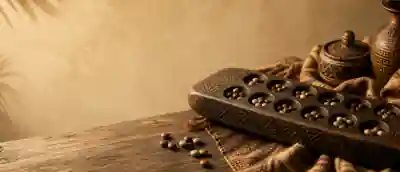
Mancala: Kalah and Oware
Two rows of pits and a handful of seeds — quite possibly the game humanity has played longest.
The most widely spread family there is
Mancala — from the Arabic naqala, “to move” — is not one game but an enormous family spread across Africa, West Asia, Southeast Asia and the Caribbean, differing everywhere in name, pit count and sowing direction. Its equipment can be as simple as two rows of holes scooped in the ground and a handful of stones, which is much of why it travelled so far.
The board is two rows of pits and the pieces are undifferentiated seeds. On your turn you lift every seed from one pit and drop them one per pit in a fixed direction. Because the landing point is fixed entirely by how many seeds you lifted, the calculation is pure arithmetic: before you move you must already know where the last seed lands and what it triggers. Nothing is hidden and nothing is random.
With a store and without are two different games
Oware is the traditional competitive mancala of the Akan people of Ghana and Côte d'Ivoire, and one of the most tournament-minded members of the family. It has no store: the only way to harvest is to make your final seed bring an opponent's pit to exactly two or three, then collect backwards. It also carries a hard constraint — you may not starve your opponent: a harvest that would empty all their pits is forfeited entirely.
Kalah is the version commercialised by the American William Julius Champion Jr. in the 1940s, and it adds a store: each pass of your own store drops a seed into it, and a final seed landing there grants another turn. That chaining rule creates long opening sequences and a marked first-player advantage — standard 6×4 Kalah has been solved, and the first player wins.
The results feel nothing alike: Kalah rolls like a snowball, Oware reads like bookkeeping, with the constant obligation not to leave your opponent unable to move. One is a solved commercial adaptation; the other is a living tradition still played competitively across West Africa.