Complete Santorini Rules
Start with what a turn allows and how the game is won.
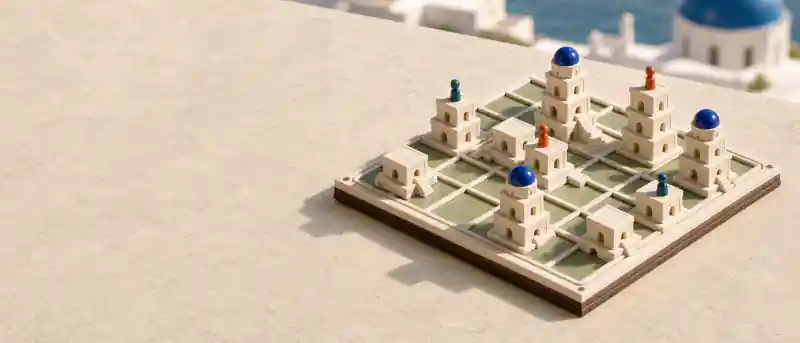
- Board
- 5 × 5 building squares
- Pieces
- 2 workers per player
- Winning conditionmove one of your workers up from a lower level onto the third level and you win immediately. The phrase "move up onto" is what matters — stepping sideways from one level-3 building to another does not win, and stepping down onto level 3 from higher does not win either. The other decisive condition is being sealed in: if it is your turn and neither worker can complete a move plus a build, you lose.
- The game starts on an empty board. The starting player places both of their workers on two different empty squares, then the other player places theirs among the remaining squares. Once placement is done, the starting player takes the first normal turn.
- Each square has a height from 0 to 4: 0 is ground level, 1 through 3 are floors a worker can stand on, and 4 is a dome, which can never be entered and never built on further. At most one worker occupies a square.
- A normal turn moves first: choose one of your workers and step to one of the eight surrounding squares. The destination must have no worker and no dome. The height restriction is asymmetric — you may climb at most one level, but you may descend any number of levels at once, or move level.
- If that move did not win outright, the worker that just moved must build one level on one of the eight squares adjacent to its new position. You may not build with the other worker, and you may not decline to build. The build square must have no worker and no dome, and heights rise 0→1, 1→2, 2→3, 3→4, where 4 is a dome.
- "Move plus build" is one indivisible turn and is legal only if both halves can be completed. The square you just left is now empty and adjacent to your new position, so under the base rules without gods, any legal move always leaves at least that square available to build on.
- A worker moving up onto level 3 from level 2 wins immediately and the turn ends there with no build. Moving sideways from one level 3 to another does not win, and moving down from a higher square does not win — it must be an ascent onto level 3.
- If, on your turn, neither of your workers can produce a complete move plus build, you lose immediately. Being unable to move at all and being able to move but having nowhere to build both produce the same result.
- The base rules include no capturing, jumping, pushing, or worker swapping, and you may not voluntarily skip a turn. Building heights only ever increase, so no repetition or draw clauses are needed.
- In Simple Gods mode both players must take different gods. Apollo may move into an adjacent opposing worker's square and swap places with it, though the active worker still obeys the one-level climb limit. The Minotaur may move into an adjacent opposing worker's square and push it one square in the same direction; the square behind must be on the board, empty, and not a dome, but there is no height limit on the pushed worker.
- Artemis may move the same worker a second time, but the second move may not return to the square it started the turn on; if the first move already reaches level 3, the win is immediate and no second move or build follows. Athena, if she moved up voluntarily on her own previous turn, prevents her opponent from moving up voluntarily on their immediately following turn; level and downward moves remain legal, and forced displacement neither triggers nor is subject to the restriction.
- Atlas may build a dome at any unfinished height instead of a block, since a dome is not a block. Demeter may build a second time on a different square after her first build. Hephaestus may add a second block on the same square, but the additional build may never create a dome.
- Pan wins by the normal climb and also wins immediately whenever one of his own workers descends at least two levels in a single voluntary move. The rules distinguish strictly between voluntary movement and forced displacement: a worker swapped by Apollo or pushed by the Minotaur never triggers a win by being sent to level 3 or forced sharply downward.
How to Play Santorini: Your First Game
Use this order of thought to get through a complete game quickly.
- Place your two workers some distance apart to cover different areas. Two workers crowded into one corner can be sealed in together with just a few builds from your opponent.
- Read every turn as two steps: after selecting a worker, look at the squares it can move to, and after landing, look at the adjacent squares it can build on. The move and the build together are one turn, and you cannot change your mind and switch workers halfway.
- Since you can only climb one level per turn, reaching level 3 requires level 1 and level 2 steps in place first. A lone three-story tower is unreachable for everybody and often just becomes a stepping stone for your opponent.
- The most practical beginner check is watching your opponent's worker on level 2: if they have a worker on level 2 with an adjacent empty level-3 square, they win next turn. When you see that, you must immediately cap the square with a dome, occupy it with your own worker, or drive them off level 2.
- Before you cap a square with a dome, confirm it does not also seal your own only route. Domes are permanent, and a mistaken one can never be undone.
- Descending any number of levels is an escape route that is easy to overlook: when your worker on level 2 is being surrounded, jumping straight back to ground level is often safer than fighting it out where you are.
Santorini Strategy
Move from knowing the rules to playing with a plan.
- Prepare two different level-3 climbing points at once. Your opponent can only build one dome per turn and cannot seal both.
- Building next to your opponent is frequently building a staircase for them. Before each build, compare: is this level more useful for my climbing route or for theirs?
- A worker on level 2 poses the greatest threat and is also the easiest to seal in with domes. After taking the high ground, keep a downward or level escape square available.
- Standing your own worker on a critical level-2 or level-3 square is a blockade that costs no building at all and can cut your opponent's route directly.
- Keeping your two workers reasonably close lets them build staircases for each other: one raises the levels while the other climbs, which is far more effective than two workers operating independently.
- When ahead, keep using domes to shrink your opponent's usable squares and treat sealing them in as a genuine winning route. When behind, do the opposite — preserve open low ground and multiple buildable squares so you are not pushed into a corner.
Santorini Winning and Special Rules
Details that are easy to miss but can change the result.
- This site offers ruleset santorini-base-v1, the two-player game without gods, and santorini-simple-gods-v1, which includes Apollo, Artemis, Athena, Atlas, Demeter, Hephaestus, Minotaur, and Pan. Switching mode or gods starts a new game; switching language or board view does not.
- A god power only rewrites the steps its card explicitly states. All other movement, climbing, occupancy, building, and seal-in rules follow the base rules. "Forced is not moved" and "Domes are not blocks" are the two key boundaries for judging combined interactions.
- A climbing win happens the instant the move completes; a further build is neither required nor permitted, and the move record for that turn contains no build square.
- Losing by being sealed in is a formal result and the win belongs to your opponent. The check considers complete turns: you lose only when neither worker can produce any move-plus-build combination.
- The default display is a fixed 2.5D view with an optional top-down helper, and the rotate button at the upper right of the board turns the viewing direction 90° each press. View and rotation change display only — the 25 logical squares, the legal moves, the turn order, and the AI's judgments are all unaffected.
- The building supply is treated as unlimited: the digital version records each square's height from 0 to 4 directly, so the physical game's component shortages never occur.
Common Santorini Rules Mistakes
The traps new players fall into most often.
- Jumping straight from ground level to level 2. You may climb only one level per turn; only descents are unlimited.
- Trying to build with the other worker after moving, or attempting to end the turn immediately after the move.
- Treating a sideways step between two level-3 buildings as a win, or trying to build again after climbing onto level 3.
- Watching only your own climbing route and failing to check whether your opponent already stands on level 2 next to an empty level-3 square.
- Using domes as a purely defensive reflex and sealing off your own only route upward.
The Story of Santorini
Where it came from, and why it turned out this way.
DesignGordon Hamilton · designed 1985 · reissued by Roxley Games, 2016
A maths teacher's classroom tool
Santorini was first designed in 1985 by the Canadian mathematics educator Gordon Hamilton, intended as a classroom game for teaching combinatorial thinking. It circulated only in small print runs for decades, until Roxley Games ran an enormously successful crowdfunded reissue in 2016 — three-dimensional white buildings and blue domes that turned an abstract game into a Greek island in miniature. Many players are drawn in by the look and only then discover a genuinely hard abstract underneath.
Move and build, and you must do both
The base rule is a single sentence: move one worker, then have that worker build one level. But the requirement to do both is exactly what creates the depth — a square you can move to but cannot build from is not a legal move at all. Building is therefore both an attack and a self-restriction, since every level you add changes reachability for you and your opponent at once. The base game has no capturing and no randomness; all the complexity comes from those two actions constraining each other.
"Move up onto the third level" — every word counts
The winning condition is not standing on level three but ascending onto it from lower down. Stepping sideways from one level-three building to another does not count, and stepping down onto level three from higher does not either. That phrasing is not pedantry: because you may climb only one level per turn while descending is unlimited, letting sideways steps win would flatten the game instantly. One qualifying clause holds up the entire rhythm of climbing.
God powers turned one game into a hundred
The commercial success of the 2016 edition really came from the god cards. Each player takes a deity that rewrites only the step its card explicitly names — Apollo swaps places with an adjacent opponent, the Minotaur pushes one away, Atlas may build a dome at any height. Two boundaries are enforced strictly throughout the design: forced displacement is not voluntary movement, and domes are not blocks. Those two sentences resolve the vast majority of power-combination disputes.
- Gordon Hamilton went on to found the mathematics education project MathPickle; Santorini is one of many puzzles and games he built for classrooms.
- Being sealed in is also a loss: if neither of your workers can complete a move-and-build on your turn, you lose outright — and that is how a great many games actually end.
- This page offers the base rules without gods and a Simple Gods ruleset with eight deities; switching starts a new game, because the search and adjudication differ completely.
Sources and References
The material this page's rules implementation is based on.
- Santorini RulebookRoxley GamesSecond Edition; this site implements the base two-player game only, without powers or expansions
Rights holder and physical editionRoxley Games