Complete SHOBU Rules
Start with what a turn allows and how the game is won.
- Boards
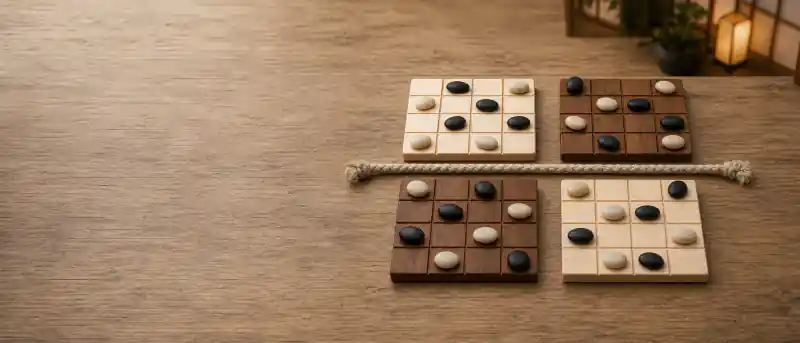
- Four 4 × 4 boards
- Stones
- 16 river stones each, black and white
- Winning conditionpush your opponent's last stone off any one of the four boards and you win immediately. Note that this is a one-of-four condition — you only need overwhelming superiority on a single board, not across the whole game, which is why the weakest board is always the focus of the position.
- All four boards start identically: white stones fill the northernmost row of four squares and black stones the southernmost row, with black moving first. The two northern boards are White's home and the two southern boards Black's, and each player's home pair is always one light and one dark.
- The first half of a turn is the passive move, which must be made on one of your own two home boards: choose one of your stones and move it in a straight line exactly 1 or 2 squares in one of the eight directions. Every square it passes through and its destination must be empty — a passive move may never jump, push, capture, or leave the board.
- The second half is the aggressive move, which must be made on a board of the opposite wood color from the passive board. "Opposite color" refers to the wood of the board, not the color of the stones, and it is not restricted to one side of the rope: after a passive move on a light board, the aggressive move may be on either dark board — your own home dark board, or the one across the rope in your opponent's half.
- The aggressive move must use a different stone of yours, and its direction and distance must match the passive move exactly: a passive move two squares up-right means the aggressive move can only be two squares up-right. All four boards share one physical orientation, and directions do not flip depending on whether you play black or white.
- The aggressive move does not have to push. A quiet move along an entirely empty path is equally legal. If you do push, you may move at most one enemy stone: each time your attacking stone advances one square, if the square directly ahead holds exactly one enemy stone, that stone advances one square in the same direction with it.
- You may not push your own stones, and you may not push a chain of two stones — if the square behind the pushed enemy stone is occupied by any piece of either color, the attack is illegal. An enemy stone pushed off the board is permanently removed; your attacking stone must itself stop on the board, and no stone may cross the gaps between the four boards.
- In a two-square attack, an enemy stone that starts directly in front of your attacking stone is pushed two squares in succession; an enemy stone first contacted on the second unit step is pushed only one square.
- The passive and aggressive moves are one indivisible turn. A passive move with no legal matching aggressive move is illegal from the start, and the interface will not light it up. A win can also only come from a completed aggressive move: a passive move never pushes anything, so it can never win the game directly.
How to Play SHOBU: Your First Game
Use this order of thought to get through a complete game quickly.
- Separate the two ideas from the beginning: the rope determines which two boards your passive move may use (the two in front of you), while the wood color determines which two boards your aggressive move may use (the two of opposite shade from the passive board). They are unrelated, and it helps to memorize them separately.
- Once you choose a passive move, the interface only lights up aggressive candidates with the exact same direction and distance — and a passive move with no viable aggressive move never appears as a candidate at all.
- Get into the habit of thinking backward: first find the push you want on the attacking board, note its direction and distance, and only then go back to your home boards to find a passive move offering the same direction and distance.
- An aggressive move that pushes nothing is perfectly legal. A quiet move can reposition a stone to build edge pressure on another board next turn.
- In the opening, scan every board for the enemy stones closest to an edge. A stone already against the edge can often be pushed off with a single correctly mirrored move.
- Check your own landing squares when you move two: one of your stones parked near an edge may be exactly the target of your opponent's next two-square attack.
SHOBU Strategy
Move from knowing the rules to playing with a plan.
- The result depends only on your weakest board, never on your total stone count. When you are down to one or two stones on some board, that board outranks everything else in priority.
- Creating pushable threats on two opposite-color boards at once is strong, because your opponent can only reproduce one direction per turn and will struggle to answer both.
- The stones remaining on your home boards are both defensive material and the source of your passive moves. Crowding them into a single cluster sharply reduces the directions and distances you have available.
- Diagonal passive moves are often the most valuable: diagonals are shorter on a 4×4 board, and a two-square diagonal attack can easily push a corner stone straight off.
- Keeping a few of your stones on the opposite-color board in your opponent's half lets you attack in their territory when you need to, instead of being restricted to targets in your own half.
- A passive move is a pure positional investment and produces nothing by itself. Since that is the case, spend it reinforcing your most endangered board or supplying the direction you currently lack.
SHOBU Winning and Special Rules
Details that are easy to miss but can change the result.
- This site uses ruleset shobu-standard-v1: a single adjacent enemy stone may be pushed two squares in succession within one two-square attack, but two different enemy stones may never be pushed at the same time.
- The passive and aggressive halves are always committed as one complete turn in the rules, the AI search, the move history, undo, and the animation, and undo takes back both together; splitting them across two clicks is purely an interface convenience.
- The standard rules contain no draw, repetition, or turn-limit clauses, and this site has not added any.
- The official materials do not cover a position where no board is cleared yet the side to move has no legal complete turn at all. For safety when parsing external positions and during search, this site defensively adjudicates it as a loss for the side to move; in normal play such a position is considered unreachable.
- Neither the boards nor the stones carry any text: the light and dark wood, the rope division, and the black and white stones are the complete rule information.
Common SHOBU Rules Mistakes
The traps new players fall into most often.
- Making the aggressive move on a board of the same wood color as the passive board, or confusing stone color with board wood color.
- Committing a passive move and only then discovering there is no matching aggressive move — or assuming a passive move may push something in passing.
- Trying to jump a blocker in a two-square attack, push two enemy stones at once, or let the attacking stone itself run off the board.
- Focusing on how close you are to clearing your opponent from one board while overlooking that you yourself are down to a single stone on another.
The Story of SHOBU
Where it came from, and why it turned out this way.
DesignManolis Vranas and Jamie Sajdak · 2019 · published by Smirk & Dagger
Four small boards instead of one large one
SHOBU was designed by Manolis Vranas and Jamie Sajdak and published in 2019. It does something very few abstracts do: it splits the board into four independent 4×4 grids, two light and two dark, divided into a near and a far half by a rope. That physical arrangement is not decoration — "the two in front of you" and "the two of opposite wood color" are two entirely different groupings, and all the rule tension comes from the mismatch between them.
One turn that must work in two places at once
The core of SHOBU is pairing: first a passive move on one of your home boards that may not touch any piece at all, then a mandatory aggressive move on a board of the opposite color, using a different piece, in exactly the same direction and over exactly the same distance. Every turn must satisfy the geometry of two boards simultaneously. A passive move with no legal matching aggressive move is illegal from the start, which turns "where do I want to go" into "which two places line up."
Why clearing one board wins
You win by pushing your opponent's last stone off any single board, and it does not matter what remains on the other three. That condition forcibly directs attention to your weakest board: you can dominate three of them and still lose at any moment because the fourth is down to one stone. It also explains why the passive move is not wasted — it is your only way of reinforcing a board that is in danger.
A design with no text
Nothing in SHOBU carries any writing or symbols: light and dark wood, one rope, black and white river stones, and the objects themselves hold every piece of rule information. That is a deliberate stance in modern abstract design, the same lineage as the GIPF series and Hive. The cost is a few minutes at the start sorting out the two groupings — but once sorted, you never consult the rules again.
- "Opposite color" refers to the wood of the board, not the color of the stones, and it is not restricted to one side of the rope — the rule beginners get wrong most often.
- An aggressive move may push at most one enemy stone, and if the square behind the pushed stone is occupied by any piece of either color, the attack is illegal.
- Smirk & Dagger, the publisher, is known for party and psychological games, which makes this pure abstract a distinctly unusual entry in their catalogue.
Sources and References
The material this page's rules implementation is based on.
- SHOBU rules (publisher-verified)Smirk & Dagger / Dized
- The designer's ruling on being unable to complete both halves of a turnBoard & Card Games Stack Exchangerelaying designer Manolis Vranas: that player loses, and there is no repetition-draw rule
Rights holder and physical editionSmirk & Dagger Games