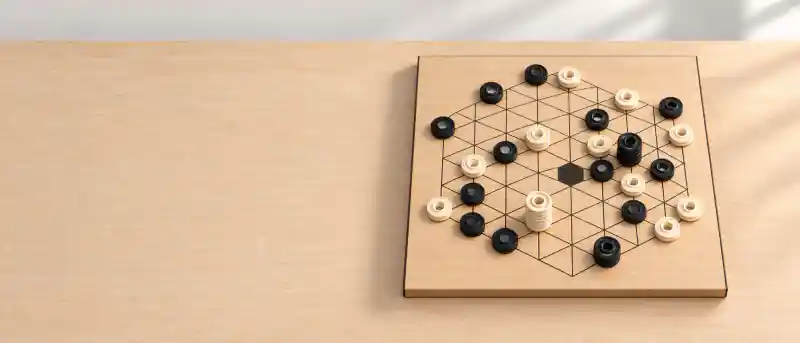
Complete TZAAR Rules
Start with what a turn allows and how the game is won.
- Board
- 60 playable points; the center hole cannot be entered or crossed
- Pieces per side
- 6 Tzaars, 9 Tzarras, 15 Totts
- Winning conditionyou win if any one of your opponent's three types — Tzaar, Tzarra, or Tott — no longer appears on top of any stack, or if you hand them a turn on which they have no legal capture. Only the top piece counts: pieces of that type buried inside stacks are worth nothing, and that single fact is the source of every tactic in the game.
- This page uses ruleset
tzaar-standard-2016-v1. The fixed setup fills all 60 points in four rings: Totts on the inner and outer rings, with Tzaars and Tzarras on the two rings between; colors alternate by each hexagonal side segment. A seeded-random setup is also available, and the same seed always reproduces the same arrangement with the exact 6/9/15 inventories. - White moves first, but White's opening turn is exactly one forced capture and then passes to Black. Every later complete turn has two phases: the first action must capture; unless that ends the game, the second action may capture again, strengthen, or explicitly pass. The first capture can never be passed.
- Pick up the entire source stack. A stack cannot be split, a middle layer cannot be extracted, and layer order cannot change. The top piece determines both control and visible type. A stack never mixes colors: capture removes the target stack instead of placing it underneath the mover.
- A stack moves on one of the six straight network directions. It may cross any number of consecutive empty points, but the first occupied stack in that direction is the only possible destination. It cannot jump that stack to reach another, and it cannot stop on an intervening empty point.
- The center hole is not an ordinary empty point. A ray ends when it reaches the hole, so it cannot continue to a point on the other side. A ray also ends at the board edge. The page highlights targets from these same frozen rays.
- A capture must land on an opposing stack. The moving stack's height must be at least the target's height. Height is capture strength only—it is neither an exact nor a maximum travel distance. On a legal capture, the entire target stack leaves play and the moving stack occupies its point unchanged.
- A second-action strengthen must land on a friendly stack. The target remains below and the moving stack is placed whole above it, making the mover's former top the combined stack's top. Strengthening has no height restriction: a tall stack may join a short one or vice versa.
- After every capture or strengthen lands, visible top types are checked immediately. A side with no top Tzaar, no top Tzarra, or no top Tott loses at once. Strengthening can bury your own last visible target type; that self-elimination immediately awards the game to the opponent.
- If the first capture removes the opponent's last visible example of a type, the complete turn ends at that first action and no second action is offered. Rules, history, undo, and AI store this one-action terminal case as one complete TurnPlan.
- No-capture loss is checked only when a complete turn hands play to the opponent. After a nonterminal first capture, the mover still takes or passes the second action even if the opponent currently has no capture. At handoff, if the new side to move has no legal capture, the previous mover wins.
- There are no draws, repetition results, or natural move limits. Games end only through a missing visible type or no legal capture at the start of a turn.
How to Play TZAAR: Your First Game
Use this order of thought to get through a complete game quickly.
- At the start of each turn, look for an opposing type with only one visible top. If an equal-or-taller stack can capture it, that is an immediate win. Protect your own types whose visible count is one.
- Do not convert height into travel distance. After selecting a stack, inspect the first occupied stack in each of six directions; it does not matter whether one empty point or five lies between.
- The first capture is compulsory. Compare candidates not only by captured height but also by the empty source point, the rays it opens, and whether the landing stack can make a useful second action.
- Strengthening creates the power to capture tall stacks, but it removes one visible stack. Before combining, check whether the target's top is your last visible example and differs from the moving top; that move would lose immediately.
- The second action does not require a piece move. Passing is often safer than casual strengthening, but it hands play over immediately, so first inspect the opponent's forced captures.
- A captured target leaves with every layer. Former friendly pieces buried in it are not rescued. Count the target's whole height, while still treating visible-type survival as the higher priority.
TZAAR Strategy
Move from knowing the rules to playing with a plan.
- Calculate complete TurnPlans. The first capture changes material and the first occupied point on multiple rays; second-action targets must be regenerated from that intermediate position rather than copied from the start of the turn.
- Height is stored force. Strengthening converts two action sources and two visible tops into one taller stack. The best combines preserve redundancy in all three types and point the new stack at a critical opposing target.
- Use stacks as ray blockers. The first occupied stack hides every stack behind it; capturing or moving that blocker can expose a previously unreachable target, creating a strong second capture.
- Creating a single surviving top of one opposing type is often stronger than raw material gain. Future forced-capture turns can then focus on that stack, while the defender may have to strengthen it to relocate the visible type.
- In the endgame, calculate both loss conditions. An opponent can retain all three visible types yet have no capture because every source is shorter than its first opposing targets. Conversely, a tall stack may preserve mobility but expose the last top of its type.
- Self-elimination is never forced as the optional action because passing is available. However, the next turn's mandatory first capture can force a fragile type onto a dangerous point, so plan that obligation one turn in advance.
TZAAR Winning and Special Rules
Details that are easy to miss but can change the result.
- Both fixed and seeded-random setup preserve exactly 6 Tzaars, 9 Tzarras, and 15 Totts per side. Randomization changes positions only, not turn order or White's one-action opening.
- Only the top type counts for survival, but every buried layer retains its original type and color so a later whole-stack move exposes the correct top. The interface uses geometry rather than T/Z/A letters.
- A first-capture terminal has no ghost second action. A normal pass is recorded as the second action inside the same TurnPlan, and undo restores the entire turn rather than a half-turn.
- The AI generates and searches complete TurnPlans entirely inside Wasm, including make/unmake, evaluation, and PVS / Alpha-Beta. It prefers root-sharded multi-Worker search; TypeScript validates the returned plan and provides the staged fallback path when Wasm or Workers are unavailable.
Common TZAAR Rules Mistakes
The traps new players fall into most often.
- Moving exactly as many points as the stack is high. Height controls capture strength only; the first occupied point controls travel distance.
- Jumping a nearer stack to capture one behind it, or crossing the center hole. Both end the ray.
- Putting a captured target underneath the mover. The target leaves play whole; only the moving stack remains at the destination.
- Forgetting the second action after the first capture, or treating the second capture as compulsory. Capture, strengthen, and pass are all valid second decisions.
- Counting a type that remains in inventory but is buried. Only stack tops satisfy the three-type survival condition.
- Strengthening over your own last visible type and losing immediately to self-elimination.
- Declaring no-capture victory immediately after the first capture. That condition is checked only after the full turn hands play over.
The Story of TZAAR
Where it came from, and why it turned out this way.
DesignKris Burm · 2007 · sixth game of the GIPF Project
The series finale
TZAAR was the last game added to Kris Burm's GIPF Project, published in 2007 to take over the slot originally held by the earlier TAMSK. It is widely regarded as the most confrontational and least forgiving entry in the series: no draws, no passing, and every complete turn must open with a compulsory capture. The other games in the series reward patient development; TZAAR has the two players cutting each other down from the very first move.
Only the top piece counts, and that decides everything
Each side owns three types — Tzaars, Tzarras, and Totts — yet the result depends not on how many you have left but on whether all three still appear on top of some stack. Pieces buried inside count for nothing. That turns strengthening into a double-edged tool: stacking your own pieces genuinely makes them stronger, but if you bury the last visible example of a type you lose on the spot. A move that looks purely constructive can end the game against you.
Height is capture strength, not travel distance
The rule most often misread: a stack's height determines how tall a target it can capture and has nothing to do with how far it can go. Travel distance is set by the first occupied point in the chosen direction — you may cross any number of consecutive empty points but never jump another stack. Beginners routinely treat height as a step count and get the entire move list wrong. The board also has a hole at its center, and a ray simply ends when it reaches it.
Two decisions per turn
Except for White's opening turn, every complete turn has two phases: the first action must capture, and the second may capture again, strengthen, or explicitly pass. That structure forces two different questions each turn — which opposing type do I weaken first, and then do I press the attack or shore up my own weakest type? If the first capture already erases one of your opponent's visible types, the turn ends immediately and no second action occurs.
- The second winning condition is easy to overlook: if the opponent has no legal capture when the turn passes to them, you win outright — often easier to arrange in the endgame than erasing a type.
- All 60 points start filled, with 6 Tzaars, 9 Tzarras, and 15 Totts per side; the more numerous a type, the harder it is to erase, which makes Tzaars inherently the most fragile.
- This page also offers a seeded random setup, where the same seed always reproduces the identical arrangement for review and bug reproduction.
Sources and References
The material this page's rules implementation is based on.
- TZAAR rulesGIPF Project (Kris Burm)
- TZAAR RulesRio Grande Games / HUCH!2016 English edition, the version this site's ruleset is frozen against
Rights holder and physical editionGIPF Project (Kris Burm)