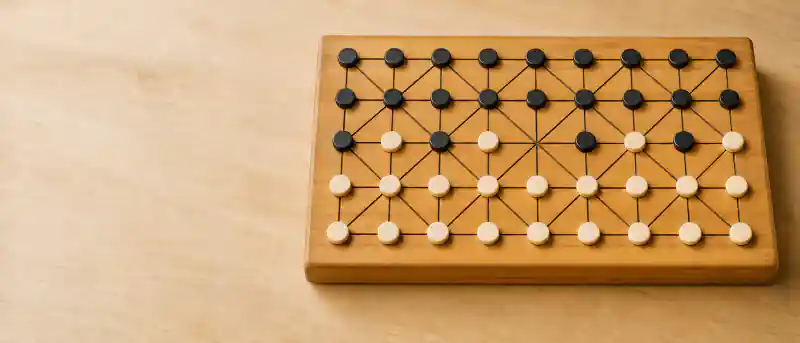
Complete Fanorona Rules
Start with what a turn allows and how the game is won.
- Board
- 9 columns × 5 rows, 45 intersections
- Pieces
- 22 per player
- Winning conditioncapture all of your opponent's pieces and you win. Likewise, if after the turn passes the player to move still has pieces but no legal move at all — neither a capture nor an ordinary move — that player loses.
- The board is a network of forty-five connected intersections, not forty-five squares. All horizontally and vertically adjacent points are linked; diagonals are drawn only between strong intersections. The eight strong intersections, identified by column plus row being even, have eight directions, while the remaining weak intersections have only four, and the central point e3 is a strong intersection.
- Each side has twenty-two identical pieces with no ranks, facings, or promotion. White occupies the two full bottom rows and Black the two full top rows, the middle row alternates colors with only the central e3 empty, and White moves first.
- An ordinary move is called a paika: travel along a drawn line to one adjacent empty point, one step at a time, never jumping a piece and never stopping on an occupied point.
- Approach captureafter moving from your origin along some direction onto an adjacent empty point, look one point further along that same straight line from your destination. If the first point holds an enemy piece, remove the entire contiguous run of enemy pieces starting there, stopping at an empty point, one of your own pieces, or the board edge.
- Withdrawal captureyou also move to an adjacent empty point, but the line you examine runs the opposite way — starting one point back from your origin along the same straight line. If that first point holds an enemy piece, the contiguous run of enemy pieces there is removed. In other words, the run you capture may lie directly ahead of where you moved or directly behind where you came from.
- If a single step has enemy pieces on both sides, both modes are simultaneously valid and you must specify which group you are taking. The interface previews each group of pieces to be removed so you can choose; you may not take both, and the system will not silently pick the larger group for you.
- Captures are compulsoryif any of your pieces has any legal capture in the current position, every paika is illegal. But the rules do not require choosing the piece, route, or mode that captures the most — any legal capture will do.
- A capture chain must always continue with the same piece that just captured; you may not switch to another piece that also has a capture, and every segment of the chain must itself be a capture, with no ordinary step inserted in the middle.
- Chains obey two restrictions: you may not land again on any intersection already visited this turn, including the first segment's origin; and the displacement direction of a segment may not be identical to the previous segment's — two consecutive segments heading west is illegal, while west, then north, then west again is fine. The restriction applies to the directed unit vector, not to the whole axis.
- You may stop a capture chain at any point: after at least one segment, a Stop button appears next to the capturing piece and ends the turn. Otherwise keep tapping lit points; when no continuation remains the turn passes automatically.
How to Play Fanorona: Your First Game
Use this order of thought to get through a complete game quickly.
- Memorize the two linesdirectly ahead of where you moved, and directly behind where you came from. Enemy pieces anywhere else cannot be captured, no matter how close they look.
- Once you select a piece, the interface highlights only the destinations the rules have validated. When a capture exists anywhere on the board, pieces that could only make ordinary moves are not highlighted at all, which tells you instantly whether this turn must be a capture.
- When a single destination allows both modes, look at what each preview removes, then think about which continuation segments remain available from that landing point, and only then make your choice.
- Check the board to confirm a diagonal is actually drawn before relying on it. Weak intersections have no diagonals, so you can neither move nor capture diagonally from them.
- In the opening, White can move from d2, e2, f2, or d3 onto e3 with a capture, and d3 to e3 offers both approach and withdrawal, giving five distinct mode-tagged first segments. Choosing among those five for your first move builds an intuitive feel for the two capture modes very quickly.
Fanorona Strategy
Move from knowing the rules to playing with a plan.
- Do not mechanically maximize this turn's captures. A route that takes only two pieces but finishes on a safe strong intersection is often better than one that takes five and parks your piece in your opponent's line of fire.
- Your opponent is bound by compulsory capture too, so you can deliberately offer a piece to force them to capture and end up on a square you have already calculated. The compulsion is a weapon you can wield.
- Plan chains backwarddecide which intersection you want to finish on, then work back and check that no segment repeats the previous direction and no landing point has already been visited.
- Strong intersections connect eight directions and make excellent pivots for chains — but they can also be captured from eight directions. Lining your pieces up in a long row is more dangerous still, since a single withdrawal capture can take the whole run.
- Under the stop-at-will ruleset, ending a chain early is a legitimate tactical choice: an extra segment may push your piece somewhere indefensible, or destroy a compulsion relationship that would have favored you next turn.
- When ahead, steadily shrink your opponent's available destinations. A player who still has pieces but no legal move loses outright, and that is a common way to win the endgame.
Fanorona Winning and Special Rules
Details that are easy to miss but can change the result.
- When one player loses their last piece, the other wins immediately.
- After the turn passes, if the player to move still has pieces but no legal move at all — neither a capture nor a paika — that player loses.
- Draws use threefold repetition: the third occurrence of the same board distribution plus side to move is an automatic draw, and the starting position counts as the first. Intermediate states inside a capture chain do not count, and the same board with a different side to move is not the same position.
- This site plays the traditional Fanoron-Tsivy rule in which a chain may be stopped voluntarily. The rule is written into the serialized position, so the player's move generation, the AI search, and undo all read the same ruleset; games saved earlier under the must-continue rule still open and can be continued.
- Historical clauses such as "the first player's opening turn may capture only one segment" or "each side's first capture is limited to one segment" are not enabled. A complete turn — the first segment plus zero or more continuations — is handled as one unit in the history, in undo, and by the AI, and the final segment cannot be taken back on its own.
Common Fanorona Rules Mistakes
The traps new players fall into most often.
- Playing it as a custodian-capture game and expecting to trap enemy pieces between two of your own. Here it is the direction of movement that captures, regardless of what stands at the far end.
- Attempting an ordinary move while a capture exists somewhere on the board — or the reverse, assuming you must always choose the route that captures the most.
- Trying to take both the run ahead and the run behind in a single step. Only one group may be chosen.
- Switching mid-chain to a different piece that also has a capture, heading the same direction on two consecutive segments, or returning to an intersection already visited this turn.
- Treating visual diagonal proximity as a drawn connection. Weak intersections have no diagonals, and a capture cannot extend past an empty point or one of your own pieces.
The Story of Fanorona
Where it came from, and why it turned out this way.
OriginMadagascar; recorded by the 17th century; related to alquerque
Madagascar's national game
Fanorona is the most important traditional board game of Madagascar, already appearing in 17th-century accounts. It is generally considered part of the alquerque family — the medieval Mediterranean diagonal-capture game that is also one of the ancestors of draughts — likely reaching the island through early European or Arab contact. Fanoron-Tsivy, played on the largest of the boards, is the version most used competitively.
Approach and withdrawal: direction is the weapon
Fanorona captures neither by jumping nor by surrounding, but by the direction you move. Move toward a line of enemy pieces (approach) and you remove the whole run; move away from a line of enemy pieces (withdrawal) and you remove that run instead. The pieces you take may lie directly ahead of where you moved or directly behind where you came from. This is exceptionally rare among the world's board games, and it is almost impossible to judge by intuition on first contact.
Compulsion as a weapon
As long as any legal capture exists anywhere on the board, every ordinary move is illegal. That compulsory-capture rule binds your opponent as much as you — so deliberately offering a piece to force them to capture and land on a square you have already calculated becomes standard tactics. Combined with the ban on revisiting intersections and on repeating the previous segment's direction, a capture chain is really a path-planning problem under strict constraints.
A historical anecdote of uncertain truth
The most repeated story holds that in 1895, as French forces advanced on Antananarivo, the royal diviners were so absorbed in a game of fanorona that critical military intelligence went unanswered. It is quoted endlessly in games literature but reads more like later legend than reliable history. What is well attested is that fanorona long carried divinatory and ritual associations in Madagascar, with the course of a game taken to reflect the course of events — which is precisely the soil in which such a story grows.
- The board's forty-five intersections come in two kinds: strong intersections, where column plus row is even, have eight directions, while the remaining weak intersections have only four.
- If a single step has enemy pieces on both sides, both capture modes are valid at once, but you must choose one group — you may never take both.
- This page plays the traditional rule in which a capture chain may be stopped voluntarily, so ending early is a legitimate tactical choice.
Sources and References
The material this page's rules implementation is based on.
On rule variationsFanorona comes in three board sizes — Fanoron-Telo (3×3), Fanoron-Dimy (5×5) and Fanoron-Tsivy (9×5); this site implements Tsivy, the most widely played. Every version agrees that capturing is compulsory when a capture is available. The real disagreement is about continuing a capture chain: most sources record that the player may stop at any step, while some versions require playing the chain out as in international draughts — and that single clause is the only difference between this site's two rule versions. Everything else (approach capture, withdrawal capture, no revisiting a point, no two consecutive moves in the same direction) is identical. Historical clauses such as “the first player may take only one segment on the opening turn” are not enabled here. Traditional sources define a draw only as “neither side can win”, with no decidable condition, so this site adds one numeric adjudication: threefold repetition is a draw.