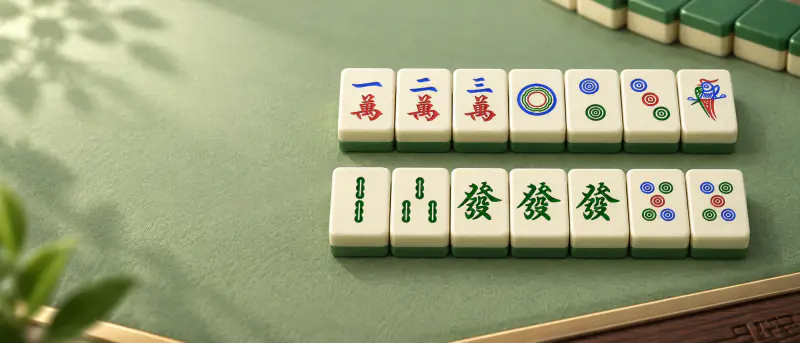
Complete Mahjong Rules
Start with what a turn allows and how the game is won.
- Players
- Usually four; three in sanma, with AI opponents
- Starting hand
- Usually 13 tiles each; the dealer has 14 and discards first
- Rules
- Seven presets; read the shared basics, then your chosen chapter
- Recognize suited tilesCharacters, dots and bamboo are the three suits, each numbered 1–9 with four copies of every tile. Four 5 characters are separate from four 5 dots: matching numbers in different suits are different tiles. The bird on 1 bamboo is still 1 bamboo, not a flower. The suits total 3 × 9 × 4 = 108 tiles.
- Honors and extra tilesEast, South, West and North are winds; Red, Green and White are dragons. Together they are seven honors, four copies each, making 28 and bringing the base set to 136. Sichuan omits honors; MCR adds eight flowers; American adds flowers and jokers; riichi uses red fives and dora indicators. A wind name can refer to a tile, a seat or a round depending on context.
- Read the tableYour hand contains your concealed tiles; the wall contains undrawn tiles. Each player's discard row records their discarded tiles, while called sets are shown as exposures. You know your tiles and public information, not opponents' concealed hands. The dealer acts first; other players are nondealers. The previous player is immediately before you in normal turn order, and the next player immediately after.
- An ordinary turnThe dealer already has the extra tile and discards first. Play normally proceeds counterclockwise; the next player draws a tile and may win if eligible; otherwise they discard one. Discarding the fresh draw is a tsumogiri; discarding an older tile changes the hand. Claims can change whose turn comes next. Sichuan and American presets also have pre-play exchanges or declarations.
- The common winning structure: A sequence is three consecutive tiles in one suit, such as 345 dots. A triplet is three identical tiles, such as East East East. A pair is two identical tiles, such as 66 bamboo. A standard win is four sequences/triplets/kongs plus one pair. Every physical tile is used only once: the same 3 dots cannot belong to two groups. Winds cannot form an East–South–West sequence, and 891 does not wrap around.
- A complete example[123 characters] [456 characters] [789 dots] [East East East] [White White] is 3 + 3 + 3 + 3 + 2 = 14 tiles. With the four groups and just one White, another White completes the pair. Your variant may additionally require a yaku, eight points or a cleared missing suit; American mahjong instead requires an exact card-row match.
- Chow and pungHolding 4 and 5 dots, you may chow the previous player's 3 dots if your rules allow it. Expose 345 dots, then discard without another draw. Holding two Easts, you may pung another player's discarded East, expose the triplet and discard. Not all variants permit chows. You may not retrieve older discards after their claim window has passed.
- Kongs and replacementsA discard kong takes a discard to join your three identical tiles. A concealed kong declares four from your own hand; an added kong adds the fourth to an existing pung. Most variants draw a replacement afterwards, then win or discard. A kong remains one structural set but contains an extra physical tile, so a standard winning hand with one kong has 15 physical tiles. American four-tile groups follow a different rule and receive no replacement.
- Ready hands and useful draws: A ready hand needs only one of its waiting tiles to complete its shape. [234 characters] [345 dots] [678 bamboo] [67 characters] [55 dots] waits on 5 or 8 characters, a two-sided wait. 4 and 6 dots waiting on 5 is a closed wait; 12 waiting on 3 is an edge wait; a lone tile waiting to become the pair is a single/pair wait. Useful draws improve the hand's distance to winning even before it is ready.
- Self-draw, discard win and Pass: Drawing the final tile yourself is self-draw or tsumo; winning on another player's discard is a discard win or ron. That player has dealt in. The last tile may complete a sequence, triplet or pair. Pass declines this claim opportunity without discarding for you. Some variants, especially riichi, restrict later wins after a passed opportunity.
- A hand versus a matchMost variants settle a hand when somebody legally wins. An exhausted wall without a winner is a draw. Sichuan battle and flow allow several wins within one hand and have different endpoints. Hand scores accumulate, so winning first in one hand is different from finishing first in the match.
- Choose a first tableBasic 13 teaches grouping; Sichuan adds exchanges, a missing suit and ongoing payments; riichi adds yaku and defensive restrictions; MCR emphasizes adding scoring patterns; American starts with a different card-based target. The seven chapters below describe this site's exact presets.
Basic 13
Learn four sets and a pair with 136 tiles and four players. This site's introductory preset has no minimum hand value.
Setup and the flow of a hand
- Tiles and dealThere are 36 characters, 36 dots and 36 bamboo tiles, plus four each of the seven honors: 136 tiles altogether, without flowers or jokers. Everyone receives 13 tiles; the dealer takes an extra tile and discards first. Turns then alternate drawing and discarding until a win or an exhausted wall.
- CallsChow only the previous player's discard; pung or kong any opponent's discard. After a chow or pung, discard without drawing again. After a kong, draw a replacement before winning or discarding. Only the current discard is available, never an older tile from a discard row.
- Competing claimsThe table collects responses, then resolves wins before pung/kong before chow. Multiple players may win on one discard. There is no riichi-style furiten or restriction caused by passing a previous winning opportunity.
What makes a legal winning hand
- Standard shapeFour sequences, triplets or declared kongs, plus a matching pair. The pair need not be a 2, 5 or 8. Honors can form pairs, triplets and kongs, but never sequences.
- Complete example[123 characters] [456 characters] [789 dots] [East East East] [White White]. The first three groups are sequences, the fourth a triplet and the last the pair. With only one White, you need another White: draw it to self-draw, or claim a fresh discard directly with Win rather than Pung.
- Seven pairsSeven different tile types appearing twice each also win, for example 11 characters, 22 characters, 33 dots, 44 dots, 55 bamboo, East East and White White. You must have no called sets or declared kongs. Four identical tiles do not count as two pairs here. Thirteen orphans is not supported in this preset.
- No scoring-pattern requirement: A standard shape or seven pairs is enough. You do not also need a full flush or all triplets. Sequences assembled inside your hand always work; permission to chow concerns taking somebody else's discard.
Scoring and the match
- PaymentsOn self-draw, each of the other three players pays 1, so you gain 3. On a discard win or robbed added kong, the source pays each winner 3; uninvolved players pay nothing. Dealing into two winners therefore costs 6.
- No extra chargesKongs have no separate payment, and a full flush or seven pairs does not increase the win payment. An exhausted wall incurs no not-ready penalty. Scores carry across eight actual hands.
- Dealer rotationThe dealer repeats after winning or after a drawn hand; otherwise the next seat becomes dealer. The eight-hand limit counts completed hands, so repeats do not turn this match into an indefinitely extended hanchan.
Sichuan blood battle
Exchange three, declare a missing suit and play without chows. Winners leave; the others continue until three players win or the wall ends.
Tiles, exchange and missing suit
- Suited tiles onlyUse 36 characters, 36 dots and 36 bamboo tiles: 108 in total, without honors or flowers. The dealer starts with 14, the others with 13. This preset plays eight hands and rotates the dealer after every hand.
- Exchange three firstSelect three tiles of one suit and pass them together in the direction shown for this hand. They need not be consecutive or identical: 2, 5 and 9 characters work; 2 characters, 5 dots and 9 bamboo do not. Everyone receives three tiles from another seat.
- Declare a missing suit next: After exchanging, choose the suit you will remove from your hand. If you choose characters, you must discard characters whenever any remain in your hand, including characters drawn later. The declaration does not automatically remove the tiles.
- Clear it before winningNeither your hand nor your exposed sets may contain the declared missing suit when you win. A single remaining suit is allowed. Four sets and a pair with even one forbidden tile still cannot win. A short, poorly connected suit is often a practical choice after the exchange.
Calls, winning and leaving the hand
- No chows, but sequences still work: You may draw 234 dots yourself; you cannot claim another player's 3 dots to chow. Pungs and exposed, concealed or added kongs are permitted, but not while you still hold missing-suit tiles, and never to expose the missing suit.
- Winning shapesFour sets and a pair, or seven pairs. Here four identical tiles may count as two pairs and may also supply a root bonus. Thirteen orphans is unavailable because there are no honors.
- Winners leaveAfter your first win, collect its payment and leave the current hand. You no longer draw, discard or pay for later wins and kongs. Three players continue after the first winner, then two after the second. The hand ends after three players have won or the wall is exhausted.
- Multiple winnersSeveral players can win on one discard, each collecting from the discarder. A self-draw is paid only by opponents still active: if one player has already left, your self-draw is paid by the other two.
- Robbing a kongWhen somebody adds a fourth tile to an existing pung, you may win on that tile if it completes your legal hand. The added kong does not complete. An ordinary concealed kong is not freely robbable this way.
This table's fan and win value
- Convert fan to pointsAn ordinary hand starts at 0 fan and value 1. Each additional fan doubles the value, capped at four fan: 0, 1, 2, 3 and 4 fan give 1, 2, 4, 8 and 16 points. Compatible bonuses stack, but the capped value remains 16.
- Main patternsAll pungs, meaning four triplets/kongs, adds 1 fan; seven pairs adds 2; full flush, with every tile in one suit, adds 2; golden hook, with four fixed sets and only the final pair in the concealed portion, adds 1. Seven pairs does not also receive all pungs.
- Roots and timingEvery four identical tiles across the whole hand count as one root, adding 1 fan even without a declared kong. A win on a kong replacement, robbing an added kong and winning at wall exhaustion each add 1. These are the enabled bonuses; do not import extra regional terminal or 2/5/8-only payments.
- Self-draw adds one pointA discard win costs its source the hand value. A self-draw costs each active opponent the hand value plus 1. For a full flush with no other bonuses, two fan give value 4: a discarder pays 4; with all four still active, self-draw collects 5 from each opponent, total 15. Self-draw does not add another doubling fan.
Kong payments and wall-end settlement
- Kongs are paid immediately: A discard kong costs its source 2; a concealed kong costs each other active player 2; an added kong costs each other active player 1. These payments accumulate separately from wins. A robbed, uncompleted added kong earns no kong fee. Kong-payment transfer is disabled.
- Missing-suit penaltyAt exhaustion, a player who has never won and still holds missing-suit tiles is a flower pig. Each pays 16 to every non-pig, including players who already won and left.
- Kong refundsA player who has never won and is not ready at settlement refunds the kong income they collected, returning each payment to its original payer. Pigs also refund. Players who already won are not subject to this refund check.
- Not-ready paymentsAmong players who have not won and have cleared their missing suit, each not-ready player pays every ready player that recipient's best possible basic winning value, capped at 16, without the self-draw extra point. Pigs are handled by their own penalty rather than paying this not-ready charge again. A draw does not automatically mean zero payments.
Sichuan blood flow
The same exchange, missing-suit rules and fan schedule, but winners remain active: they can win repeatedly and still have to pay.
From the deal to the first win
- Shared rulesUse 108 suited tiles, exchange three of one suit, then declare a missing suit. Discard that suit first; no chows, but pungs and kongs are allowed. Standard hands and seven pairs win. The blood battle chapter's bonuses, four-fan cap, extra point per self-draw payer and kong fees all apply.
- Match and endpointPlay eight hands, rotating the dealer after each. Three players having won does not end a blood flow hand. All four remain involved, normally until the wall runs out.
What happens after you win
- The waiting hand locksThis site's preset locks your ready-hand structure after the first win. A self-drawn winning tile is removed; a discarded winning tile is not permanently added to your concealed hand. You keep the waiting structure for future wins.
- Draw and discard againOn later turns, draw a tile and win again if legal. Otherwise discard the newly drawn tile; you cannot rearrange the locked hand to pursue something else. No new pung, discard kong or added kong is allowed after winning. A concealed kong is allowed only when it satisfies the conditions and preserves the waits.
- Repeated payments work both ways: Winning does not exempt you from payment. You still pay opponents' later self-draws, and your discards can deal in. Several eligible hands may win on the same discard.
- Repeated-win exampleWith characters missing, an ordinary hand waits on a single 5 dots. A player discards 5 dots and pays you 1. Later you draw 5 dots yourself; absent extra bonuses, each opponent pays 2, adding 6. If your next discard of 7 bamboo lets somebody else win, you still pay for that discard. Timing bonuses are assessed separately for each win.
When the wall is exhausted
- Final checksMissing-suit penalties, kong refunds and not-ready payments still apply. For these checks, 'has not won' means no win recorded anywhere in this hand. Previously winning locked hands are not checked as non-winners for not-ready payments. A player who never won must still meet the missing-suit and readiness requirements.
- This preset's boundarySome home blood flow rules allow changing waits after a win or use different bonuses. This table locks the hand and normally requires discarding each fresh draw. Learn that restriction as well as the opportunity to win repeatedly.
Four-player riichi
136 tiles, 25,000 points each and an East–South hanchan. Establish a yaku first, then score the hand using han and fu.
The table and the winning requirement
- Tiles and wallUse three suits and seven honors without flowers. One five in each suit is a red five replacing a normal copy. The dealer begins with 14 tiles, the others with 13. Fourteen tiles form a dead wall, unavailable for ordinary draws; it contains kong replacements and dora/ura-dora indicators.
- HanchanPlay East 1–4, then South 1–4. The dealer repeats after winning and after an exhaustive draw when ready, so there may be more than eight actual hands. This preset ends when anyone goes below zero; a qualifying dealer repeat continues even at South 4.
- Two winning requirementsComplete four sets and a pair, seven pairs or thirteen orphans, and have at least one yaku. A yaku is an eligible scoring pattern or circumstance. Han measures yaku and bonus value; fu is a separate measure of hand details. A complete shape plus dora but no yaku still cannot win.
- Closed versus openA hand is closed when it has no chow, pung, discard kong or added kong. Concealed kongs do not open it. Opening removes yaku such as riichi and closed self-draw and reduces some others. Closed does not mean self-draw only: you may win a closed hand on a discard.
Yaku to learn first
- Riichi and closed self-draw: Successfully declaring riichi on a closed ready hand gives 1 han. Winning by drawing the last tile while closed gives menzen tsumo, also 1 han. They can combine. Being ready without declaring riichi does not automatically earn riichi.
- All simples and value honors: Tanyao uses only suited 2–8 tiles, with no terminals or honors; it gives 1 han and may be open at this table. A triplet/kong of Red, Green or White, your seat wind, or the round wind gives yakuhai, 1 han each. A wind that is both seat and round wind gives 2. An unrelated wind triplet is not a yaku.
- PinfuA closed hand with four sequences, a non-value pair and a two-sided wait completing the last sequence gives 1 han. For example [234 characters] [345 dots] [678 bamboo] [67 characters] [55 dots] waits on 5 or 8 characters. Four sequences alone do not prove pinfu.
- Common two-han routesSeven pairs requires seven distinct pairs; four identical tiles cannot count twice. All triplets allows open triplets/kongs. Three concealed triplets requires three concealed triplets/kongs; a triplet completed by ron is not concealed for that count. Mixed triple sequence means the same sequence in all three suits; pure straight means 123, 456 and 789 in one suit. These last two are 2 han closed, 1 open.
- Flushes and outside hands: Half flush uses one suit plus honors and gives 3 han closed, 2 open. Full flush uses one suit only: 6 closed, 5 open. Mixed outside hand has a terminal/honor in every set and pair, and includes a sequence: 2 closed, 1 open. Pure outside hand has no honors: 3 closed, 2 open.
- Other yaku and limitsOne identical sequence pair in a closed hand is iipeikou, 1 han; two such pairs are ryanpeikou, 3, without additionally counting iipeikou or seven pairs. Little three dragons means two dragon triplets/kongs and the third dragon as a pair; all terminals and honors uses only 1/9 tiles and honors; three kongs requires three declared kongs; mixed triple pung means the same-number triplet/kong in each suit. Each is 2 han. Thirteen orphans uses each suited 1/9 and each of the seven honors, plus one duplicate. Big three dragons, four concealed triplets, all honors, little/big four winds, all terminals, all green, nine gates, four kongs and heavenly/earthly hands are yakuman-level patterns or circumstances. Start with riichi, value honors and all simples, then use the settlement's yaku list to learn more.
Declaring riichi and counting dora
- DeclarationBe closed, hold at least 1,000 points, have at least four live tiles remaining, and choose a discard that leaves you ready. Select the riichi action and its associated discard. Once accepted, pay a 1,000-point deposit into the winner's pool; after a draw it carries forward. Not every discard leaves the same hand ready.
- After riichiNormally discard every fresh draw without changing the original hand, and do not chow or pung. Only qualifying concealed kongs preserving the waits are allowed. Ippatsu adds 1 han for winning within the following uninterrupted turn cycle; relevant calls cancel it. An uninterrupted first-turn declaration may be double riichi, worth 2 han.
- Indicators show the preceding tile: A 3 dots indicator makes 4 dots dora; suited 9 wraps to 1. Winds cycle East–South–West–North–East, and dragons White–Green–Red–White. Each dora adds 1 han; a red five adds another 1. A red five that is also indicated dora counts both bonuses.
- Ura and kong doraOnly riichi winners count ura-dora. Each completed kong immediately reveals another dora indicator in this preset. These bonuses increase a legal hand's value; none supplies the required yaku.
Ron, tsumo and furiten
- Ron and tsumoRon wins on another player's current discard; tsumo wins on your own draw. A winning discard can complete a sequence, triplet or pair. Declare the win directly rather than first calling a set.
- Discard furitenIf any tile that completes your current shape appears among your own previous discards, you cannot ron on any of your waits. Waiting on 3 and 6 dots after previously discarding 3 dots also prevents ron on 6 dots. A discard later taken for another player's set still counts as your discard.
- Temporary and riichi furiten: Passing a discard that completes your current shape, even without a yaku, blocks ron until your next draw. Passing such a tile after declaring riichi blocks ron for the rest of the hand. These forms of furiten do not prevent a self-draw that meets the yaku requirement.
- Call restrictions and timing: Chow the previous player and pung/kong any opponent, but kuikae is prohibited: immediately discarding the called tile's type or making a prohibited sequence-end substitution. Added kongs may be robbed; concealed kongs have special exceptions such as thirteen orphans. A kong-replacement self-draw can earn rinshan; the last normal draw or last discard can earn haitei or houtei.
Fu, payments and drawn hands
- Count han, then fu: A regular hand starts with 20 fu. Closed ron usually adds 10; self-draw usually adds 2. A dragon, seat-wind or round-wind pair adds 2 fu (4 for a double-wind pair here); an edge, closed or pair wait adds 2. Open simple/terminal-or-honor triplets give 2/4; concealed triplets 4/8; open kongs 8/16; concealed kongs 16/32. Usually round up to the next ten fu. Seven pairs is fixed at 25; pinfu self-draw is 20; an open hand otherwise worth only 20 fu is counted as 30.
- Basic paymentBelow mangan, basic points are fu multiplied by 2 to the power of (han + 2), capped at 2,000. Nondealer ron costs the discarder four times basic points; dealer ron six times. On nondealer tsumo, the dealer pays twice basic and each other nondealer once; dealer tsumo costs everyone twice. Round each payment up to 100. Settlement calculates this for you.
- Examples without counters or deposits: Nondealer 1 han 30 fu ron is 1,000; dealer ron is 1,500. Nondealer 3 han 40 fu ron is 5,200. Nondealer mangan ron is 8,000, or tsumo payments of 2,000, 2,000 and 4,000. Dealer mangan ron is 12,000, or 4,000 from each on tsumo.
- Limits and countersFive han is mangan; 6–7 han haneman, 8–10 baiman, 11–12 sanbaiman, and 13+ uses this preset's counted yakuman. Four han 40 fu and three han 70 fu already reach mangan. Each honba adds 300 from the discarder on ron, or 100 from each payer on tsumo. Deposits are separate from han.
- Exhaustive drawsIf the live wall ends without a win, a total of 3,000 moves from not-ready players to ready players. With one ready player, each other pays 1,000. With two, each not-ready player pays 1,500 and each ready player receives 1,500. With three, the remaining player pays 3,000. All ready or all not ready means no transfer.
- Special endingsDouble ron is allowed; triple ron aborts the hand. The table also handles nine terminals/honors, four identical first wind discards, four riichi declarations and qualifying four-kong aborts. Four kongs by one player do not cause the multiple-owner four-kong abort. Nagashi mangan requires an entirely terminal/honor discard row with no claimed tiles and a closed hand, then uses this table's drawn-hand mangan settlement.
Three-player riichi
108 tiles and 35,000 points each. Retain yaku, fu and furiten, remove 2–8 characters, prohibit chows and allow North extraction.
The deck and turns
- Three seatsEast, South and West play, without a fourth player. Removing the 28 tiles numbered 2–8 characters leaves 108 tiles; dots, bamboo and honors remain. Only dots and bamboo have red fives. A dead wall is still reserved.
- No chowsNobody can chow a discard. Pungs and exposed, concealed and added kongs remain available. You can build dot and bamboo sequences inside your hand; characters contain only 1 and 9, so cannot make sequences. The four-player mixed-triple-sequence plan is therefore unavailable.
- Match and winningPlay East 1–3 and South 1–3, starting at 35,000 each, with dealer repeats and negative-score endings as in the four-player chapter. Standard shapes, seven pairs and thirteen orphans remain valid. At least one yaku is required; dora and extracted Norths alone are not yaku.
How North extraction works
- Two uses for NorthKeep it for a pair, triplet or thirteen orphans, or extract it during your legal draw/discard phase. Extracted Norths go to a separate area and each supplies bonus value. Draw a replacement from the live-wall tail, then continue your turn.
- Replacement and closed status: Extraction is not a chow or pung and does not open the hand. Its replacement does not earn rinshan. After riichi, you may extract only a newly drawn North, not an old North from the locked hand. Another qualifying North may be extracted after the replacement.
- Indicators and robbing North: A 1 characters indicator makes 9 characters dora, and 9 makes 1. Other cycles match four-player riichi. Each extracted North normally adds 1 han, with further dora/eligible ura bonuses when West is the indicator. This preset permits qualifying thirteen-orphans wins to rob an extraction, and extraction cancels ippatsu.
Payments with one fewer opponent
- Tsumo lossOnly the two actual opponents pay; nobody compensates for the missing fourth payer. Without honba, nondealer mangan tsumo collects 4,000 from the dealer and 2,000 from the other nondealer, total 6,000. Dealer mangan tsumo collects 4,000 from each, total 8,000.
- Ron and countersNondealer mangan ron still costs the discarder 8,000; dealer ron costs 12,000. A honba adds 300 on ron, but only 100 from each actual payer on tsumo. The winner also collects deposits.
- Draw paymentsThis preset retains a total 3,000-point not-ready transfer. If one player is ready, the other two pay 1,500 each; if two are ready, the third pays 3,000, split into 1,500 each. Double ron can occur. Four-player conditions such as four riichi declarations and four first wind discards cannot occur here.
Chinese official MCR
144 tiles and four players with automatic flower replacement. A complete shape needs at least 8 points, excluding flowers from that minimum.
Tiles, flowers and turns
- Deck and matchThe 136 suited/honor tiles are joined by eight flowers and seasons, making 144. Players start with 13; the dealer has one extra and discards first. This table plays sixteen hands, rotating the dealer each time through four rounds: East, South, West and North.
- Flowers are bonusesA drawn flower is displayed and automatically replaced until you receive a normal tile. It occupies no slot in four sets and a pair. Each flower adds 1 point only after the non-flower hand qualifies for the eight-point minimum. Flowers cannot form sets, pairs or wildcards.
- CallsChow the previous player; pung or kong other opponents. After chow/pung, discard directly; after a kong, draw a replacement. Wins take priority. If multiple players claim a win, the nearest player after the discarder in turn order wins; this preset does not allow multiple winners.
- No riichi requirement or furiten: You do not declare riichi, and there are no dora or riichi-style furiten. A complete shape must nevertheless meet MCR's separate points requirement.
Permitted winning structures
- Standard and seven pairsNormally form four sequences, triplets or kongs and a pair. Seven pairs is also valid; four identical tiles may count as two pairs. Seven pairs cannot include previously called sets or declared kongs.
- Thirteen orphansTake the 1 and 9 of each suit and all seven honors, one each, then duplicate any of those thirteen types as a pair. This makes fourteen tiles and requires no prior exposed sets.
- Knitted straightFor example, 147 characters, 258 dots and 369 bamboo supply nine knitted tiles; add a normal set and a pair. Assign the 147, 258 and 369 groups to the suits in any permutation. The knitted groups are not normal sequences you can chow.
- Lesser and greater honors and knitted tiles: Select fourteen distinct tiles from a valid knitted-suit allocation and distinct honors. Lesser honors and knitted tiles scores 12. With all seven honors plus seven suited tiles fitting the allocation, greater honors and knitted tiles scores 24. Fourteen arbitrary disconnected tiles do not qualify.
The eight-point minimum and common fan
- Points add rather than double: MCR has 81 scoring elements covering patterns, circumstances and flowers. Apply combination and exclusion rules, then require at least eight points without flowers. Do not use Sichuan's doubling-per-fan formula.
- Small elementsPure double chow, mixed double chow, short straight, two terminal chows, one voided suit, no honors and self-drawn are each 1 point. A dragon, prevalent-wind or seat-wind triplet/kong gives 2. Concealed hand means winning on a discard without exposures, worth 2. All chows means four sequences and a suited pair, worth 2 without riichi pinfu's closed-hand or two-sided-wait conditions. All simples uses only suited 2–8 tiles, worth 2. Combination exclusions still apply.
- Recognizable routesAll pungs and half flush are each 6. Mixed straight, using 123, 456 and 789 in different suits, is 8; last-tile draw, last-tile claim, out with replacement tile and robbing the kong are each 8. Pure straight, using 123/456/789 in one suit, is 16; mixed triple chow is 8. A route worth less than eight needs other compatible points.
- Larger patternsSeven pairs and full flush are 24 each; all terminals and honors is 32; little three dragons and little four winds are 64. Thirteen orphans, big three dragons, big four winds and nine gates are 88. Similar names in riichi or Sichuan have different values.
- Do not count every related name: A larger pattern can exclude smaller elements it already entails. Full flush does not also score one voided suit or no honors; seven pairs does not add single wait. Set reuse and rearrangement are also restricted by the official combination principles. Settlement lists qualifying elements after those exclusions.
Examples and who pays
- A qualifying example[222 characters] [555 characters] [333 dots] [666 dots] [88 bamboo]. All pungs supplies 6, and all simples supplies 2: those two already meet eight. Other elements are included only when their conditions and exclusions permit.
- An invalid shortcutA hand worth seven non-flower points cannot win just because two flowers would make the arithmetic total nine. The hand's non-flower patterns and winning circumstances must reach eight first.
- Self-drawEach opponent pays 8 plus the final hand value. A qualifying hand whose final value is 10 collects 18 from each, for a total of 54.
- Discard winEach opponent pays a base 8; the discarder additionally pays the hand value. With value 10, the discarder pays 18 and the other two pay 8 each, total 34. The eight-point base payment and eight-point qualifying minimum serve different purposes.
- Flower and kong detailsA flower-replacement win can earn self-drawn, but it is not a kong-replacement win. This table has no separate Sichuan-style kong taxes and no riichi-style not-ready penalty on an ordinary draw.
American mahjong
152 tiles and four players. Read the hand card, exchange tiles in the Charleston, then match an enabled fourteen-tile pattern exactly.
The tiles and the table's hand card
- DeckAdd eight flowers and eight jokers to the normal 136 tiles for 152. Flowers stay in your hand as pattern tiles; all eight are interchangeable. They are not automatically replaced as in MCR. The dealer has 14, the others 13. This preset plays eight hands, rotating the dealer after each.
- A different goalYour concealed tiles and exposed groups must exactly match one enabled fourteen-tile card row. Numbers, suit relationships, winds, dragons, group sizes and C/X restrictions all matter. An ordinary four-sets-and-a-pair hand may match no legal row.
- Letters and numbersF means flower; N/E/W/S mean North/East/West/South. D means the dragon corresponding to the marked suit: characters pair with Red, bamboo with Green and dots with White. Zero means White dragon, not a suited zero. NEWS is four different wind singles, not a kong.
- Suit markingsThe same color or letter grouping means the same suit; different markings mean different suits. Card colors do not prescribe the ink color printed on real tiles. Two differently marked numbered groups could use characters and dots, but could not both use characters.
- Scope of this cardOpen Table rules & hands for enabled patterns. The site transcribes the supplied 2026 tracker, expanding printed numbers without adding omitted official 'any number' fine print. This is not a verified complete NMJL annual card. For the official card, use the publisher's current edition.
The Charleston before ordinary play
- Mandatory first roundPass three tiles right, then across, then left, with everyone exchanging simultaneously at each step. Jokers cannot be passed; flowers can. Keep tiles supporting one or two candidate rows and pass unrelated tiles.
- Optional second roundAfter the first round, everyone must agree to a second left–across–right round. Any refusal skips to courtesy passing. The first round itself is not optional.
- Blind passingOn the first round's last left pass and the second round's last right pass, you may forward some incoming tiles unseen to make up three. The table identifies steps allowing zero to three tiles selected from your hand and handles the remaining blind portion. This is not permission to select fewer tiles at every step.
- Courtesy acrossOpposite players agree on zero to three additional tiles. The table uses the smaller of the two requests: if you choose three and your opposite player one, you each pass one. Afterwards the dealer discards first, then ordinary draw-and-discard turns begin.
Exposures, C/X and jokers
- Permitted exposuresAn X row allows open groups. Claim a fresh natural discard and combine it with your naturals and/or jokers to complete an allowed group of three, four, five or six identical tiles; expose the entire group and discard. There is no ordinary chow of a sequence.
- C does not mean self-draw only: C requires your hand to remain concealed before winning, so you cannot call tiles to expose groups along the way. You may still win a C hand on a legal final discard. X permits exposure but does not require it; you may finish concealed.
- Singles, pairs and years: You cannot call simply to collect a single, complete a pair, or expose a mixed grouping such as NEWS or 2026. You may claim the final tile to win a complete legal row, including when that tile fills the last single or pair.
- Joker limitsJokers substitute only within identical groups of three or more, never singles, pairs, NEWS or individual year digits. Two natural 5 dots plus a joker can make a triplet, but one 5 dots plus a joker cannot make a pair. A quint of one numbered tile necessarily needs a joker because only four naturals exist.
- Four-tile groups do not draw replacements: These groups already occupy four of the card's fourteen target tiles. Expose and discard; do not draw a kong replacement. An exposed group cannot later be freely dismantled or extended.
- Discarded jokers and competing calls: Nobody may claim a discarded joker for exposure or a win. A winning claim outranks an ordinary exposure; equal winning or exposure claims resolve in favor of the next claimant in turn order.
Redeeming jokers and completing a row
- When to redeemDuring your legal turn after drawing or completing a called exposure, exchange a natural from your hand for a matching joker in anyone's exposed group, including your own. Then finish the turn by discarding or winning. You cannot simply retrieve an old discard to redeem a joker.
- Redemption exampleAnother player exposes [7 bamboo, 7 bamboo, joker] as a group of 7 bamboo. If you hold a natural 7 bamboo, replace that joker and take it into your hand for an eligible group of your own. Redemption itself does not open your concealed hand.
- Reading a rowSuppose it asks for [two flowers] [four 1 characters] [four 2 dots] [four 3 bamboo]: 2 + 4 + 4 + 4 = 14. The flower pair needs natural flowers; the three four-tile groups can use jokers. You cannot substitute White dragons for the flowers or freely replace the ones with fives. The table has the corresponding consecutive-run pattern; follow its displayed numbers and suit relationships.
- Do not expose too earlyOnce you expose, any alternative target must be an X row compatible with that entire group. A C target is no longer available. Compare card rows against the exposed tiles as well as the remaining concealed tiles.
Card value, payment and ending a hand
- Start with the row value P: A self-draw costs each opponent 2P. On a discard win, the discarder pays 2P and each other opponent P. For P = 25 without another doubling, self-draw collects 50 each, total 150; discard win collects 50 + 25 + 25 = 100.
- Jokerless bonusIf no joker remains anywhere in your winning hand or exposures, and the pattern contains a group of at least three that could use jokers, this table doubles its value before applying the payment formula. Singles-and-pairs-only patterns cannot use jokers in the first place, so do not receive this extra doubling.
- Win or wall exhaustionThe first valid winner under claim priority ends the hand. If nobody completes a card row before the wall ends, it is a draw with no not-ready penalty. Having fourteen tiles without exactly matching any row means you must keep playing and discard.
- Physical-table procedures: False declarations, dead-hand penalties and spoken-call etiquette are another layer of live tournament play. The site checks legal actions and matching patterns; its current transcribed card should not be treated as the universal rules of every American mahjong table.
How to Play Mahjong: Your First Game
Use this order of thought to get through a complete game quickly.
- Finish a Basic 13 hand first: Choose Basic 13 and Beginner difficulty. Count complete sequences/triplets and a possible pair, then connected tiles. A 45 dots shape accepts 3 or 6 dots, while a lone East mainly needs other Easts. Practise organizing loose tiles into four sets and a pair.
- Check each draw in orderFirst see whether you can win, then consider a worthwhile kong, then choose a discard. Chow and Pung buttons offer legal choices rather than recommendations. You do not need to press Chow to display a sequence already assembled in your concealed hand.
- Discard correctly on a phone: When tiles are small, first tap a region to enlarge three tiles with neighbouring transitions. This does not discard; tap the enlarged target to submit it. Naturally large tiles instead use selection followed by a second tap on the same tile. Moving your finger cancels the click; tapping outside collapses selection.
- Read choices before confirming: With several chows or kongs, select the exact group; choose Pass if you do not want to call. Sichuan requires three same-suit exchange tiles before confirming, followed by a missing-suit choice. American exchanges follow the displayed direction and count and cannot include jokers.
- Compare your idea with a hint: Master Hint is available during your own draw/discard turn when neither paused nor on autoplay. It highlights a suggested tile/action; Analysis details explains candidates, useful draws and risk. Choose a candidate mentally before reading the advice to learn why the suggestions differ.
- Read settlementCheck who won, who paid, how tiles were grouped and the han/fu or card value. If you could not win, check the variant's gate: missing suit in Sichuan, yaku and furiten in riichi, eight non-flower points in MCR, or an exact fourteen-tile row in American.
Mahjong Strategy
Move from knowing the rules to playing with a plan.
- Build structure before chasing value: Keep completed groups, pairs and flexible partial sets. A 45 shape generally accepts more tiles than 12, but consider existing groups before deciding. Do not automatically discard every terminal.
- Count remaining copiesOrdinary suited and honor tiles usually have four copies. Include your hand, discard rows and exposures when estimating what remains. A claimed discard is still one physical tile, not a second copy to count. A tile whose copies are all visible is not a plentiful useful draw.
- Recheck the winning requirement before calling: Opening may remove your planned riichi yaku; MCR needs a fresh eight-point check; American exposures must fit a target row. Sichuan prohibits chows but still allows sequences you draw yourself.
- Watch opponents and the wall: Riichi declarations, concentrated suit exposures and an almost-empty wall can change the risk worth taking. Public information supports an estimate, not certainty about concealed tiles or the next draw.
- Consider the match scoreA lead can make low-value attacks unattractive; a trailing player may seek more value. Battle winners leave payment obligations, flow winners do not, and sanma self-draws have one fewer payer. Adapt your decisions when changing rules.
Mahjong Winning and Special Rules
Details that are easy to miss but can change the result.
- Seven pairs differs by table: Basic 13 and riichi require seven distinct pairs; Sichuan and MCR allow a quad to count twice. American singles/pairs hands must match an enabled card row rather than a generic seven-pairs formula.
- Safety has a ruleset and an opponent: Riichi furiten restricts ron, not self-draw. A tile safe against one riichi player need not be safe against another opponent, and the same logic cannot be transferred unchanged to Basic 13 or Sichuan without furiten.
- Display versus physical tiles: A kong's fourth tile may stack above the others but still exists. Click a player's discard row to enlarge their discards and exposed groups. Rotated side-seat tiles retain the same rank and suit.
- Pause, autoplay and saves: Pause stops play; autoplay authorizes AI to act for your seat until you take over. Valid local matches restore automatically, and starting a new match saves the previous one in local history. Clearing site data removes local records; there is no cross-device sync. Returning from the background may require Continue.
Common Mahjong Rules Mistakes
The traps new players fall into most often.
- This is not mahjong solitaire: Solitaire is a separate single-player matching game. Here you take turns against other seats, compete to win hands and accumulate points.
- Do not only count fourteen: Thirteen is the usual waiting structure, fourteen the standard post-draw/winning structure. Kongs increase physical tile count; flowers are separate, while American four-tile groups do not draw replacements. Grouping and the selected rules determine correctness.
- Do not mix same-named scores: A full flush adds 2 fan in this site's Sichuan preset, gives 6 han closed or 5 open in riichi, and 24 points in MCR. Their units and payment formulas differ and cannot be added across variants.
- Read the table agreementOther groups may require a 2/5/8 pair, double for self-draw, compensate sanma's missing payer or use another American annual card. These conventions are not automatically enabled here. Use the selected chapter and Table rules & hands.
The Story of Mahjong
Where it came from, and why it turned out this way.
OriginChina · nineteenth century
Familiar tiles, different tables
Mahjong developed in nineteenth-century China and spread with Chinese communities around the world. Recognizable characters, circles, bamboos, winds and dragons did not turn it into a single universal rulebook. Asking which rules are in use is part of sitting down to play. Here a rule change affects the tile set, available calls, winning requirements and payments, rather than merely changing the table's name.
A plan that changes with every draw
A fresh tile can turn an isolated tile into a useful connection, or make yesterday's promising shape expendable. Meanwhile every discard and exposed set tells the table something. A declared riichi can transform the value of an otherwise efficient discard. This balance of combination-building, probability and incomplete information is why understanding the rules does not make every decision obvious. The interesting choice is often between a faster hand and a safer one.
Six ways to build a hand
Basic 13 offers a starting point for drawing and discarding. Sichuan introduces a missing suit and distinct ways to continue after wins. Riichi adds yaku, furiten and the commitment of a declaration. MCR asks for a route through patterns and a minimum score, while American mahjong organizes the goal around a yearly hand card. This site gives these families a shared table while preserving their separate conditions, so a familiar-looking hand can deserve a different plan after a rule change.
- Mahjong solitaire borrows the tiles for a one-player matching puzzle. It has its own page and does not use the rules here.
- Four sets and a pair describe a familiar fourteen-tile shape; kongs add physical tiles, while American hands organize fourteen tiles according to the card.
- All opponents here are local AI. The interface does not present them as online human players.
Sources and References
The material this page's rules implementation is based on.
On rule variationsPublic references explain shared terms; concrete actions and payments are checked against the seven site presets. Basic 13 is the site's introductory table. Sichuan uses exchange-three, a declared missing suit, a four-fan cap, an extra self-draw point and locked post-win blood flow hands. Site riichi differs from parts of EMA 2025: for example, a declaration here requires four live tiles remaining. Sanma does not compensate the absent self-draw payer. American patterns transcribe the supplied 2026 tracker without adding missing official fine print. References explain rule families rather than overriding the selected table agreement.
- MahjongWikipediaTiles, hand structures and regional variants
- Japanese mahjongWikipediaRiichi concepts; sanma differences checked against the site preset
- Riichi Rules 2025European Mahjong AssociationUK mirror; yaku, fu and furiten reference, not the site's full table agreement
- Sichuan Mahjong? It's that simple! — Part 1Vitaly Novikov / MahjongSoftSichuan tiles, missing suit and winners leaving; site exchanges and payments use its own preset
- Mahjong Competition RulesWorld Mahjong Organization2006 rulebook; eight-point minimum, scoring elements and exclusions
- MCR Scoring ElementsMahjongclub Haagse KringenValues and individual explanations of the 81 MCR elements
- American mahjongWikipediaTile set, annual hand cards and basic payments
- FAQ 19 — American Mah-JonggTom Sloper / SloperamaCharleston, C/X, calls, jokers and redemption
- National Mah Jongg LeagueNMJLOfficial annual-card publisher; the site transcription is not a complete official card