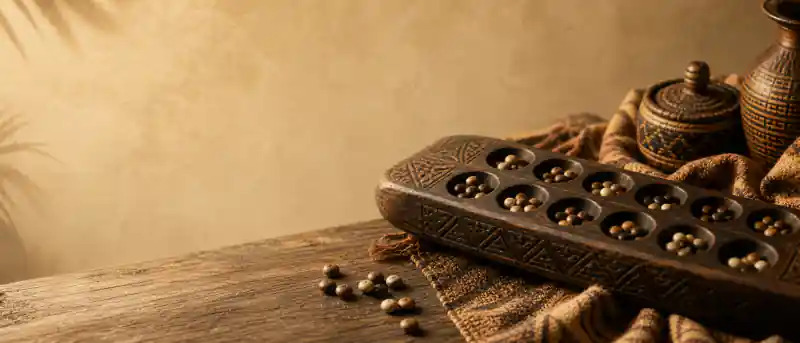
Complete Oware Mancala Rules
Start with what a turn allows and how the game is won.
- Board
- 6 pits per player
- Setup
- 4 seeds per pit, 48 total
- Winning conditionwith 48 seeds in play, the first player to harvest 25 — more than half — wins, and 24 each is a draw. Oware has no stores; seeds move only between the pits and each player's harvest pile, and the only way to harvest is to land your last seed in an opponent's pit and make it hold exactly two or three seeds.
- Each player controls the six pits on their own side. On your turn, choose one of your non-empty pits, lift out all its seeds, and drop one into each following pit counter-clockwise, including your opponent's pits.
- With more than eleven seeds you complete a full lap, and in that case you must skip the pit you started from without dropping a seed there, continuing past it. This detail shifts every subsequent landing spot by one.
- If your last seed lands on your opponent's side and makes that pit hold exactly two or three seeds, you harvest all the seeds in it. You then check backward along the sowing direction: as long as the previous pit is also on your opponent's side and also holds two or three seeds, you harvest it too, continuing until a pit fails the condition or you reach your own side.
- If the last seed lands on your own side, or lands in an opponent's pit that does not end up with two or three seeds, the turn produces no harvest at all.
- You may not starve your opponent: if a harvest would empty all six of your opponent's pits, the entire harvest is cancelled and the seeds stay where they are, though the move itself still stands.
- When your opponent's six pits are all empty, you may only choose pits that will sow seeds onto their side. If no such move exists, the game ends immediately and every seed remaining on the board is added to your harvest.
- Harvesting 25 seeds wins immediately, and since that is more than half of the 48 in play, the game ends the moment the count is reached. A final split of 24 seeds each is a draw.
How to Play Oware Mancala: Your First Game
Use this order of thought to get through a complete game quickly.
- Before every move, count the seeds in your hand, count counter-clockwise to the landing pit, and confirm which side that pit is on and how many seeds it will hold afterward. Those two facts alone determine whether the move harvests anything.
- To judge whether a harvest is available, look at the current counts in your opponent's pits: a pit currently holding 1 or 2 becomes exactly 2 or 3 after you add one seed, which makes it a target. A pit already holding 3 or more will never land in the harvest range from a single added seed.
- For chained harvests, count backward from your landing pit: if the pit before it also holds 1 or 2, one move harvests two or three pits in a row, often several times the yield of a single pit. So when choosing a move, look for the far end of a run of thin pits on your opponent's side.
- Then run the same count over your own side: pits currently holding exactly 1 or 2 are your opponent's targets next turn. Sowing them empty, or building them past 3, both defuse the threat.
- Keep one large pit stocked. It can sweep more than half the board and is the only tool that places seeds precisely at long range, so do not spend it casually for a gain of one or two seeds.
Oware Mancala Strategy
Move from knowing the rules to playing with a plan.
- The two or three pits closest to your opponent's side reach their territory most easily, so building them up keeps an attack available at all times.
- Deliberately keep your own pits at 3 seeds or more, so that a single seed from your opponent can never push them into the 2-or-3 harvest range. That makes your whole row effectively immune.
- A large pit skips its own starting pit on a full lap, and you can use that one-place offset to land the last seed exactly at the end of your opponent's weakest run, engineering a multi-pit chain harvest.
- When ahead, prioritize reducing your opponent's available targets while making sure you always have seeds to sow. When behind, do the opposite: hoard a large pit and gamble on a chain harvest of three or more pits to close the gap.
- When your opponent's side is nearly empty, calculate ahead. The feeding obligation sharply limits your legal moves, and the move you are forced to make often drops seeds right into their harvest range.
Oware Mancala Winning and Special Rules
Details that are easy to miss but can change the result.
- The anti-starvation rule takes priority over harvest detection: an apparently valid chain harvest can yield nothing at all because it would empty your opponent's side, and in that case the seeds remain in their pits.
- The feeding obligation when your opponent has no seeds is a hard constraint — the interface only marks pits that can feed as selectable. When none exists, the game goes straight to scoring and every remaining seed is yours.
- If the position falls into a loop, this site forces an end once the total move count reaches its limit, at which point each player takes the seeds remaining on their own side and the totals are compared.
- The game also ends when all forty-eight seeds have been harvested into the two piles, with the winner decided by comparing the harvests.
Common Oware Mancala Rules Mistakes
The traps new players fall into most often.
- Importing Kalah rules and expecting a capture from landing in your own empty pit, or expecting a store that grants extra turns. Oware has neither.
- Looking only at where the last seed lands and forgetting to continue harvesting backward, leaving several pits' worth of seeds on the table.
- Forgetting that a large pit skips its starting pit on a full lap, which shifts the whole second half of the sowing by one and invalidates every harvest calculation.
- Executing a harvest that would empty your opponent's side completely: you get nothing, and you have just delivered a pile of seeds onto their row.
- Failing to plan ahead when your opponent's side is nearly empty, then finding on your turn that only one pit can feed them and being forced into a move that hands over points.
The Story of Oware Mancala
Where it came from, and why it turned out this way.
OriginAkan peoples of West Africa; traditional competitive mancala of Ghana and Côte d'Ivoire
The genuinely competitive mancala
If Kalah is the commercial simplification of mancala, Oware is the family's competitive mainstream. It is played across the Akan-speaking regions of West Africa, in present-day Ghana and Côte d'Ivoire, and Abapa is the rule version used by adult experts. Locally the game is more than a pastime: boards are often made as substantial objects, matches are played in public, and spectating and commentary are part of the occasion.
No store, so harvesting has to be calculated
Oware strips out both of Kalah's sweeteners. There is no store, so there are no extra turns, and a last seed landing on your own side does nothing at all. The single way to score is to land your last seed in an opponent's pit and make it hold exactly two or three seeds. That very narrow condition turns the whole game into precise counting — you have to count all the way to the landing pit and then confirm whether it currently holds one seed or two.
"Do not starve your opponent" is an ethical rule
Oware's most distinctive rule is the anti-starvation clause: if a harvest would empty all six of your opponent's pits, the entire harvest is cancelled; and when they have no seeds, you must play a move that delivers seeds to their side. It is simultaneously competitive design and cultural statement — the game must continue, and you may not win by leaving your opponent with nothing to do. Many Western abstracts, by contrast, write "opponent cannot move" directly into their victory conditions.
Chain harvesting: the part you count backwards
All of Oware's explosive power is in chain harvesting. Once your landing pit reaches two or three, you keep checking backwards along the sowing direction: as long as the previous pit is still on your opponent's side and also holds two or three, you take it as well. So you choose a move by looking not at a single pit but at the far end of a run of thin pits. A three-pit chain can reverse the score in one turn, which is why strong players will nurse a big pit and wait for the moment.
- Oware has long been a formal event at the Mind Sports Olympiad, one of the few traditional mancalas to enter the international competitive circuit.
- The same family carries different names in different regions: Warri in the Caribbean, Bao in East Africa, with rule differences large enough that they cannot be played interchangeably.
- A pit large enough to complete a full lap must skip its own starting pit — a detail that shifts every subsequent landing spot by one, and the single most common beginner miscalculation.
Sources and References
The material this page's rules implementation is based on.
On rule variationsThis site implements the skeleton of Abapa, the formal adult version: sowing counter-clockwise, and harvesting when the final seed brings an opponent's house to exactly two or three, then collecting backwards along the row. The sharpest disagreement is the Grand Slam — what happens when a harvest would empty every one of the opponent's houses. Four treatments are documented: (1) the move is illegal; (2) the move is legal but no capture results, which international competitions commonly follow; (3) the capture is allowed but every remaining seed on the board goes to the opponent; (4) the capture is allowed but the last (or first) house is not taken. This site uses (2). The feeding obligation is consistent across versions: when the opponent has no seeds, you must play a move that delivers seeds to their side. An endless cycle traditionally ends by mutual agreement with each player taking the seeds on their own side; this site forces the same settlement once a move ceiling is reached.
- OwareWikipedia