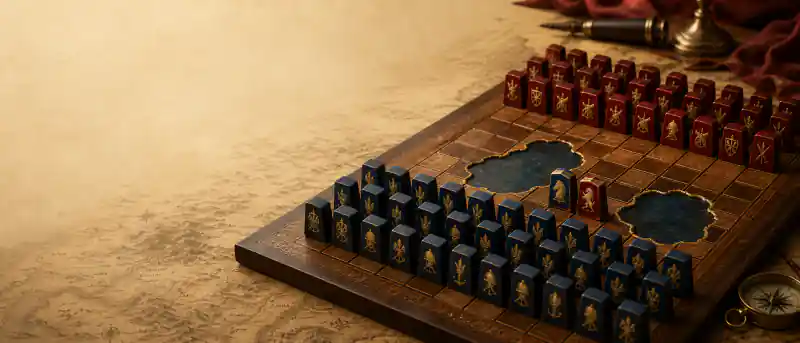
Complete Stratego Rules
Start with what a turn allows and how the game is won.
- Board
- 10 × 10 with two lakes covering 8 squares
- Pieces
- 40 per side, Red moves first
- Winning conditionmove any of your pieces onto the square holding your opponent's flag and you win immediately, with no additional requirements. You also win when your opponent has only bombs and the flag left and no movable pieces at all. Captures are merely the means to those two ends.
- Ranks from highest to lowest are Marshal 10, General 9, Colonel 8, Major 7, Captain 6, Lieutenant 5, Sergeant 4, Miner 3, Scout 2, and Spy 1. Each side fields 1 Marshal, 1 General, 2 Colonels, 3 Majors, 4 Captains, 4 Lieutenants, 4 Sergeants, 5 Miners, 8 Scouts, 1 Spy, 6 Bombs, and 1 Flag.
- Except for Scouts, movable pieces step one square horizontally or vertically per turn, never diagonally, never over another piece, and never into a lake. Flags and bombs can never move and cannot even be selected in the interface.
- A Scout may travel any distance along a rank or file with no piece or lake square in its path, and it may attack at the end of that same move — it is the only unit that can capture from a distance.
- Combatmoving onto a square occupied by an enemy piece is an attack, both ranks are revealed simultaneously, the higher rank stays on the square, and equal ranks eliminate each other. A piece that survives combat is permanently revealed to both players and the interface keeps it face up.
- Three exceptions bypass rank: a bomb destroys any piece that attacks it, and only a Miner attacking a bomb defuses it; the Spy wins when it attacks the Marshal, but the Spy dies when attacked by the Marshal or by anything else; and a Scout that moves more than one square in a single move automatically reveals itself to the opponent, while a Scout moving a single square is indistinguishable from any ordinary piece.
- The two-square ruleafter a piece has shuttled back and forth between the same two squares for three consecutive moves, the fourth move may not return there, and you must move in a different direction or move a different piece. Interposing a move with another piece resets the counter, and the system simply removes illegal moves from the highlighted targets.
- The lakes occupy rows 5 and 6 in columns 3–4 and 7–8, so the midline is left with only three corridors two columns wide: columns 1–2, 5–6, and 9–10. Every attack has to pass through one of those three.
- Each game starts with setup: the site lays out an army in your chosen style, and you can click or drag two of your pieces to swap them. A layout can be saved on this device and loaded again later. There are three automatic styles. Defensive rings the flag with all six bombs two deep and keeps the Marshal and General on the second and third rows. Balanced puts four bombs around the flag, one in a corridor and one far away on the back row. Aggressive uses only the bombs that seal the flag, builds a decoy nest around a low piece on the other wing with the rest, and stands the Marshal and General on the front two rows. In every style the squares next to the flag are all bombs, the Spy stays within two squares of the General, and each of the three corridors has a Captain or higher at its mouth. Defensive always keeps the flag on the back row; the other two sometimes put it one row up. Each press of the refresh button deals a new layout, and your opponent picks its own style, whatever you chose.
How to Play Stratego: Your First Game
Use this order of thought to get through a complete game quickly.
- You play Blue and move second by default, and the settings let you switch to Red and move first. Red always moves first, and switching sides immediately starts a new game and flips the board view to your side.
- In the opening, probe forward one square at a time with the mid-and-low ranks on your third and fourth rows — Sergeants and Lieutenants — rather than pushing the Marshal across the lakes. A Scout that moves only one square reveals nothing and works perfectly well as an ordinary space-filler.
- Keep at least two Miners for the middlegame. Finding the flag and being unable to defuse the bombs around it is the most common way to lose, so do not spend your five Miners colliding with ordinary pieces.
- In combat both ranks flip face-up for about a second. Afterwards the loss bar above the board keeps the two pieces from that battle, with the one that fell crossed out. An eye badge on the top-right corner of one of your pieces means your opponent has identified it, and it has no disguise value from then on.
- Open the loss bar above the board to see how many of each of the twelve ranks both players still have: a filled dot is still on the board, a hollow one has fallen. On a computer the Enemy forces list in the side panel shows your opponent's half all the time. A glance every few moves tells you how many high ranks and Miners your opponent has left.
- Post a mid-rank piece at a corridor mouth as a gatekeeper before you think about advancing. Holding one two-column corridor is far more effective than chasing enemy pieces in the open.
Stratego Strategy
Move from knowing the rules to playing with a plan.
- Information matters more than material: every combat exposes your own piece too. Use Scouts and Sergeants to bump into unknown pieces, and keep the Marshal and General in reserve until you have located the enemy Marshal.
- The Spy works by ambush, not pursuit. Station it on the second line near your own Marshal and counterattack when the enemy Marshal pushes forward. Once the Spy's position is known, your opponent can remove it by attacking with literally any piece.
- A Scout's long move is a one-time resource. One long run reveals it permanently, after which it is just a rank-2 piece. Using it to sweep an entire row and confirm your opponent's layout is usually worth more than capturing a small piece.
- A cluster of pieces that never moves is a signpost to the flag. Periodically shifting the pieces near your flag, or keeping an equally static cluster in an irrelevant corner, muddies your opponent's read on which area is the flag zone.
- Bombs at the corridor mouths are more effective than all six piled around the flag: they stall your opponent's main force without letting six immobile pieces mark the flag's location outright.
- In the endgame, count the remaining unit types. While the enemy Marshal is on the board, keep every one of your revealed high ranks out of its reach; once your opponent's Miners are gone, your bomb positions become an impassable wall.
Stratego Winning and Special Rules
Details that are easy to miss but can change the result.
- Moving onto the square holding your opponent's flag wins immediately with no additional conditions. Separately, a player left with only bombs and the flag and no movable pieces loses.
- A player whose pieces all have no legal move on their turn — blocked in by their own pieces and the lakes, or restricted by the two-square rule — loses.
- There are two kinds of draw: one hundred twenty consecutive moves with no combat at all, and both players simultaneously having no movable pieces. Any combat resets the no-combat counter.
- Equal ranks eliminate each other, which means attacking the enemy Marshal with your own Marshal is a one-for-one trade — usually good only when you still hold your Spy.
- When the game is decided every piece on both sides flips face-up; close the result card to see your opponent's whole setup.
- The AI receives a sanitized observation: it knows its own full force, the enemy pieces already identified, and the pool of remaining unit types both sides can deduce, and then samples and searches across the enemy deployments still consistent with that. It never reads ranks that remain hidden, it is not told which layout style you picked, and it does not assume your flag is on the back row.
Common Stratego Rules Mistakes
The traps new players fall into most often.
- Treating the Spy as an unconditional counter to the Marshal. It wins only when the Spy attacks the Marshal, and it loses to any piece that attacks it.
- Sending a Scout on a long run to capture a small piece, trading a long-range reconnaissance tool for an almost worthless result.
- Assuming a Scout can pass over pieces or lakes. It only travels far; anything blocking its path cuts the move short.
- Attacking a long-immobile piece with your Marshal. A piece that never moves is very likely a bomb, and there are six of them.
- Spending your Miners on frontal exchanges early, then locating the flag with nobody left to defuse the bombs.
The Story of Stratego
Where it came from, and why it turned out this way.
OriginFrench L'Attaque (1908, designed by Hermance Edan) · published as Stratego by Jumbo in the Netherlands
A French woman's patent
Stratego's direct ancestor is the French game L'Attaque of 1908, designed and patented by Hermance Edan. For that era, a woman patenting a military-themed game under her own name was itself unusual. The game later reached the Netherlands, where Jumbo published and trademarked it as Stratego after the Second World War, and that name became the standard one in the West. The Netherlands remains the game's most important competitive centre to this day.
The price of attacking is exposure
Stratego's central tension is not the rank table but information: any combat permanently reveals both participants to each other. If you want to know what that enemy piece is, you have to touch it with one of your own — and in doing so you disclose yourself. Choosing what to probe with therefore becomes the most important decision in the game: Scouts and Sergeants are expendable, while the Marshal and General are held back until the enemy Marshal has been located.
Three exceptions that exist to curb rank
A bomb destroys anything that attacks it and only a Miner can defuse it; the Spy wins when it attacks the Marshal and dies to any piece that attacks it; and a Scout moves at long range and may attack at the end of the move, but reveals itself automatically the moment it travels more than one square. All three do the same job — stopping the highest rank from simply sweeping the board. With six bombs and a Spy, seven pieces per side exist specifically to handle big ranks.
The pieces that never move are talking
The most useful deductive signal in Stratego is often not combat results but which pieces have never moved. Bombs and the flag cannot move, so a cluster that has sat still all game is essentially the coordinates of the flag zone. Conversely, strong players deliberately shuffle pieces near their own flag, or keep an equally static cluster in an irrelevant corner, purely to poison that line of reasoning.
- The two lakes in the middle of the board cut the front into three corridors two columns wide, so every attack must pass through one of them — holding a corridor is far more effective than chasing pieces in the open.
- The two-square rule forbids shuttling one piece endlessly between the same two squares, preventing both sides from stalling the game with repetition.
- Equal ranks eliminate each other, so attacking the enemy Marshal with your own is a one-for-one trade, generally worthwhile only while you still hold your Spy.