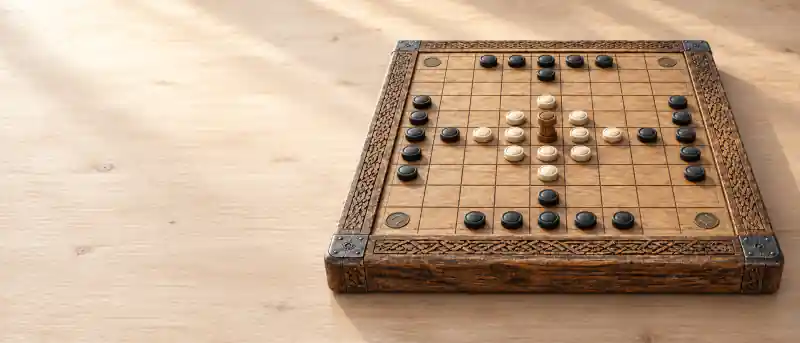
Complete Hnefatafl (Viking Chess) Rules
Start with what a turn allows and how the game is won.
- Board
- 11×11 squares; throne at F6 and four corner refuges
- Forces
- 24 attackers versus 12 defenders and one king
- First move
- Attackers
- All pieces move any number of empty squares horizontally or vertically, like a chess rook. They may not jump or move diagonally. Only the king may stop on the central throne or a corner. Everyone may cross an empty throne; an ordinary piece cannot stop on it.
- An ordinary enemy next to the moved piece is captured when the square directly beyond it contains one of the mover's friendly pieces. The king counts as friendly support for defenders. Moving a piece voluntarily between two enemies is safe: captures happen only when the arriving move closes the sandwich.
- An empty corner is hostile to ordinary pieces of either side. The throne is always hostile to attackers, but it is hostile to a defender only while empty. A king sitting on the throne therefore does not help an attacker capture a neighboring defender. The ordinary board edge is never hostile.
- Shieldwall capture applies only on the four edges. A continuous enemy group of at least two must have an unbroken friendly rank immediately inward and friendly brackets at both ends; a corner may replace one end bracket. Crucially, the move just played must land on a real end bracket. Filling the inward rank or moving elsewhere does not trigger an already completed wall.
- The king may be a friendly bracket or inward shieldwall piece. If attackers shieldwall a defending edge group that contains the king, every ordinary defender in the group is removed but the king remains.
- Defenders win immediately when the king reaches any corner. The king does not win merely by reaching an ordinary edge square.
- Defenders also win with an exit fort: the king is on a non-corner edge, can still move inside a region sealed from attackers, and every defender forming the boundary has lateral support that prevents a sandwich capture. A visual pocket with an open wall or unsupported guard is not a fort.
- Away from the edge, attackers capture the king by occupying all four orthogonal neighbors. When the king is next to the throne, the empty throne supplies that side and attackers need the other three. The final attacking move must close the surround. A king on the edge is immune to this ordinary surround rule.
- Attackers win by encirclement when the king and every remaining defender lie in one non-attacker region that has no orthogonal path to any board edge. Encircling only the king is insufficient if a defender remains outside the ring; one open square leading to an edge also defeats the claim.
- A side with no legal move loses; there is no pass. The position key is the 121-square board plus the next side to move. Under this frozen 2025 Copenhagen version, the third occurrence is legal and then makes the defenders lose. A draw is recorded only by explicit mutual agreement—never from a material threshold, move count, or AI timeout.
How to Play Hnefatafl (Viking Chess): Your First Game
Use this order of thought to get through a complete game quickly.
- As the attackers, do not chase the king with one piece at a time. Hold two corner approaches, then shorten the king's open rook lines so every defending move has a cost.
- As the defenders, open several routes before committing the king. A single clear file to a corner is easy to block; two perpendicular threats force the attackers to divide their wall.
- After selecting a piece, use the highlighted destinations. Restricted squares, blockers, and the empty-throne crossing rule are already included.
- Before every move, inspect all four squares around the destination. One arrival can close several ordinary captures at once.
- Edge formations are dangerous. Count the enemy run, its inward supporting rank, both end brackets, and where the last move actually lands before assuming a shieldwall capture.
- The king is powerful support for defender captures, but it is also the sole escape objective. Avoid using it as a routine capturing piece if the move closes your best corner route.
Hnefatafl (Viking Chess) Strategy
Move from knowing the rules to playing with a plan.
- Attackers should build a perimeter with overlapping rook lines rather than a solid clump. A spaced ring controls more files and makes it harder for defenders to break one link by sandwich capture.
- Defenders can use an apparent king route as a decoy while moving guards toward a different edge. The exit-fort threat forces attackers to respect supported wall shapes, not just corner distances.
- A shieldwall threat is a tempo weapon even when it does not capture immediately. If the opponent must move an end bracket or inward support, a central lane may open elsewhere.
- Near the throne, remember the asymmetry: an empty throne helps capture a defender, but an occupied throne does not. Conversely, the throne always supports a defender's sandwich against an attacker.
- For encirclement, trace the entire non-attacker region from the king to the edge. Then locate every surviving defender. An outside defender means the ring does not yet satisfy the Copenhagen condition.
- Repetition favors the attackers in this rules version. Defenders should avoid a forced shuttle that returns the same board with the same side to move for a third time; attackers can deliberately preserve such a loop when escape threats are otherwise hard to contain.
Hnefatafl (Viking Chess) Winning and Special Rules
Details that are easy to miss but can change the result.
- This page uses
copenhagen-hnefatafl-11x11-2025-v1. It is not Fetlar, Tablut, Brandubh, or a historical reconstruction, and it does not mix rules among those families. - The newer minor-changes rule that forbids a defending move before it creates the third repetition is not used. Here the move remains legal, lands, and then the defenders lose.
- Exit-fort adjudication is structural and deterministic. Search depth, AI confidence, distance from an attacker, or elapsed time never proves a fort.
- Mutual draw is an external adjudication requiring both sides. The solo AI neither offers nor accepts it, so an AI game never draws automatically because few pieces remain.
Common Hnefatafl (Viking Chess) Rules Mistakes
The traps new players fall into most often.
- Trying to stop an ordinary piece on the throne or a corner. Only the king may occupy those five restricted squares.
- Treating the edge as a capturing wall. Only hostile restricted squares can replace ordinary sandwich support; the plain edge cannot.
- Removing the king as an ordinary two-sided capture or as part of a shieldwall. The king has its own surround rule and survives inside a captured edge group.
- Claiming shieldwall after filling the inward rank. The last move must be one of the actual end brackets.
- Calling any edge pocket an exit fort without checking that the king can move, the chamber has no leak, and every wall defender has perpendicular support.
- Calling encirclement while one defender is outside the ring, or while an empty path still connects the king's region to an edge.
The Story of Hnefatafl (Viking Chess)
Where it came from, and why it turned out this way.
OriginNorse tafl family; widespread in the Viking Age; modern rules reconstructed in the 21st century
A Viking game whose rules were lost
The tafl family was played across northern Europe throughout the Viking Age, roughly 400 to 1100 CE, and archaeology has recovered a substantial number of pieces and boards from Birka to the British Isles, with the sagas mentioning the game repeatedly. The problem is that nobody wrote the rules down in full. The equipment survived and the play did not — a genuinely unusual situation among the world's major board games.
The only real clue comes from Lapland in 1732
The closest thing to an original rule set is the account the botanist Linnaeus recorded of a game called tablut during his 1732 expedition to Lapland. That record then created a problem of its own: it was rendered into a Latin summary in which passages were misunderstood, so Western reconstructions from the 19th century onward were long built on a distorted source. The hnefatafl played today is, fundamentally, a reconstruction assembled from incomplete evidence.
Which version you play therefore matters
Since the rules are reconstructed, multiple versions exist and the differences are substantial: can the king take part in captures, how many sides must surround the king to capture him, does the board edge count as hostile, are shield walls and exit forts recognized? Each one shifts the attack-defense balance. This page freezes the 2025 Copenhagen rules and pins all of it down. That is not pedantry — without naming a version, the question "do the defenders win?" cannot even be discussed.
Asymmetric by design
Twenty-four attackers face twelve defenders and one king, two to one in material, and yet the two sides pursue completely different goals: the defenders must get the king to a corner refuge or build an exit fort, while the attackers must capture the king or completely enclose him with all remaining defenders. That structure, where the two players are not really playing the same game, is borrowed constantly in modern design — and tafl is one of its oldest specimens.
- Hnef means fist in Old Norse, so hnefatafl reads roughly as "the fist king's table," referring to the besieged king at the center of the board.
- The empty throne and the four corner refuges are hostile to ordinary pieces and can serve as one side of a capture — the rule most often altered in reconstructions and the one that most affects balance.
- This page does not adopt the newer clause forbidding defenders from creating a third repetition: the move that forms it remains legal and is fully played out, after which the defenders lose.
Sources and References
The material this page's rules implementation is based on.
On rule variations“Hnefatafl” is not one ruleset but a family — Fetlar, Copenhagen, Tablut, Brandubh, and various historical reconstructions — which differ on board size, whether the king may take part in captures, and whether reaching an edge square wins. This site is fixed to Copenhagen on an 11×11 board and does not mix clauses from other versions. Compared with the earlier Fetlar rules, Copenhagen adds four things: an armed king (who can act as one half of a defending sandwich), the shieldwall capture, the exit fort, and a win for the attackers when the king and all surviving defenders are surrounded. Copenhagen itself later received a minor-changes revision adding “the defence may not create the same position a third time”; this site does not adopt it — here the move that forms the position a third time is still legal and is played out, after which the defence loses.
- Summary on the Copenhagen Hnefataflaagenielsen.dk