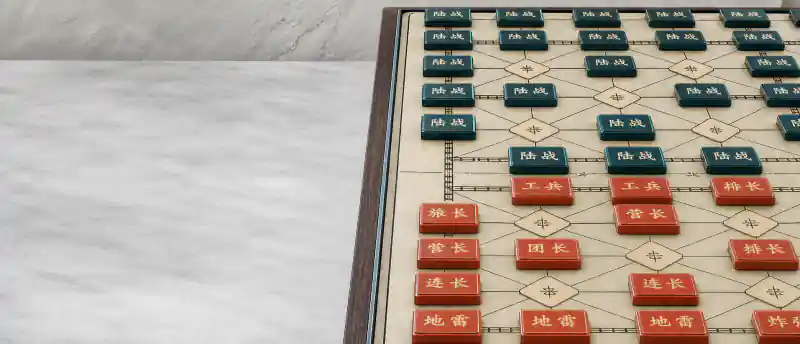
Complete Junqi (Army Chess) Rules
Start with what a turn allows and how the game is won.
- Board
- 5 columns × 12 rows, 10 camps, 4 headquarters
- Pieces
- 25 per side; you play Red and move first
- Winning conditionmoving any of your pieces into the headquarters holding your opponent's flag wins instantly, and so does leaving your opponent with no legal move on their turn. Captures never decide the game directly — they only clear the way toward those two routes.
- Ranks from highest to lowest are field marshal, general, division commander, brigade commander, regiment commander, battalion commander, company commander, platoon commander, and engineer. The attacker with the higher rank captures the defender and takes the point; equal ranks eliminate each other. Each side's twenty-five pieces are 1 flag, 1 field marshal, 1 general, 2 division commanders, 2 brigade commanders, 2 regiment commanders, 2 battalion commanders, 3 company commanders, 3 platoon commanders, 3 engineers, 2 bombs, and 3 mines.
- Three exceptions bypass rank entirely: a bomb colliding with any piece removes both, including a bomb against a mine; a mine cannot move, and only an engineer capturing it counts as clearing it, while any other piece (including the field marshal) that hits a mine dies while the mine stays in place; and the flag is captured the moment any piece moves onto it, ending the game immediately.
- Deployment restrictionsthe flag may only go into one of the two headquarters, the three mines only on your last two rows, the two bombs not on your front row, and the five camps must be empty at the start. Clicking two of your own pieces swaps them, and a swap violating any of these restrictions is rejected with an explanation.
- Road movement travels to one adjacent point per turn. A camp is also connected to the four points on its diagonals, which makes camps the diagonal hubs of the road network; there are no other diagonals anywhere on the board.
- A piece standing on a railway square may travel any distance in a straight line along the railway, passing over no pieces, but it may not turn. Only engineers may turn repeatedly on the railway network and follow multi-segment paths. A piece not on a railway square can only take a single road step.
- The railways are the whole of rows 2, 6, 7, and 11, plus the vertical lines in columns 1 and 5 running from row 2 to row 11. Between the two front lines (rows 6 and 7) only columns 1, 3, and 5 connect, and all three of those connections count as railway in this implementation.
- A piece inside a camp cannot be attacked, and neither player may move into an occupied camp, so holding a camp grants shelter and creates a roadblock at the same time. Headquarters exist only to hold the flag: any piece that enters a headquarters can never move again.
- Hidden-rank adjudication is handled by the system in place of a referee: neither side ever sees the opponent's ranks. When a clash occurs you learn only your own piece's outcome — victory, death, or mutual destruction — never what the opposing piece was, and a surviving enemy piece is not revealed by the clash.
Flip Junqi
Another way to play on the same board: all 50 pieces are shuffled and dealt face down, there is no setup, and a turn is flipping one piece or moving one of yours. Choose it under Mode on the play page.
The deal and who plays which colour
- Red and Blue have 25 pieces each. All 50 are shuffled and placed face down on the 50 points that are not camps; the 10 camps start empty. The backs are identical, so a piece's colour is known only once it is flipped.
- On your turn you do one of two things: flip any face-down piece, or move one of your own face-up pieces. A flip uses the whole turn.
- The first player to flip the same colour twice in a row plays that colour, and the other player takes the other. Until then both players may only flip, and the pieces already face up belong to nobody.
What differs from Junqi with a setup
- A headquarters is an ordinary point here: a piece standing on one can move away.
- Landmines and Flags can be anywhere, even on a railway. A Landmine on a railway blocks that line until it is cleared.
- A face-down piece cannot be attacked, only flipped.
- No move may simply throw a piece away: only an Engineer or a Bomb can go onto a Landmine, and a piece cannot attack one that outranks it. Equal ranks still trade, and a Bomb still removes itself and whatever it hits.
- Losing the Commander does not reveal the Flag.
How to win
- First clear all 3 enemy Landmines: an Engineer removes one and survives, a Bomb removes one and is lost with it. After that, any of your pieces that moves onto the enemy's face-up Flag wins at once.
- While any enemy Landmine remains, the enemy Flag cannot be touched. A Flag that is still face down cannot be touched either; it has to be flipped first.
- A side with no Engineers and no Bombs left can no longer clear Landmines and can win only by the next rule.
- If the opponent, on their turn, has no face-down piece to flip and no piece that can move, you win.
- After 80 turns in a row with no flip and no capture the game is a draw. A piece in a camp cannot be taken, so once both sides are out of Engineers and Bombs a side that keeps to the camps is hard to wipe out, and such games usually end drawn.
Playing it here
- Tap a face-down piece to flip it. Tap one of your face-up pieces to light the points it can reach, then tap one to move.
- Beside the board every one of both sides' 25 pieces is listed: a square in the side's colour is face up on the board, a grey square is still face down, a crossed square has been lost.
- A face-up Flag carries a small shield in its top-left corner while its side still has Landmines; the shield goes when the last one is cleared.
- Play the computer at four levels, or share one screen with another person. Undo turns a freshly flipped piece face down again.
How to Play Junqi (Army Chess): Your First Game
Use this order of thought to get through a complete game quickly.
- Start deployment with the flag: put it in one of the headquarters on row 12, use two mines to hold the points immediately left and right of it on the same row, and place the third mine directly in front of it on row 11. Then even an opponent who guesses the right side has to dig through two layers with engineers.
- The other headquarters has to hold a piece too: your 25 pieces exactly fill the 25 points that are not camps. Whatever stands there can never move again, so give it a low rank such as a platoon commander.
- Probe with platoon and company commanders along the flank railways in the first few moves rather than moving your field marshal immediately. The moment a piece moves, your opponent can rule out that it is the flag or a mine, so every move hands over information.
- How to playclicking one of your pieces lights up its legal destinations, and long railway runs and engineer zigzags are animated segment by segment along the path. Clicking a different piece of yours re-selects. Before starting, choose an Aggressive, Defensive, or Balanced Auto Layout, then fine-tune it by hand.
- Take the two forward camps on your own half early (row 8, columns 2 and 4). A camp is absolutely safe and simultaneously blocks your opponent's road route south, making it the highest-value outpost available.
- Keep at least one engineer out of the early exchanges. Only engineers can clear mines and only engineers can loop around behind via the railways, so trading all of them away means giving up your route to the flag.
Junqi (Army Chess) Strategy
Move from knowing the rules to playing with a plan.
- Deduce identities from three signals combined: whether a piece has ever moved, whether it travels on railway or road, and what clashes it has produced. A piece that never moves and sits on the back two rows is probably a mine or the flag; a piece that boldly runs long railway lines is probably high-ranked; a piece that only steps one square could be anything.
- The field marshal's greatest danger is not the general but a bomb. Once your opponent locates your field marshal, they usually trade a bomb for it directly. Routing the field marshal along lines with friendly cover, or sending the general forward disguised as the field marshal, is far safer than pushing it in alone.
- The engineer's real value is the railway zigzag: it can start from your back rank and loop along the flank railways to any railway square in your opponent's half in one move, and it is the only piece that can get behind the flag to clear mines. Protecting an engineer's route matters more than capturing an extra small piece.
- Camps are both strongpoints and roadblocks. A piece holding a camp cannot be captured and seals that route — but the same square also blocks your own follow-up pieces, so confirm your main force has another path before attacking.
- In the casualty panel, only enemy field marshals and flags are revealed by name; everything else is counted face down, so you must track your opponent's losses from the clash results yourself. Every "your piece wins" tells you they lost a piece of rank no higher than yours.
- In the endgame you do not have to fixate on the flag. Exhausting all of your opponent's movable pieces wins just as well — a player left with only a flag and mines has no legal move on their turn and loses outright.
Junqi (Army Chess) Winning and Special Rules
Details that are easy to miss but can change the result.
- There are only two ways the game is decided: any piece entering the headquarters holding the opposing flag wins immediately, and a player with no legal move on their turn loses. This implementation has no draw condition and no turn limit.
- The death of a field marshal immediately reveals that side's flag position, whether the marshal died attacking, defending, or in mutual destruction. Your own flag then shows a gold reveal badge and the enemy flag displays its rank directly — but the game does not end there; you still have to walk a piece over and take it.
- Clash information is one-directional: you learn whether your own piece won, died, or was mutually destroyed, and you never see your opponent's rank. So "my regiment commander died" only tells you the opponent had a higher rank, a bomb, or a mine, and you must narrow it down further from position.
- Pieces inside camps cannot be attacked or passed through, while pieces in a headquarters — including ones that are not the flag — permanently lose the ability to move. The difference between these two special points is the thing most often overlooked during deployment.
- The AI receives an observation sanitized exactly like yours and never reads undisclosed enemy ranks or the identities of enemy casualties; it decides by sampling and searching across many possible identity distributions.
Common Junqi (Army Chess) Rules Mistakes
The traps new players fall into most often.
- Trying to turn a corner on the railway with an ordinary piece. Only engineers can turn, and other pieces simply show no targets beyond the corner — that is not an interface bug.
- Charging an unknown piece with your highest rank. A field marshal that meets a bomb or a mine is gone either way, and with two bombs and three mines per side, five pieces on the board exist specifically to kill big ones.
- Putting a strong piece into the other headquarters, where it will be unable to move for the rest of the game.
- Expecting enemy pieces to be revealed after a clash. This implementation announces only the outcome, and surviving enemy pieces stay hidden.
- Trading away all three engineers, so that even once you have located the flag, you cannot clear the mines guarding it.
Four-player Junqi: what changes
The same pieces, with four armies in two teams.
- The board becomes a cross. Each army holds one arm, laid out exactly like one half of the two-army board; the centre adds nine stops, and a curved railway at each corner joins neighbouring territories. There are 129 stops in all.
- Four armies make two teams: the army facing you is your ally, the two beside you are opponents, and turns pass south, east, north, west. You cannot capture your ally's pieces or move onto them.
- Movement and battles are those of two-army Junqi: one stop by road, any distance along a straight or curved railway, and only engineers turn square corners. Higher rank wins, equals both go, a bomb takes anything with it, engineers clear mines, and a piece in a camp is safe.
- Results are counted by team. An army whose flag is taken, or which has no move on its turn, leaves the board with all its pieces; a team loses when both armies are gone. One army may have to play on alone against two.
- What you can see comes in three kinds: only your own army, your ally's as well, or all four. In each of them a battle announces only its result, and a fallen field marshal shows that army's flag to everyone.
- A draw is seventy consecutive moves without a battle, counted across all four armies.
The Story of Junqi (Army Chess)
Where it came from, and why it turned out this way.
OriginChina; a military-themed hidden-rank game popularized in the 20th century
The Chinese version of the same idea
Junqi is a military-themed hidden-rank game that spread widely in 20th-century China, built on the same premise as the French L'Attaque of 1908, the ancestor of Stratego: give pieces ranks, hide them from your opponent, and deduce identities from the outcomes of clashes. But Junqi went further on the board itself, adding two overlaid movement networks of roads and railways, camps that grant immunity from attack, and headquarters that immobilize whatever enters them. Position therefore often matters more than nominal rank.
Why traditional Junqi needs a referee
The awkward part of any hidden-rank game is that when two pieces collide, neither player may look at the other's rank, yet somebody has to adjudicate. Traditional four-player Junqi therefore has both an open version and a hidden version, the latter requiring a third person as referee who announces only the outcome and never the rank. This page replaces that referee with the system: you learn whether your own piece won, died, or was mutually destroyed, and never what your opponent had.
Railways and engineers: position beats rank
A piece standing on a railway may run any distance in a straight line but cannot turn — except the engineer, which can turn repeatedly across the railway network. The engineer is the lowest-ranked piece on the board and yet the only one that can loop from your own back rank into your opponent's half in a single move, and the only one that can clear mines. Junqi thereby produces an unusual inversion of value: the smallest piece is frequently the one that decides the game.
You win by taking the flag, not by killing
The winning conditions are entering the headquarters that holds your opponent's flag, or leaving them with no legal move. Captures score nothing directly; they only clear the way to those two routes. That also explains the core logic of deployment: the flag must go into a headquarters, three mines guard it, and then you hope your opponent's engineers get traded off first — because for anything other than an engineer, hitting a mine is a one-way trip.
- The death of a field marshal immediately reveals that side's flag position, but the game does not end there — you still have to walk a piece over and take it.
- Pieces in a camp cannot be attacked or passed through, while pieces in a headquarters — even ones that are not the flag — permanently lose the ability to move, the costliest thing to overlook during deployment.
- Each side has two bombs and three mines, five pieces existing specifically to kill high ranks — which makes charging an unknown piece with your field marshal a distinctly risky choice.