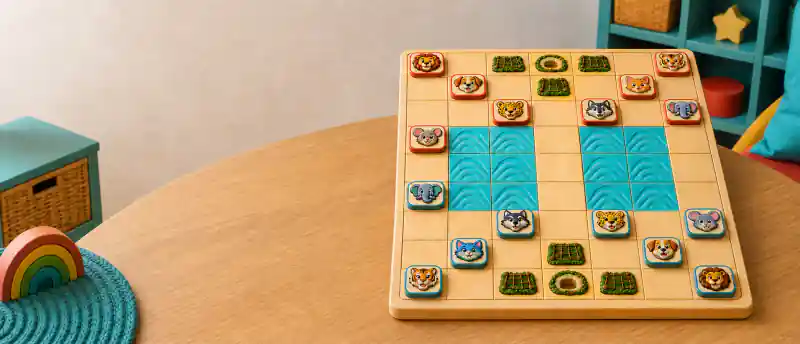
Complete Dou Shou Qi (Jungle Game) Rules
Start with what a turn allows and how the game is won.
- Board
- 7 files × 9 ranks
- Pieces
- 8 animals per side
- Winning conditionmoving any one of your animals into your opponent's den wins immediately — it makes no difference whether that animal is the elephant or the rat. Capturing every enemy animal, or leaving your opponent with no legal move, also wins. The real objective is the breakthrough; capturing exists mainly to clear the path for it.
- The board is 7 files by 9 ranks with two water areas of 3 ranks by 2 files, at B4–C6 and E4–F6. The dens sit at D1 and D9, and the three squares outside each den — C1, E1, D2 and C9, E9, D8 — are that side's traps. Jade (the bottom side) moves first.
- Every animal moves one square orthogonally per turn, never diagonally, and may never enter its own den. Entering the opponent's den wins immediately.
- The ranking from lowest to highest is rat, cat, dog, wolf, leopard, tiger, lion, elephant. An animal may capture an enemy animal of equal or lower rank, so equal ranks can capture each other.
- Only the rat may enter water squares. Lions and tigers cannot stop in water, but they may leap in a straight line over an entire water area and land on the first land square on the far side — a vertical leap crosses three water squares, a horizontal leap crosses two, and the leap is invalid if the landing square would be off the board.
- If any rat, friendly or enemy, sits on a water square along the leap's path, the leap is blocked. If an enemy animal occupies the landing square, ordinary rank rules decide whether it can be captured.
- Captures require both animals to be on the same type of terrain: a rat in water cannot capture a land animal, and a land animal cannot capture a rat in water. Two rats both in water can capture each other, as can two rats both on land.
- A rat may capture the elephant only when both are on land. The elephant can never capture a rat under any circumstances, with one exception: when that rat is standing in the elephant's own side's trap.
- An enemy animal that steps into your trap counts as rank zero, so any of your animals can capture it — rat takes elephant, elephant takes rat, all of it. Your own animals standing in your own traps are entirely unaffected.
How to Play Dou Shou Qi (Jungle Game): Your First Game
Use this order of thought to get through a complete game quickly.
- Memorize the three rules people get wrong most: the rat captures the elephant but the elephant never captures the rat; a rat in water and an animal on the bank cannot touch each other; and a lion or tiger's river leap is blocked by any rat in the water, including your own.
- A good opening is to walk your rat from G7 to G6 and then into the water at F6. A rat parked in the water permanently pins down the enemy elephant and simultaneously seals the horizontal leap for lions and tigers on that side.
- Guard the three trap squares outside your own den at C9, E9, and D8. An enemy animal that steps in becomes rank zero and can be captured by anything you have, so never pull every defender away from the traps just to chase a piece.
- Do not let a strong animal push deep into enemy territory alone. A lion or tiger that reaches the area around the enemy traps can be taken by a cat or even a rat.
- Once you select an animal, the board marks every legal destination, including river-leap landing squares for lions and tigers. Reading those markers before you move is faster and more reliable than reconstructing the rules from memory.
Dou Shou Qi (Jungle Game) Strategy
Move from knowing the rules to playing with a plan.
- Tie down one flank with a strong animal such as the elephant or lion, while the tiger or lion on the other flank builds a den threat, pulling your opponent's defenders apart.
- The rat is the only animal that restrains the elephant and the only one that can seal the river leap, so do not trade it for a lower-ranked cat or dog.
- When closing in on the enemy den, calculate the traps first: you have to capture or lure away the animals guarding them, or you will never be able to take the final step into the den.
- In the middlegame, try to occupy the land squares along the riverbanks. Those squares control both the leap landing points and the rat's routes in and out of the water.
- In the endgame, calculate forcing routes: consecutive threats against the den are usually faster than chasing weak animals in the distance. Also keep the hundred-half-move no-capture draw in mind, since the losing side can play for a draw by stalling.
Dou Shou Qi (Jungle Game) Winning and Special Rules
Details that are easy to miss but can change the result.
- There are three ways to win: move any animal into the opponent's den, capture all of their animals, or leave them with no legal move on their turn, in which case they lose.
- One hundred consecutive half-moves — counting both sides — without a capture is a draw, which prevents endless chases in the endgame.
- Traps only weaken enemy animals that step in; your own animals standing in your own traps keep their normal rank.
- This implementation applies the demotion in both directions: an animal in an enemy trap counts as rank zero when computing what it can capture, so it cannot capture adjacent enemy animals from inside the trap. The one exception is rat takes elephant: that rule ignores the demotion, so a rat in a trap can still capture an adjacent elephant. Common rule sets usually apply the demotion only to being captured, so this page is stricter.
- A lion's or tiger's river leap counts as one complete move, and the animation shows the full path across the water squares it passes. Both the starting square and the landing square must be land.
Common Dou Shou Qi (Jungle Game) Rules Mistakes
The traps new players fall into most often.
- Assuming the elephant is untouchable because it is the highest rank, forgetting the rat exception — and forgetting that once the rat is in the water the elephant cannot reach it at all.
- Leaping with a lion or tiger without checking the water for rats. Your own rat blocks your own leap just as effectively as the enemy's.
- Trying to capture a rat in water with a land animal, or to capture a land animal with a rat in water. Neither is legal.
- Focusing on captures and leaving an open lane straight to your own den. A single enemy cat walking into your den wins regardless of its rank.
The Story of Dou Shou Qi (Jungle Game)
Where it came from, and why it turned out this way.
OriginChina; a folk children's game popularized in the 20th century, exact source unknown
A game with no family tree
Almost everyone in China has played Dou Shou Qi, yet its origins are surprisingly murky: there are no reliable historical texts and no archaeological evidence, and it is generally treated as a folk children's game that appeared and spread in the 20th century. It travelled to the West as Jungle or The Jungle Game, with no earlier source there either. So this is a game everybody knows and nobody can trace.
Why the rat eats the elephant
The single most famous line in the rank table is that the rat captures the elephant while the elephant can never capture the rat. This is plainly not naturalism but a direct expression of the Chinese folk idea that everything has its nemesis — the belief that elephants fear mice is very widespread. The practical effect is real too: on rank alone, the top piece would simply sweep the board, but with this cycle in place the strongest piece must constantly watch out for the weakest.
Rivers and traps turn rank into terrain
The board is where the real ingenuity sits. Only the rat may enter water, so the rat is both the elephant's nemesis and able to hide where the elephant cannot reach. Lions and tigers can leap the river, but any rat sitting in the water blocks the leap. Traps drop rank to zero instantly, letting anything capture whatever steps in. The result: a piece's strength is decided not by its rank but by where it currently stands.
Winning is not about wiping anyone out
Many people play it as a game of attrition, but the den is the main line: moving any piece into your opponent's den wins immediately, and it makes no difference whether that piece is the elephant or the rat. That turns the whole game into a two-way race for a breakthrough, where captures serve either to clear your own path or to stall your opponent's. Once you see that, sneaking a cat around the flank stops being a cheap trick and becomes correct play.
- Trap demotion on this page works in both directions: a piece in an enemy trap counts as rank zero when computing what it can capture too, so it cannot take adjacent enemies from inside the trap (rat takes elephant is the one exception) — stricter than common rule sets.
- A lion or tiger's river leap is blocked by any rat in the water, including your own — the rule beginners overlook most often.
- One hundred consecutive half-moves without a capture is a draw, which exists to terminate endless endgame chases.
Sources and References
The material this page's rules implementation is based on.
On rule variationsDou Shou Qi is a traditional game with no authoritative rulebook, and the disagreements cluster around its two special terrains, the river and the traps. This site adjudicates as follows: the rat may enter the water; a rat in the water blocks the lion's and tiger's river jump; a rat on land may take the elephant but may not take a land piece while itself in the water; the elephant may not take the rat; and no piece may enter its own den. Other versions let rats in the water capture each other, or let the rat capture the elephant from the water, or let the elephant capture the rat. The reach of the trap demotion also varies: this site follows the more common reading, where a piece standing in an enemy trap counts as rank 0 against any enemy piece, while some versions demote it only against the trap owner's pieces. The board, orthogonal single steps, the lion and tiger river jump with its rat block, and winning by entering the enemy den are consistent across sources.
- Solving Dou Shou QiLeiden University (Jan van Rijn)
- Dou Shou Qi printable rulesAncientChess.com