Complete Cribbage Rules
Start with what a turn allows and how the game is won.
- Players and deck
- 2 players · 52 cards · no jokers
- Deal
- 6 each · discard 2 each · 4-card crib
- Game
- First to 121 · scoring ends immediately at 121
How many cards are dealt in two-player Cribbage?
Six cards each. Both players discard two, leaving four-card hands and a four-card crib that belongs to the dealer.
Does a four-card flush count in the crib?
No. A crib flush scores only when all four crib cards and the starter share the same suit, for five points. A four-card flush in your own hand does score four.
What is the highest possible Cribbage hand?
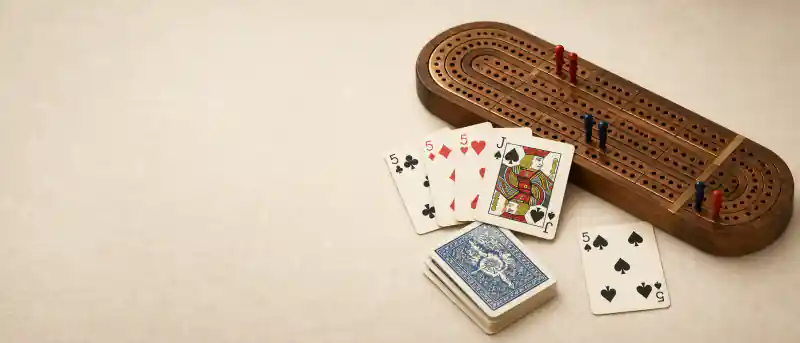
Twenty-nine. Hold a jack and three fives, and the starter must be the fourth five in the jack's suit: eight fifteens for 16, four of a kind for 12, and one for his nob.
Are a king and a queen a pair in Cribbage?
No. Both are worth ten when you count toward fifteen or thirty-one, but a pair needs the same rank, so only queen with queen or king with king scores two.
How many points is a Go worth in Cribbage?
One point to the player who laid the last card before the count reset, or two if that card brought the total to exactly 31. A card making 31 never also collects the Go point.
- Cut for first dealBoth players cut the pack and the lower card deals; equal cuts are cut again. After the first hand the deal alternates, so the crib passes back and forth and each player gets the same number of turns with it.
- The dealSix cards to each player, dealt one at a time starting with the opponent. Both hands stay private for the whole hand — the only cards everyone can see are the starter and the cards already played.
- Building the cribEach player pushes two cards face down onto a four-card pile called the crib. The crib belongs to the dealer and is counted last, so you are feeding your own extra hand when you deal and feeding your opponent's when you do not.
- The starterThe pone cuts the pack and the dealer turns the top card face up. It stays there all hand and acts as a fifth card for both hands and for the crib. If the starter is a jack the dealer immediately pegs 2 for his heels.
- The play beginsThe pone lays a card face up and says the total, the dealer adds a card and says the new running total, and so on alternately. Aces count 1, jack, queen and king each count 10, and no card may take the total past 31.
- Scoring during the playMaking the total exactly 15 scores 2 and exactly 31 scores 2. Matching the rank just played is a pair for 2, a third of that rank is 6, a fourth is 12. One card can score twice at once — playing 7♥ onto A♦ 7♣ is fifteen for two plus a pair for two, announced as fifteen for four.
- Runs during the playThree or more consecutive ranks among the cards since the last reset score one point per card, and they do not have to arrive in order — 8, then 6, then 7 gives the player of the 7 a run of three. A repeated rank breaks it: after 5, 6, 7, another 6 scores nothing, because the last three cards cannot form a sequence.
- Go and last cardIf you cannot play without passing 31 you say Go, and your opponent keeps laying cards while able. Whoever played the last card takes 1, or 2 if it made exactly 31 — a 31 never pays the Go point as well. The count then resets to zero and the player who did not play last leads the next sequence.
- Order of the showOnce all eight cards are played, the pone counts first, then the dealer counts their hand, then the dealer counts the crib. That order is exactly why being pone is worth something in a close game.
- Counting a handPut your four cards beside the starter and count all five together. Every distinct combination adding to 15 scores 2, every pair scores 2, and every run of three or more scores one point per card. The same card may be reused in as many different combinations as it fits.
- Duplicates multiply runs5♠ 6♠ 7♠ 7♥ with a K♦ starter is worth 10 — two different runs of 5-6-7, one with each seven, for 6, the pair of sevens for 2, and 5+K for fifteen two. Count distinct combinations of cards, not the shapes you happen to notice.
- Flush and nobsFour hand cards of one suit score 4, or 5 when the starter matches as well. The crib is stricter and scores only a five-card flush. A jack in hand or crib whose suit matches the starter scores 1 for his nob.
- Reaching 121 ends itThe game stops the instant a peg lands on 121, mid-count if necessary. Nobody finishes counting, so a pone who counts out first beats a dealer whose hand and crib would have been worth more.
How to Play Cribbage: Your First Game
Use this order of thought to get through a complete game quickly.
- Count in the same order every time — fifteens, then pairs, then runs, then flush, then nobs. Most missed points come from spotting one attractive pattern, scoring it, and forgetting to sweep the rest of the hand.
- Learn what a 5 is worth before anything else. Sixteen cards in the deck count as ten, so a 5 pairs with all of them for fifteen. Keep fives, and think twice before ever throwing one into your opponent's crib.
- Discard toward your own crib and away from theirs. Cards that work together — a pair, a 5, or two cards adding to 15 such as 7 and 8 — pay you twice when it is your crib, and pay your opponent when it is not.
- Throw junk to the opponent's crib: a king with an unconnected low card is the classic safe pair, because a king can only build a run downward and rarely lands on fifteen.
- In the play, do not lead a 5 and try not to leave the total at 5, 10 or 21. Those numbers hand your opponent an easy fifteen or thirty-one with any of the sixteen ten-cards.
- Keep one low card back for the end of a sequence. Holding an ace or a 2 is what lets you answer a total of 29 or 30 and collect the Go instead of giving it away.
- Cribbage has its own table talk: fifteen two, fifteen four, a pair is six, thirty-one for two, one for the Go, one for his nob. The score breakdowns on this table use the same names, so the phrases carry straight over to a real board.
Cribbage Strategy
Move from knowing the rules to playing with a plan.
- Discard evaluation has two sides: the expected score of the kept four cards over all possible starters, and the expected crib value of the two cards you release. Add crib value when you deal; subtract it when the opponent deals.
- Pegging is a constrained information game. Track which ranks have appeared, preserve low cards that can answer dangerous counts, and notice when a pair invitation is more likely to become a triple against you.
- The dealer normally has the structural advantage because the crib counts last for the dealer. The pone often values immediate pegging pressure and safe opponent-crib discards more highly.
- Judge your progress against pace, not against the opponent alone. Two deals are worth roughly 26 points to a competent pair — about 16 with the crib and 10 without — so a hand that leaves you short of that pace is a hand you needed to play harder.
- Position decides whether to play offense or defense. As dealer, aim to reach the end of a hand around 76-86 or 102-112 and take risks to get there; the same windows are exactly the ones the pone should avoid, so the two players want opposite things from the same board.
- At expert level, average points are not the final objective; probability of crossing 121 before the opponent is. Board position can justify defensive variance reduction while ahead or higher variance while behind.
Cribbage Winning and Special Rules
Details that are easy to miss but can change the result.
- This table plays the mainstream two-player game with American Cribbage Congress scoring for flushes, runs and the Go. Muggins (claiming points your opponent overlooked), the stinkhole and skunk stakes are widespread house rules that are deliberately not applied here.
- Automatic mode performs exact scoring and exposes each score event. Count Practice asks you to claim a total first, then records claimed and actual values while the rules engine still applies the exact score.
- The AI contract is observation-only: it receives its own hand, public cards, counts and the canonical legal actions. Hidden stock order and the opponent's hand never enter its input.
- Discard analysis enumerates all 15 discard pairs, every legal starter, and every neutral crib completion. It is a browser-side decision tool, not a remote service.
- Game-win odds come from an offline model: one hundred million self-played deals condensed into a table of win probabilities for every score pair and dealer. The analyzer and review look up your position in that table after simulating the rest of the hand; the odds describe the model's fixed reference strategy on both sides, not any particular opponent. If the table fails to load, win odds are reported as unavailable rather than estimated some other way.
- The two peg values shown for each player are the prior and current score. This mirrors leapfrog peg-board semantics instead of presenting one unexplained progress number.
Common Cribbage Rules Mistakes
The traps new players fall into most often.
- Counting a four-card flush in the crib. Unlike a hand, the crib needs all five cards in one suit.
- Treating a queen and a king as a pair because both count ten. Ten-value is only used for fifteens and the running total; pairs, triples and runs all go by rank.
- Trying to run K-A-2 or Q-K-A. The ace is always low in cribbage and the sequence never wraps around from king back to ace.
- Adding every visible run when duplicate ranks are present. Count distinct card combinations of the longest run, not every shorter run inside them.
- Scoring one pair for three equal ranks. Three of a kind contains three pairs and scores six; four of a kind contains six pairs and scores twelve.
- Giving the last-card point after a play of 31. Thirty-one already scores two and resets the sequence; it does not also receive last card.
- Waiting for the rest of the hand after someone reaches 121. Cribbage ends at once, including during heels, pegging or the pone's count.
The Story of Cribbage
Where it came from, and why it turned out this way.
OriginEngland · early 17th century · traditionally linked to Sir John Suckling
From noddy to the crib
Cribbage developed from the older English game noddy in the early seventeenth century and is traditionally associated with poet and courtier Sir John Suckling. Its decisive invention was the crib: each player contributes cards to a second hand owned by the dealer, turning one discard into both self-improvement and controlled risk.
A score you can see
The peg board is more than a score counter. Leapfrog pegs preserve the prior and current score at once, reduce arguments, and make the race visible from across a table. That physical rhythm is why a digital version should retain dealer, crib, starter and two-peg language instead of flattening the game into a generic progress bar.
A portable social game
A standard deck, a narrow board and short deals made Cribbage unusually portable. It became closely associated with pubs, ships, military life and family tables, surviving less as a software category than as a repeated social ritual passed between generations.
Twenty-nine
The celebrated maximum hand is 29: three fives and a jack in hand, the fourth five as starter, with the jack matching the starter suit. It combines eight fifteens, six pairs and nobs. Its rarity and instantly recognizable shape make it Cribbage's shared piece of folklore.
- Cribbage is one of the few card games routinely scored with purpose-built physical equipment.
- The board records movement, but all game points still come from cards; peg holes do not change the rules.
- The impossible 19-point hand gave rise to 'nineteen' as traditional slang for a zero hand.