Complete Gin Rummy Rules
Start with what a turn allows and how the game is won.
- Players and deck
- 2 players · 52 cards · no jokers
- Deal
- 10 cards each · non-dealer gets the first upcard option
- Match
- Standard to 100 · Oklahoma to 150
- The non-dealer may take the original upcard or pass; after a pass the dealer receives the same choice. If both pass, the non-dealer draws from stock. A normal turn draws one stock card or the top discard, then discards one face up.
- A card taken from the discard pile—including the opening upcard—cannot be discarded back on that same turn. A stock card may be discarded immediately. Knocking is optional and always uses the chosen discard to leave a ten-card hand.
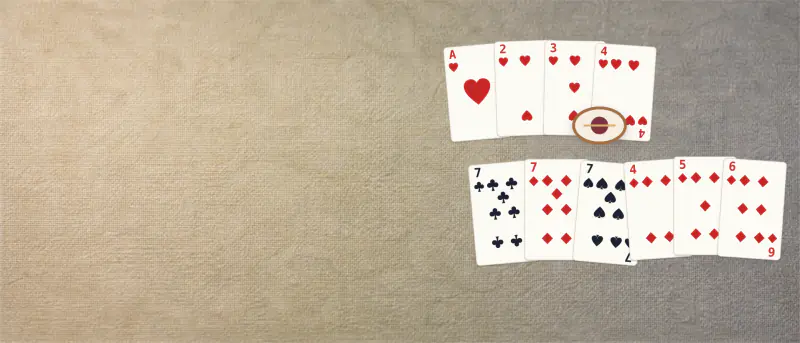
- A set is three or four cards of one rank. A run is three or more consecutive cards of one suit. Ace is low only: A-2-3 is legal, Q-K-A is not. One card cannot belong to both an overlapping run and set.
- Deadwood is every card outside the chosen melds. Ace counts 1, number cards count face value, and J/Q/K count 10. The table searches all disjoint meld partitions and shows the true minimum; it never double-uses a card.
- In Standard Gin the knock limit is always 10 and the match target is 100. In Oklahoma Gin the original upcard sets the limit, face cards mean 10, and an ace means gin only. Oklahoma is played to 150, and a spade upcard doubles the complete hand award.
- After a non-gin knock, the defender exposes melds and may lay deadwood onto the knocker's melds: the fourth card of a set or a consecutive same-suit card at either end of a run. Layoffs may chain. No layoffs are allowed after gin, onto deadwood, or from the knocker to the defender.
- Gin scores 25 plus the defender's deadwood. A successful knock scores the deadwood difference. If the defender is equal or lower after layoffs, the defender undercuts for 25 plus the difference; equality therefore belongs to the defender.
- When a stock draw leaves two cards and the player discards without ending the hand, the hand is cancelled for zero points and the same dealer redeals. After a scored hand, the hand winner deals next.
How to Play Gin Rummy: Your First Game
Use this order of thought to get through a complete game quickly.
- On the opening offer, take the upcard when it immediately completes or strongly connects a meld; otherwise passing conceals your needs and preserves the unknown stock draw.
- Before discarding, compare the selected-card actions. If Knock or Gin appears beside Discard, the same ten-card remainder is legal to end; choosing ordinary Discard deliberately continues the hand.
- Release isolated kings, queens and jacks early unless they form a pair or two-card suited connector. Each exposed high card removes ten possible deadwood points.
- Watch every card the opponent takes from discard. Avoid feeding the same rank or neighboring cards of the same suit, because those are direct routes into the meld they revealed.
- In Oklahoma, read the limit chip before planning. A low upcard makes early knocking difficult; an ace removes knock entirely, while a spade makes both gin and an undercut twice as expensive.
Gin Rummy Strategy
Move from knowing the rules to playing with a plan.
- Flexible cards can join both a set and a run, but only one at settlement. Preserve them while drawing; the partition solver will choose the legal non-overlapping arrangement that leaves the least—or strategically safest—deadwood.
- A high knock is vulnerable because the defender can both choose a better meld split and lay off onto yours. With a healthy stock, experienced play often waits below 5–6 deadwood; near the two-card stop, taking a smaller certain difference becomes more attractive.
- Drawing the discard gives exact improvement but public information. Drawing stock hides your plan and offers many possibilities. Higher AI tiers compare the known discard improvement with the average value of unseen stock faces.
- A three-card set is a layoff opening for its fourth card; a run can accept cards at both ends and may unlock a chain. When choosing between equivalent knock layouts, blocking likely layoffs can matter more than making the prettiest melds.
- Count unavailable cards from your hand, the discard and public takes. A pair whose other two rank mates are already visible is dead; a one-gap run with both completing cards visible should usually be broken before a live alternative.
Gin Rummy Winning and Special Rules
Details that are easy to miss but can change the result.
- The table automatically resolves overlapping melds and defender layoffs by exhaustive legal search. On a knock it selects the declarer's best legal layout against the defender's best response, with canonical tie-breaking; this reproduces optimal face-up arrangement without a second manual dialog.
- A chained layoff is legal: against 5-6-7 of hearts, a defender holding 4 and 3 of hearts may lay 4 first and then 3. The reverse processing order does not make 3 permanently deadwood.
- Oklahoma's spade multiplier is applied after the base difference or 25-point bonus is calculated. It does not double deadwood, alter the 150 target, or affect whether a knock is legal.
- The original upcard remains the Oklahoma indicator even after someone takes it. Later discards never change the knock limit or spade multiplier.
- This implementation uses the widespread modern 25/25 package and omits post-match line, game and shutout money bonuses. Older 20-point gin and 10-point undercut scoring is a different convention, not silently mixed into these modes.
Common Gin Rummy Rules Mistakes
The traps new players fall into most often.
- Taking the upcard and trying to put it straight back. The same physical card is blocked for that discard step; choose another card or pass before taking it.
- Using one card in both a set and a run when counting deadwood. Only disjoint melds count, so trust the displayed minimum rather than adding apparent combinations separately.
- Assuming a tie rewards the knocker. Equal deadwood after all legal layoffs is an undercut: the defender receives the 25-point bonus.
- Laying off after gin. Gin closes that option completely, so the defender's best own meld partition is scored without extending the declarer's melds.
- Waiting for a final stock draw. The bottom two stock cards are never drawn; discarding after the third-last draw without ending cancels the hand for zero.
The Story of Gin Rummy
Where it came from, and why it turned out this way.
OriginNew York · around 1909–1911 · Elwood T. Baker
A faster two-handed rummy
Gin Rummy is generally credited to New York whist teacher Elwood T. Baker, with the name suggested by his son. It condensed earlier knock-rummy ideas into a tense ten-card duel: no meld is exposed until someone chooses to end the hand, so memory and timing matter as much as collection.
From parlours to a wartime craze
The game spread dramatically in the 1930s and 1940s, becoming a Hollywood and wartime pastime. Its modest equipment, short deals and expressive score made it equally suited to a kitchen table, a club match or a train compartment. Newspaper columns, instructional books and celebrity play then carried the same compact rules far beyond the circles in which the game began.
The knock is a wager
A legal knock does not guarantee victory. The defender can reorganize an overlapping hand and lay cards onto the declarer's melds, turning an apparent lead into an undercut. That reversal makes the central decision psychological: bank a small advantage now, or conceal one more draw in pursuit of gin.
Oklahoma raises the stakes
Oklahoma Gin turns the original upcard into a contract for the whole hand. Low cards demand cleaner hands, an ace demands gin, and the familiar spade double magnifies every scoring decision. Its 150-point match is a coherent tournament-style alternative rather than a house-rule toggle.
- A ten-card gin can be two five-card runs; it need not have the familiar 4-3-3 meld shape.
- The two bottom stock cards are deliberately never drawn, preventing complete deduction of the last hidden cards.
- Hollywood Gin is another famous scoring format, but it runs three simultaneous score columns rather than changing the hand rules used here.