Complete Canasta Rules
Start with what a turn allows and how the game is won.
- Players and deck
- 4 players · fixed opposite partnerships · 108 cards
- Deal
- 11 cards each · draw one or take the whole discard pile
- Game target
- 5,000 cumulative points
- A turn begins by drawing the stock's top card or legally taking the entire discard pile. After drawing, you may make or extend any number of your partnership's melds, then discard one card to end the turn.
- A normal meld contains at least three cards of one rank from 4 through ace, at least two of them natural, with at most three wild cards. Twos and jokers are wild. A partnership cannot keep two separate melds of the same rank.
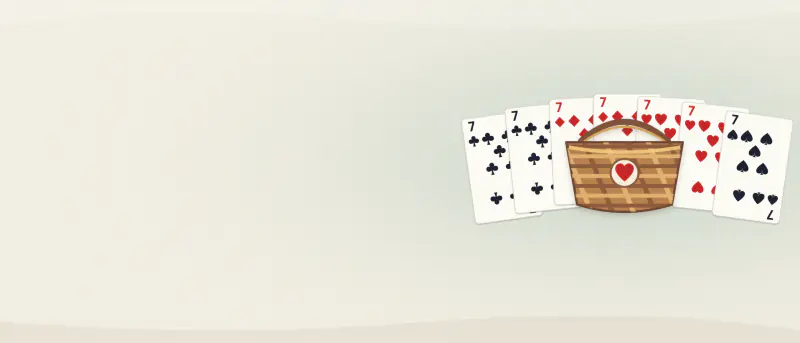
- Seven or more cards in one meld form a canasta. A natural canasta has no wild card and earns 500 bonus points; a mixed canasta contains one to three wild cards and earns 300. Adding a wild card changes a natural canasta into a mixed one.
- A partnership's first meld in a hand must total 15 points from a negative score, 50 from 0–1,495, 90 from 1,500–2,995, or 120 from 3,000 upward. Several melds laid together may meet it; red-three and canasta bonuses never count toward the threshold.
- Before your partnership opens, and whenever a wild card has frozen the discard pile, taking the pile requires two natural cards from hand matching the natural top discard. When unfrozen, one matching natural plus a wild also works, or the top card may extend your existing meld.
- Red threes are exposed immediately and replaced when drawn from the stock. They score 100 each, or 800 for all four, if the team has melded; otherwise the same amount is deducted. A black three on top stops only the next player from taking the pile and has no effect after it is covered.
- Going out earns 100 points and requires at least one completed canasta. Melding the entire hand in one turn without earlier participation, including a new canasta, earns an extra 100 concealed bonus. If the stock is exhausted, the hand ends when play cannot legally continue.
How to Play Canasta: Your First Game
Use this order of thought to get through a complete game quickly.
- Keep natural pairs that can capture a frozen discard pile. The buried cards may be worth far more than a small immediate meld, but remember that the top card must be melded before the rest enters your hand.
- Do not spend wild cards casually. They help open difficult hands and complete mixed canastas, but every meld still needs at least two natural cards and can hold no more than three wilds.
- Watch your partner's melds as shared resources. Adding the sixth natural card can prepare a safe canasta, while adding a wild to a natural canasta permanently lowers its bonus from 500 to 300.
- A red three is not an opening meld. Even several exposed red threes do not unfreeze the pile for your team or help satisfy the initial point requirement.
- Before reducing your hand to one card, confirm that your team already has a canasta. Without one you must keep enough cards to make the mandatory end-of-turn discard and continue playing.
Canasta Strategy
Move from knowing the rules to playing with a plan.
- Discard safety depends on public melds and the frozen state. A rank already melded by an opponent is dangerous on an unfrozen pile; a black three buys one turn, while a discarded wild freezes the pile for longer.
- The initial threshold rises with success, so high-scoring teams must retain concentrated high-value groups rather than scattering aces and faces across speculative ranks.
- Taking a large pile is both opportunity and liability. It can supply several canastas, but all unmelded cards still count against the team if the hand ends first.
- Going out is a partnership decision even when no formal consultation is used. Your partner's remaining cards count against your side, so delaying can be correct when the stock and discard risk are controlled.
- Count the twelve wild cards and eight naturals of each rank. Public melds, discards, and your hand reveal whether a natural canasta remains possible and whether an opponent can hold the pair needed to take a frozen pile.
Canasta Winning and Special Rules
Details that are easy to miss but can change the result.
- The opening threshold has one Classic exception: after drawing from stock, an unmelded player may put down the whole hand (or leave one final discard) without reaching the threshold if that play contains a complete canasta. Taking the discard pile to open never receives this exception.
- The concealed bonus is lost if you add to a meld your partner already had when your turn began. You must build a complete canasta within your own one-turn laydown.
- Black threes cannot form ordinary melds. A group of three or four may be laid without wild cards only as part of the final turn when going out.
- When taking the discard pile for an initial meld, only the top discard and cards supplied from hand count toward the threshold; useful cards buried in the pile cannot be counted first.
- A one-card hand may not take a one-card discard pile. This prevents a draw that would leave no card available for the required use and discard sequence.
- If the final stock card is a red three, it is exposed but cannot be replaced; the hand ends immediately without a meld or discard by that player.
- This game uses worldwide Classic Canasta. Modern American Canasta is a substantially different 13-card, 8,500-point ruleset and is not silently mixed into this mode.
- If both partnerships reach 5,000 in the same hand, the higher cumulative total wins. An exact tie continues to another hand.
Common Canasta Rules Mistakes
The traps new players fall into most often.
- Taking only the top discard. A legal capture always takes the entire pile after the top card is melded.
- Treating a black three as a permanent freeze. In Classic Canasta it blocks only while it remains the top card.
- Counting canasta or red-three bonuses toward the opening minimum. Only the face values of cards laid in the initial meld count.
- Starting a second meld of a rank your partnership already has. Matching cards must extend the existing shared meld.
- Going out without a canasta. Emptying a hand is illegal until the partnership has completed one, including a canasta completed on that final turn.
The Story of Canasta
Where it came from, and why it turned out this way.
OriginMontevideo, Uruguay · 1939 · worldwide boom in the 1950s
A South American game goes worldwide
Canasta emerged in Montevideo in 1939 and travelled through Argentina to North America and Europe. Its late-1940s standardized partnership form became an international phenomenon in the early 1950s, combining the accessibility of matching ranks with a long partnership score arc.
The discard pile is a prize and a trap
Unlike most draw-and-discard games, a player who uses the top discard correctly takes everything beneath it. A pile accumulated over many turns can transform a hand, but every captured card becomes a potential end-of-hand penalty. Freezing and stop cards turn that shared public pile into the table's main strategic contest.
Shared construction
Partners own melds together. One player can begin a rank and the other can finish its canasta; success depends on preserving natural pairs, rationing wild cards, and reading when a partner needs one more card rather than immediate help elsewhere.
Classic, not Modern American
Canasta developed many regional descendants. Modern American Canasta uses a different deal, target, meld restrictions, special hands, and canasta requirements; even the American Canasta Society calls Classic a different game. This table therefore freezes the globally recognized four-player Classic rules as one coherent ruleset.
- Canasta is Spanish for basket, a name that became attached to both the game and its completed seven-card meld.
- A natural canasta's red marker and a mixed canasta's black marker are physical bookkeeping conventions reflected here by clear labels rather than hidden state.
- Red threes score outside ordinary melds, while black threes govern access to the discard pile and may be melded only when going out.