Complete Indian Rummy Rules
Start with what a turn allows and how the game is won.
- Players
- 2 · individual
- Cards
- Two 53-card packs · 13 cards each
- Format
- One Points Rummy deal · maximum 80 penalty
- Each pack has 52 standard cards and one printed Joker, for 106 physical cards. After thirteen cards are dealt to each player, one card starts the open discard pile and another becomes the public Joker indicator. Every standard card of the indicator's rank is wild; if the indicator is a printed Joker, all aces are wild.
- On your turn, draw the top closed card or take the top open discard, then return to thirteen cards by discarding one. A physical card just taken from the open pile cannot be put straight back in the same turn, although a second copy with the same face may be discarded.
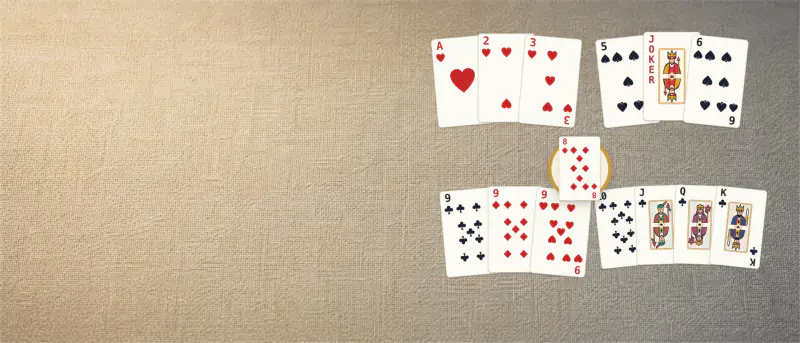
- A pure sequence is three or more consecutive cards of one suit with no Joker substituting for a gap. A wild-rank standard card may still be used naturally at its printed suit and rank. An impure sequence uses wild cards to fill consecutive positions. A set contains equal ranks in different natural suits and may be extended beyond four cards by Jokers.
- Aces may be low in A-2-3 or high in Q-K-A, but sequences never wrap: K-A-2 is invalid. One physical card cannot belong to two groups, even when two deck copies show the same face.
- A declaration is valid only when all thirteen remaining cards form disjoint sequences or sets, with at least two sequences and at least one pure sequence. The Declare action appears only after the rules engine has verified a complete layout.
- The loser counts unmatched cards: 2–9 at face value, 10/J/Q/K/A as 10, and every wild card as 0. With no pure sequence, all cards count. With a pure sequence but no second sequence, only the best pure sequence is protected. After both lives exist, every valid set and sequence is protected. The final penalty is capped at 80.
- Drop before your first draw for 20 points, or after you have drawn at least once for 40. Because this is a two-player deal, a drop immediately awards the game to the opponent. If the last closed card is drawn and no declaration follows, the completed discard ends a void hand for 0–0.
How to Play Indian Rummy: Your First Game
Use this order of thought to get through a complete game quickly.
- Find a natural three-card suited run first. Until the pure sequence exists, even excellent Joker sets do not reduce the worst scoring category.
- Keep adjacent suited pairs such as 6-7 and one-gap pairs such as 6-8. They offer more live completions than isolated high cards and can grow into the second compulsory sequence.
- Use Jokers in the second sequence or in an awkward set after the pure life is safe. Printed and wild-rank Jokers score zero, so they are rarely the card to discard.
- Select a card after every draw and compare the available actions. Declare is shown only when discarding that card leaves a complete legal thirteen-card layout; ordinary Discard continues play.
- A first drop costs 20 rather than risking up to 80, but it also concedes immediately. Consider it only when the opening hand has no credible pure-run structure.
Indian Rummy Strategy
Move from knowing the rules to playing with a plan.
- The pure sequence is a scoring gate, not merely one meld among many. Preserve its natural cards even when a Joker could make the same-looking run, because using the Joker as a substitute changes the run to impure.
- Track open cards the opponent chooses. Avoid discarding the same rank or neighboring cards of that suit; those faces directly support the set or sequence the opponent revealed by taking the discard.
- Duplicate faces are real separate cards. A pair of identical suited cards cannot sit together in a pure run or as two natural suits in one set, but one copy may belong elsewhere or a wild copy may substitute a different position.
- Compare a certain open-card improvement with the unknown closed draw. Higher AI tiers make this same observation-only comparison while respecting two physical copies of every standard face.
- Near the bottom of the stock, prefer a modest legal declaration over waiting for a prettier arrangement: the final closed draw can turn the entire deal into a zero-point void.
Indian Rummy Winning and Special Rules
Details that are easy to miss but can change the result.
- If sevens are wild, 5-6-7-8 of hearts remains a pure sequence when the heart seven is used naturally. A seven of another suit filling the same position is a substitution and therefore makes the run impure.
- A can be at either end but never in the middle of a wrap. A-2-3 and Q-K-A are legal; K-A-2 and K-A-J are not.
- The scoring solver first searches for a pure life and a second sequence, then protects every additional legal meld. If the second life is absent, sets do not become protected merely because they look complete.
- Modern platform scoring uses first drop 20, middle drop 40, wrong declaration 80 and an 80-point cap. The interface prevents wrong declarations; it does not silently mix Pagat's older 10-point first pack and special hand-rummy settlements into this mode.
- Deals Rummy and 101/201 Pools are separate multi-deal formats with chips or elimination. This release intentionally provides the mainstream single-deal Points format only.
Common Indian Rummy Rules Mistakes
The traps new players fall into most often.
- Trying to declare with one pure run and only sets. You still need a second sequence, pure or impure, before the sets can complete a winning hand.
- Treating a wild-rank card as automatically impure. It stays natural only when it occupies its own printed suit and rank; elsewhere it is a substitute.
- Putting two natural cards of the same suit into an equal-rank set just because they came from different decks. Physical duplication does not create a fifth suit.
- Wrapping the ace through both ends of the rank order. Choose low or high for each sequence; never connect king to ace to two.
- Taking the open card and attempting to discard that same physical instance. Choose another card; a separate identical copy is legal because the block follows the instance, not the face.
The Story of Indian Rummy
Where it came from, and why it turned out this way.
TraditionIndia · twentieth-century rummy family
Thirteen cards and two lives
Indian Rummy, often called Paplu in traditional accounts, reshaped draw-and-discard rummy around a distinctive declaration contract. A player must build two sequences, and one must remain pure. Players commonly call these the first and second life: without them, otherwise attractive sets do not make the hand safe.
The moving Joker
Alongside printed Jokers, each deal reveals a rank that becomes wild. The indicator changes the geometry of every hand without changing the rules themselves. A wild-rank card can patch a missing position, yet it can also remain natural when used at its own printed suit and rank—one of the game's most important small distinctions.
A household game becomes an online format
Family tables traditionally attached local stakes and packing conventions to the same thirteen-card core. Large Indian platforms standardized a fast Points format: first and middle drops have fixed costs, an invalid declaration costs the maximum, and ordinary losses are capped at eighty. Deals and Pools then build longer competitions on top of that single-deal grammar.
Why open cards matter
Every discarded card is public evidence. Taking one announces a likely rank or suited neighborhood, while refusing it preserves uncertainty. The deck may be large, but two copies of each face make memory subtler rather than less useful: a visible card is not necessarily exhausted, and an identical physical copy can still be live elsewhere.
- Aces may sit below two or above king, but a sequence cannot wrap through both ends.
- The word 'pure' describes how a Joker is used, not merely whether its printed rank happens to be wild.
- Points, Deals and Pools share the same hand-building core but use different match structures.