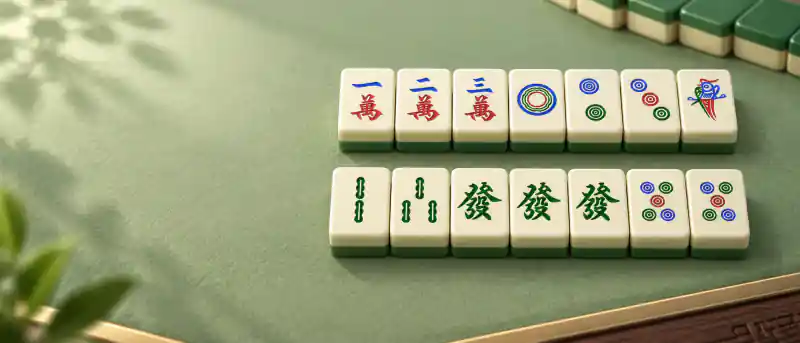
Riichi mahjong is the Japanese way of playing mahjong, and the name comes from its signature move. When your concealed hand is one tile from winning you may declare riichi, put a 1,000-point stick on the table, and play out the hand locked in exchange for an extra scoring condition. Three rules set it apart from Chinese and American styles. A complete hand cannot win unless it also has a yaku, a named scoring condition. A player who has discarded one of their own winning tiles is furiten and cannot win on anyone else's discard. Hands are scored in two units, han and fu, which convert into points through a table. The basics shared by every style (the tiles, drawing and discarding, chi, pon and kan, and four sets plus a pair) are covered on the Mahjong rules page, and this page picks up from there. Riichi has no single rulebook, so wherever this site, the World Riichi Championship (WRC) rules and Japan's M.League differ, the page says so.
What makes riichi different from other mahjong
The short answer is that riichi asks how you won as well as what you hold. Compared with the Chinese Official rules (MCR), which this site also offers:
| Riichi (4 players here) | Chinese Official (MCR) | |
|---|---|---|
| Tiles | 136, with one red five in each suit | 144, including eight flowers |
| Minimum to win | One yaku, of any value | 8 points, flowers not counted |
| Scoring | Han and fu converted into points, capped in bands from 5 han up | Points of every pattern added together |
| Declaring a ready hand | Riichi, optional, costs 1,000 | None |
| Furiten | Yes | No |
| Bonus tiles | Dora, hidden dora, kan dora, red fives | Flowers |
| One discard, several winners | Two may win together, three means a draw | Only the next player in turn wins |
| Starting score and length | 25,000 each, East and South rounds | 500 each, 16 hands |
How a game of riichi mahjong runs
A game is a hanchan: two rounds, East and South, of at least four hands each, starting from 25,000 points apiece. The player with the most points at the end wins.
- Deal. The last 14 tiles of the wall become the dead wall, which supplies replacement tiles for kans and holds the dora indicators (8.13). One indicator is turned face up. The dealer (East) takes 14 tiles and discards first, everyone else takes 13.
- Play. Turns go counter-clockwise, drawing and discarding, with chi from the player on your left and pon or kan from anyone. Swap-calling is forbidden (8.3). After a pon you may not throw the same tile straight back, and after calling a 4 with 2-3 you may not discard the 4 or the 1. The discard that follows the last wall tile can be won on but not called (8.4).
- Riichi. A concealed ready hand may declare, under the conditions below.
- Winning. Win on your own draw (tsumo) or on another player's discard (ron). Here two players can ron the same tile, and if three do the hand is abandoned as a draw.
- After the hand. If the dealer wins, or the wall runs out with the dealer ready (tenpai), the dealer stays on and a continuance counter (honba) is added (9.4, 9.5). Otherwise the deal passes to the right.
- End of the game. The game ends when the fourth hand of the South round is over and the dealer does not repeat. A dealer leading after that last hand plays on if they win again, since there is no stopping early (section 10). On this site the game also ends the moment anyone drops below zero (exactly zero plays on), riichi sticks still on the table at the end go to the leader, and there is no uma or oka.
Riichi · 4 players is what the English Mahjong table starts with. Riichi · 3 players sits among the Rules buttons in the side panel, or behind the rule name shown in the phone toolbar.
Can you win with dora but no yaku?
No, dora add han to a hand that already has a yaku but never count as one. The formula for a riichi win is a complete shape plus at least one yaku. The shape can be four sets and a pair, Seven Pairs (seven different pairs) or Thirteen Orphans. The yaku can come from the tiles, such as All Simples or a dragon triplet, or from the way you win, such as Riichi or a concealed self-draw.
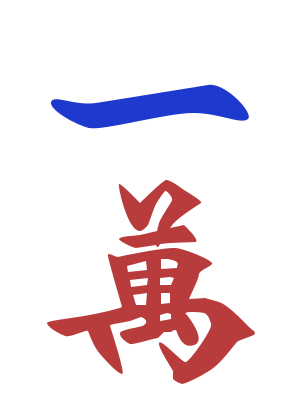
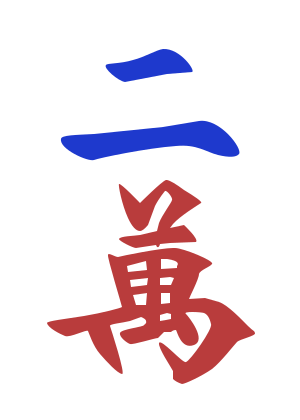
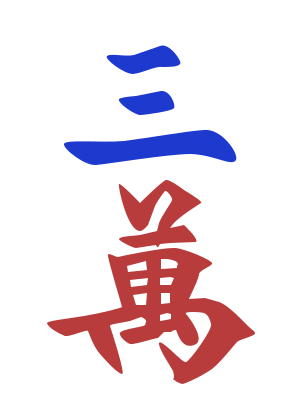
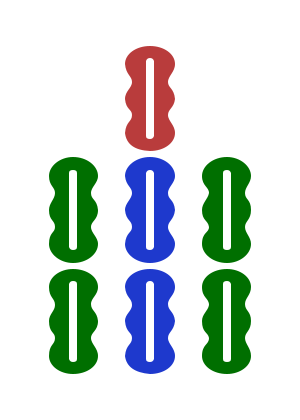

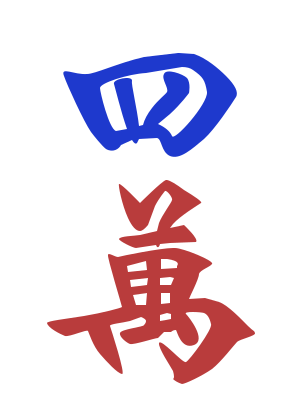
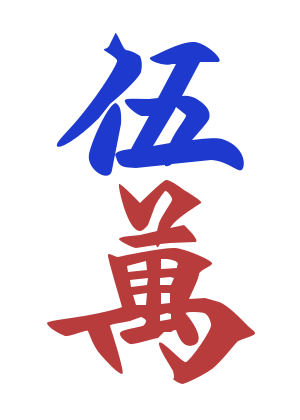
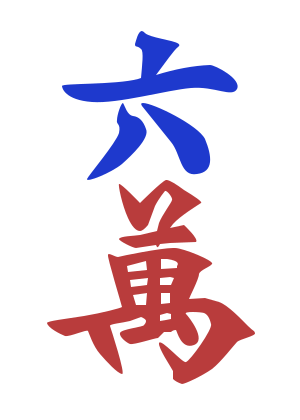
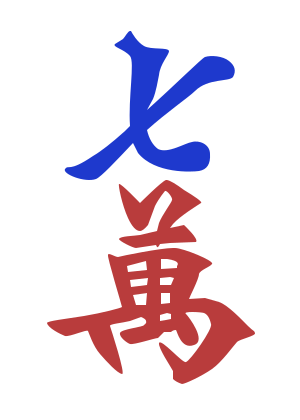
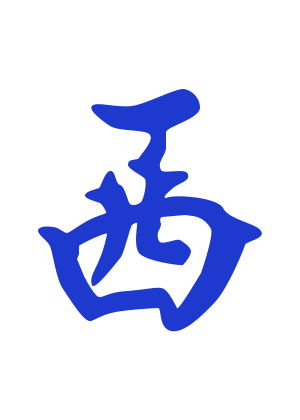 123 Characters was a chi from the left; waiting on 3 or 6 Characters
The West pair is neither this player's seat wind nor the round wind, so it adds nothing. This is the usual way beginners end up with a dead hand: a quick chi to finish a set, which breaks the hand open and leaves no yaku. Before you call, name the yaku you will still have afterwards.
Riichi mahjong hands: the complete yaku list
The site's riichi tables recognise 39 entries, all listed below from the in-game hand chart: 11 common yaku, 14 more, 11 yakuman and 3 bonuses. A few related conditions share a row, such as Riichi with Double riichi.
Whether a yaku survives an open hand matters as much as its value:
| After a call | Yaku |
|---|---|
| Lost (closed hands only) | Riichi, Double riichi, Ippatsu, Concealed self-draw (menzen tsumo), Pinfu, Pure double sequence (iipeikou), Twice pure double sequence (ryanpeikou), Seven pairs; among yakuman, Thirteen orphans, Four concealed triplets, Nine gates, Heavenly and Earthly hands |
| One han less | Mixed triple sequence (sanshoku) and Pure straight (ittsu) 2→1; Mixed outside hand (chanta) 2→1; Pure outside hand (junchan) and Half flush (honitsu) 3→2; Full flush (chinitsu) 6→5 |
| Unchanged | All simples (open tanyao is allowed here), value honors (yakuhai), All triplets, Three concealed triplets, Three kongs, Triple triplets, All terminals and honors, Little three dragons, kong replacement win, Robbing a kong, last-tile wins |
Common yaku
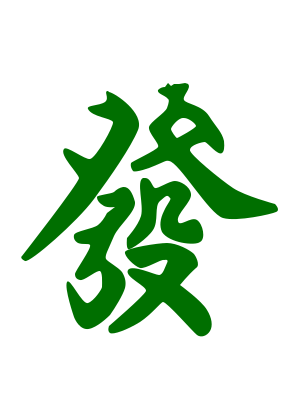
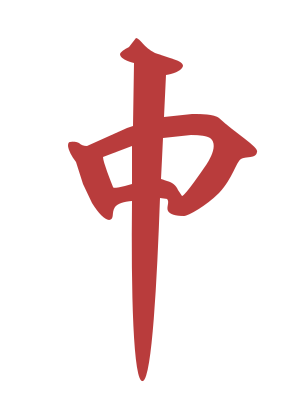
Dragons: White · Green · Red1 han each
A triplet/kong of any dragon; calls allowed. A pair is not enough.

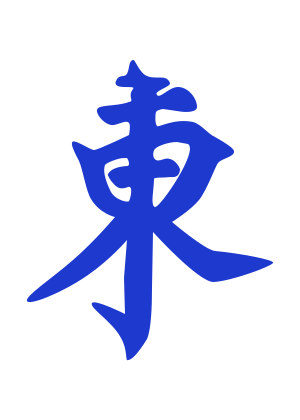
Round-wind triplet/kong1 han
Three or four of the current round wind; calls allowed.
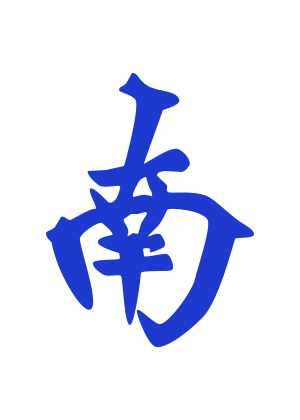
Seat-wind triplet/kong1 han
Three or four of your current seat wind; calls allowed.
Riichi / Double riichi1 / 2 han
Declare with a closed hand one tile from completion: 1 han. Declare on your first discard, before any interrupting call: 2 han.

Closed self-draw · Menzen tsumo1 han
No open calls; draw the tile that completes your hand yourself.
All simples · Tanyao1 han
Only suited 2–8 tiles, no terminals or honors. Open calls are allowed here.
Pinfu1 han
Closed; four sequences; a pair that is neither dragons nor your round/seat wind; win on either end of a sequence wait, such as 67 waiting for 5 or 8.
Seven pairs · Chiitoitsu2 han
Closed, with seven distinct pairs. Four identical tiles are not two pairs.
All triplets · Toitoi2 han
Four triplets/kongs and a pair; calls allowed.
Half flush · HonitsuClosed 3 / open 2 han
One suit together with honors.
Full flush · ChinitsuClosed 6 / open 5 han
Only one numbered suit, with no honors.
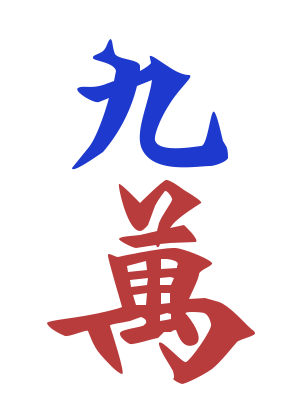
More yaku
Ippatsu1 han
Win in the first uninterrupted cycle after riichi, including your next draw.
Pure double sequence / Twice pure double sequence1 / 3 han
Closed: one pair of identical sequences is 1 han; two such pairs are 3 han.
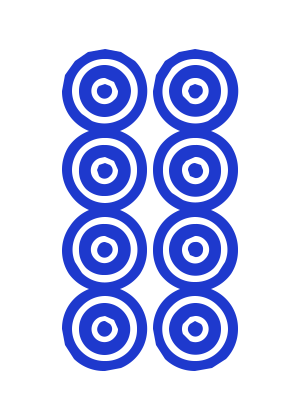
Mixed triple sequence · SanshokuClosed 2 / open 1 han
The same sequence once in each suit.
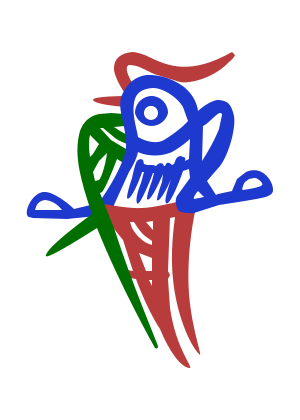
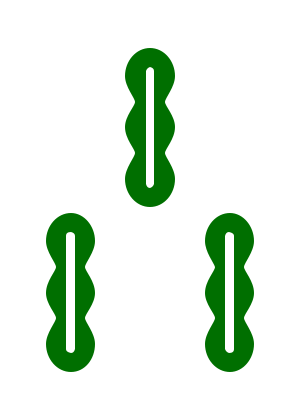
Pure straight · IttsuClosed 2 / open 1 han
123, 456 and 789 sequences in one suit.
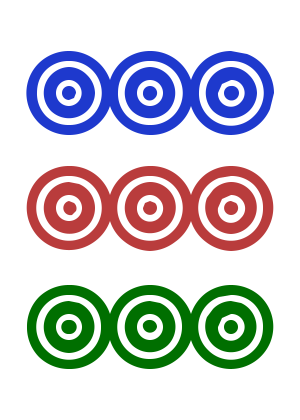
Mixed outside hand · ChantaClosed 2 / open 1 han
Every set and the pair contains a terminal/honor; includes both a sequence and honors.
Pure outside hand · JunchanClosed 3 / open 2 han
Every set and pair contains a terminal, with sequences and no honors.
Three concealed triplets2 han
Three concealed triplets/kongs; the remaining set may be open.
Three kongs2 han
Three declared kongs.
Triple triplets2 han
A triplet/kong of the same rank in all three suits.
All terminals and honors2 han
Only terminals and honors, with no sequences.
Little three dragons2 han
Two dragon triplets/kongs and a pair of the third dragon.
Last-tile draw / Last-discard win1 han
Self-draw on the last live tile, or ron on the final discard.
Kong replacement win1 han
Self-draw on a kong replacement tile; sanma North replacement does not count.
Robbing a kong1 han
Ron on another player's added-kong tile; furiten still applies.
Yakuman and liability payments
A yakuman pays a fixed 32,000 to a non-dealer and 48,000 to the dealer, whatever the han and fu. On this site Thirteen orphans on the 13-sided wait, Four concealed triplets on a pair wait, Pure nine gates and Big four winds count double, two different yakuman in one hand add up, and an ordinary hand that piles up 13 han or more is paid as a single yakuman.
Thirteen orphans · KokushiYakuman / 13-way double
Closed: every terminal and honor once, plus a duplicate. A 13-sided wait is double yakuman.
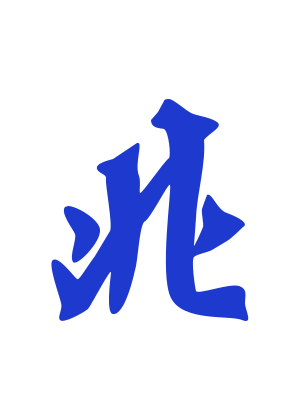
Four concealed tripletsYakuman / pair wait double
Four concealed triplets/kongs; waiting for the pair is double yakuman.
Big three dragonsYakuman
Triplets/kongs of all three dragons.
Little four windsYakuman
Three wind triplets/kongs and a pair of the fourth wind.
Big four windsDouble yakuman
Triplets/kongs of all four winds.
All honorsYakuman
Every tile is an honor.
All greenYakuman
Only 2,3,4,6,8 Bamboo and Green dragons, in a complete hand.
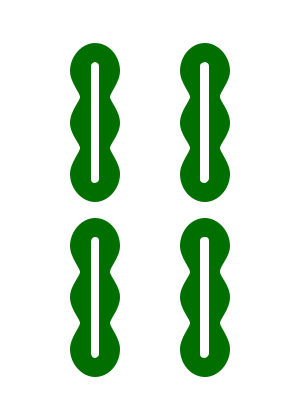
All terminalsYakuman
Only suited 1s and 9s, as four triplets/kongs and a pair.
Four kongsYakuman
Four declared kongs by you, plus a pair.
Nine gatesYakuman / pure double
Closed 1112345678999 plus any tile of that suit; an original nine-sided wait is double yakuman.
Heavenly / Earthly handYakuman
Heavenly: dealer wins initially. Earthly: nondealer wins on the first uninterrupted draw.
Big three dragons and Big four winds carry a liability payment (pao). If two dragon sets (or three wind sets) are already on show and you discard the tile that gets called for the last one, you are liable. Should that player then win by self-draw you pay the whole yakuman yourself, and on a ron you split it with the player who dealt in. Checked with the site's scorer, a non-dealer's self-drawn Big three dragons costs the feeder all 32,000, while a ron off someone else costs the two of them 16,000 each. WRC also applies liability to Four kongs (9.1.1). This site does not.
Dora bonuses and draw payouts
Dora / Red dora / Ura dora+1 han per tile
Bonuses only, not yaku. Ura dora applies only after a riichi win.
Extracted NorthAt least +1 han each
In sanma, choose to set a North aside for a bonus and draw a replacement. It adds han, but you still need a yaku.
Nagashi manganMangan payment
At wall exhaustion, remain closed; all your discards are terminals/honors and none were claimed.
Riichi declaration requirements
You can declare riichi here when four things are true at once. Your hand is closed (concealed kans are fine), one discard leaves it tenpai, you hold 1,000 points or more, and the live wall still has four or more tiles. Turn the declaring discard sideways and put a 1,000-point stick in the middle of the table.
- A furiten hand may still declare, and so may a hand with no other yaku, because Riichi is itself a 1-han yaku.
- From then on the hand is locked. Each tile you draw goes straight out unless it wins, or unless it forms a concealed kan that leaves your wait unchanged (8.9.1). When there is nothing to decide, the table discards the drawn tile for you.
- If someone rons your declaring discard, the riichi never happened and you keep the 1,000 points. If it is merely called for a set, the riichi stands (8.9).
- Ippatsu is one extra han for winning before or on your next draw, provided nobody calls or makes a kan in between. Extracting a North in three-player riichi also breaks it.
- Double riichi is riichi on your very first discard before anyone has called (a concealed kan counts), worth 2 han instead of 1.
- The next player to win collects every riichi stick on the table. After a draw they stay put. When two players ron the same tile, the sticks go to the one nearer the discarder in turn order.
- Only a winner who declared riichi turns over the hidden dora (ura dora).
WRC 2025 drops both thresholds and allows riichi below 1,000 points and with fewer than four tiles left, even on the last draw (8.9). This site keeps them.
Furiten rules: the three kinds
Being furiten stops you winning on discards but never on your own draw, and while it lasts it blocks ron on every one of your waits, not only the tile that caused it (8.11.2).
- Discard furiten. One of the tiles you are waiting on sits in your own discard pond, including a discard someone else later called. Before riichi you can get out of it by changing the hand so none of the new waits is in your pond.
- Temporary furiten. You let a winning discard pass, even one you could not take because the hand had no yaku. It lasts until your next draw. WRC also lifts it when you call a tile; here only a draw does.
- Riichi furiten. You let a winning tile pass after declaring riichi. You cannot ron for the rest of the hand and must win by self-draw.
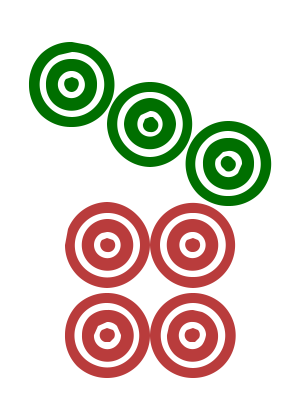
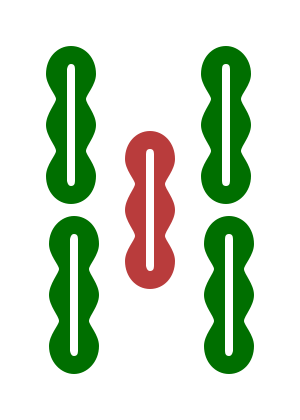 Waiting on 3 or 6 DotsYour own earlier discard
The same rule is the basis of defence, covered below. Nothing in a riichi player's pond, and nothing they have let pass since declaring, can be won on by them.
Dora, ura dora and red fives
A dora is the tile after the face-up indicator, and each one in your hand, in your called sets or in a concealed kan adds 1 han. They add value only. A hand with no yaku stays unable to win however many it holds.
- Suits count up by one, with 9 wrapping round to 1.
- Winds run East, South, West, North and back to East. Dragons run White, Green, Red and back to White.
- Every kan, by any player, turns over another indicator. If two indicators point at the same tile, each copy counts twice (11.4).
- Ura dora are the tiles under the indicators, revealed only for a winner who declared riichi.
- Red fives each add 1 han. There are three in four-player riichi here and two in three-player (Dots and Bamboo). A red five that is also the dora scores both. WRC tournament rules play without red fives.
Indicator 9 Dots, dora 1 DotsIndicator North, dora EastIndicator Red dragon, dora White dragonThree-player: indicator 1 Characters, dora 9 CharactersHow to count fu
Fu start at 20 for any win. You add points for a closed ron, a self-draw, the wait, the pair and every triplet or kan, then round the total up to the next ten (11.3). Seven pairs is always exactly 25 fu.
| Source | Fu |
|---|---|
| Winning at all | 20 |
| Ron with a closed hand | +10 |
| Self-draw (not with Pinfu) | +2 |
| Edge, middle or pair wait | +2 |
| Pair of dragons, your seat wind or the round wind | +2; for a double wind (your seat wind matching the round) +4 here, +2 under WRC |
| Open hand with nothing beyond the 20 | counted as 30 |
| Triplets and kans | 2 to 8 | Terminals and honors |
|---|---|---|
| Open triplet (pon) | 2 | 4 |
| Concealed triplet | 4 | 8 |
| Open kan (including an added kan) | 8 | 16 |
| Concealed kan | 16 | 32 |
Sequences score nothing. A triplet completed by ron counts as open, and one completed by your own draw counts as concealed. Pinfu therefore always comes to 20 fu on a self-draw and 30 fu on a ron.
Worked example: a closed ron at 40 fu
Non-dealer in riichi, middle wait on 5 BambooThe player opposite discards 5 Bamboo: ronDora indicator 4 Bamboo, so 5 Bamboo is doraWithout the riichi this hand has no yaku at all. The 9s rule out All simples and the middle wait rules out Pinfu.
Worked example: a concealed kan at 60 fu
Concealed kan of 1 CharactersNon-dealer in riichi, waiting on 2 or 5 BambooSelf-drawn 2 BambooWon by ron on the same 2 Bamboo, the hand is 20 + 10 + 32 = 62, rounded to 70 fu, but it loses the self-draw yaku and pays 2,300 for 1 han 70 fu. A kan adds no han, but it moves fu a long way.
Riichi mahjong scoring table
Look up han against fu. One han and 30 fu earn a non-dealer 1,000 on a ron and the dealer 1,500, and from 5 han up fu stop mattering and the hand is paid by band. In each cell the first number is a ron and the bracket shows a self-draw, written as non-dealers' share / dealer's share for a non-dealer win. Every value matches the site's scorer.
Non-dealer wins:
| Fu | 1 han | 2 han | 3 han | 4 han |
|---|---|---|---|---|
| 20 | — | self-draw only (400/700) | self-draw only (700/1,300) | self-draw only (1,300/2,600) |
| 25 | — | 1,600 (—) | 3,200 (800/1,600) | 6,400 (1,600/3,200) |
| 30 | 1,000 (300/500) | 2,000 (500/1,000) | 3,900 (1,000/2,000) | 7,700 (2,000/3,900) |
| 40 | 1,300 (400/700) | 2,600 (700/1,300) | 5,200 (1,300/2,600) | mangan |
| 50 | 1,600 (400/800) | 3,200 (800/1,600) | 6,400 (1,600/3,200) | mangan |
| 60 | 2,000 (500/1,000) | 3,900 (1,000/2,000) | 7,700 (2,000/3,900) | mangan |
| 70 | 2,300 (600/1,200) | 4,500 (1,200/2,300) | mangan | mangan |
| 80 | 2,600 (700/1,300) | 5,200 (1,300/2,600) | mangan | mangan |
| 90 | 2,900 (800/1,500) | 5,800 (1,500/2,900) | mangan | mangan |
| 100 | 3,200 (800/1,600) | 6,400 (1,600/3,200) | mangan | mangan |
| 110 | 3,600 (900/1,800) | 7,100 (1,800/3,600) | mangan | mangan |
Dealer wins:
| Fu | 1 han | 2 han | 3 han | 4 han |
|---|---|---|---|---|
| 20 | — | self-draw only (700 all) | self-draw only (1,300 all) | self-draw only (2,600 all) |
| 25 | — | 2,400 (—) | 4,800 (1,600 all) | 9,600 (3,200 all) |
| 30 | 1,500 (500 all) | 2,900 (1,000 all) | 5,800 (2,000 all) | 11,600 (3,900 all) |
| 40 | 2,000 (700 all) | 3,900 (1,300 all) | 7,700 (2,600 all) | mangan |
| 50 | 2,400 (800 all) | 4,800 (1,600 all) | 9,600 (3,200 all) | mangan |
| 60 | 2,900 (1,000 all) | 5,800 (2,000 all) | 11,600 (3,900 all) | mangan |
| 70 | 3,400 (1,200 all) | 6,800 (2,300 all) | mangan | mangan |
| 80 | 3,900 (1,300 all) | 7,700 (2,600 all) | mangan | mangan |
| 90 | 4,400 (1,500 all) | 8,700 (2,900 all) | mangan | mangan |
| 100 | 4,800 (1,600 all) | 9,600 (3,200 all) | mangan | mangan |
| 110 | 5,300 (1,800 all) | 10,600 (3,600 all) | mangan | mangan |
| Band | Han | Non-dealer | Dealer |
|---|---|---|---|
| Mangan | 5, or 4 han from 40 fu, or 3 han from 70 fu | 8,000 (2,000/4,000) | 12,000 (4,000 all) |
| Haneman | 6–7 | 12,000 (3,000/6,000) | 18,000 (6,000 all) |
| Baiman | 8–10 | 16,000 (4,000/8,000) | 24,000 (8,000 all) |
| Sanbaiman | 11–12 | 24,000 (6,000/12,000) | 36,000 (12,000 all) |
| Yakuman | a yakuman, or 13 han and up | 32,000 (8,000/16,000) | 48,000 (16,000 all) |
The table comes from one formula. The base is fu × 2^(han + 2), capped at 2,000, which is mangan. A ron costs the discarder 4 times the base, or 6 times for a dealer's hand. On a self-draw the dealer pays twice the base and each non-dealer once, and when the dealer self-draws everyone pays twice. Each payment rounds up to the hundred. Every honba adds 300 to a ron, or 100 from each payer on a self-draw.
This site does not round 4 han 30 fu or 3 han 60 fu up to mangan: both are 7,700, or 11,600 for the dealer. WRC rounds a base of 1,920 up to 2,000 and pays them as mangan, 8,000 (11.2).
Draws: noten payments, nagashi mangan and abortive draws
When the wall runs out and nobody wins on the final discard, the players who are not tenpai pay 3,000 points between them to those who are, and the dealer stays on if tenpai (9.2).
| Players tenpai | Each noten player pays | Each tenpai player gets |
|---|---|---|
| 1 | 1,000 | 3,000 |
| 2 | 1,500 | 1,500 |
| 3 | 3,000 | 1,000 |
| 0 or 4 | nothing | nothing |
Only the shape counts, so a ready hand with no yaku is tenpai. The table decides who is tenpai for you, which means you cannot hide a ready hand by declaring noten as WRC allows, and a wait on a tile whose four copies are all in your own hand does not count. A honba is added and riichi sticks stay on the table for the next winner.
Nagashi mangan exists here but not under WRC. If at an exhaustive draw every one of a player's discards is a terminal or honor, none was called, and that player made no open call, they are paid a self-drawn mangan (2,000/4,000, or 4,000 all for the dealer) with no honba, and the normal noten payments are skipped.
Abortive draws end a hand early. WRC has none (section 9), and this site has five:
- Nine terminals. On your first draw, before anyone has called, a hand holding nine or more different terminals and honors may abandon the deal. You can also keep it and go for Thirteen orphans.
- Four winds. All four first discards are the same wind. Four-player only.
- Four riichi. Every player has declared riichi (all three in three-player) and nobody wins on the last declaring discard.
- Four kongs. Four kans have been made by more than one player and the next discard is not won on. Four kans by a single player play on, since that hand is going for Four kongs.
- Triple ron. Three players ron the same tile.
After an abortive draw the dealer stays and a honba is added.
Three-player riichi (sanma) rules
Three-player riichi on this site uses 108 tiles with the 2 to 8 of Characters removed, starts each player on 35,000, allows no chi and lets you set Norths aside as bonus tiles. Yaku, fu and furiten work exactly as in the four-player game. What changes:
- Tiles. Only 1 and 9 remain in Characters, and the red fives are the 5 Dots and 5 Bamboo. A 1 Characters indicator makes 9 Characters the dora, and a 9 makes the 1.
- Length. East 1 to 3, then South 1 to 3, with dealer repeats adding hands as usual.
- No chi. Pon and kan are allowed. Characters cannot form sequences, so Mixed triple sequence is impossible.
- North extraction (nukidora). After drawing, you may set a North aside, draw a replacement and gain 1 han per North, more when a West indicator makes North the dora. It keeps the hand closed but breaks ippatsu, the replacement draw is not a kong replacement win, after riichi only a freshly drawn North can go, and only Thirteen orphans can rob it. North is nobody's seat wind, so a North triplet is not a yaku.
- Self-draws pay less. The missing fourth player's share is simply not paid. A non-dealer's mangan self-draw collects only 6,000, with the dealer paying 4,000 and the other player 2,000. A ron is unchanged at 8,000.
- Honba. 300 on a ron, 100 from each of the two payers on a self-draw.
- Draws. Noten payments still total 3,000, three riichi declarations abort the hand, and there is no four-winds draw.
| Mangan by self-draw | Four players | Three players |
|---|---|---|
| Non-dealer wins | 4,000 + 2,000 + 2,000 = 8,000 | 4,000 + 2,000 = 6,000 |
| Dealer wins | 4,000 × 3 = 12,000 | 4,000 × 2 = 8,000 |
Riichi rule variations: this site, WRC and M.League
There is no single worldwide riichi ruleset, and the differences that most often catch players out are red fives, mangan rounding, double ron, abortive draws and nagashi mangan. WRC is the international tournament ruleset and M.League the Japanese professional team league; a dash means that ruleset's published text does not cover the point.
| Rule | This site | WRC 2025 | M.League |
|---|---|---|---|
| Starting points | 25,000 | 30,000 (6.1) | 25,000 (ch. 6 art. 1) |
| Red fives | three | none (section 2) | three (ch. 1 art. 2) |
| Open tanyao | yes | yes (section 2) | — |
| 4 han 30 fu | 7,700, no rounding | mangan (11.2) | mangan (ch. 6 art. 4) |
| Same discard, several winners | two win; three is a draw | one winner, by turn order (9.1) | one winner, by turn order (ch. 5 art. 1) |
| Abortive draws | five kinds | none (section 9) | none (ch. 3 art. 2) |
| Nagashi mangan | yes | no (section 2) | — |
| Double-wind pair | 4 fu | 2 fu (11.3) | 2 fu (ch. 6 art. 3) |
| Riichi needs 1,000 points and 4 tiles left | yes | no (8.9) | — |
| Temporary furiten ends on | your next draw | your next draw or call (8.11.2) | — |
| Thirteen orphans robbing a concealed kan | allowed | forbidden (8.11.1) | — |
| Liability payment | Big three dragons, Big four winds | those two and Four kongs (9.1.1) | same three as WRC (ch. 8 art. 1) |
| Double yakuman for special waits | yes | no (section 2) | — |
| Score below zero | game ends | play on (9.3) | play on (ch. 3 art. 2) |
| Riichi sticks left at the end | to the leader | left on the table (10.2) | to the leader after a final draw (ch. 6 art. 2) |
If you come from tournament play, the two that will surprise you here are 4 han 30 fu staying at 7,700 and double ron.
Japanese mahjong rules for beginners: two hands to learn first
Start with two plans. One is to keep the hand closed and declare riichi as soon as it is ready, and the other is All simples, every tile 2 to 8, which here may include called sets. Both are reachable from most starting hands and both guarantee a yaku.
Closed riichi. Throw lone honors and isolated 1s and 9s first, but hold a pair of dragons, your seat wind or the round wind, since a third copy makes a value triplet and gives you a third plan. Do not call anything. When you are one tile away, declare. The hand is then automatic, which leaves you free to watch the table.
All simples. If your starting hand is mostly middle tiles, get rid of terminals and honors early, then pon pairs and chi runs freely. A chi of 1-2-3 ends the plan, because every set must stay inside 2 to 8.
The habit both plans teach is naming your yaku before every call. The Hand Coach on the table shows how your current hand can qualify and marks each winning tile as Discard win, Self-draw only or Cannot win yet, which makes a missing yaku or furiten obvious. Hand patterns & guide has the illustrated yaku list, and the hand result after every hand lists each yaku with its han, the fu and the dora indicators.
Riichi strategy: tile efficiency and safe tiles
Two-sided, middle and edge waits
The more tiles that complete your hand, the better your chances. A two-sided wait takes two tile types, up to eight tiles. A middle wait, an edge wait and a pair wait each take one, so four at most. A double-pair wait (shanpon) takes two types, but only two of each remain, four in total.
Two-sided: 3 or 6 DotsMiddle: only 5 BambooEdge: only 3 CharactersDouble pair: 7 Dots or 9 BambooPair wait: only another 5 DotsWith a poor wait and a yaku already in hand, it can pay to stay silent (dama) and declare only once the wait improves, or to wait for an unsuspecting discard.
Genbutsu and suji against a riichi
When an opponent declares and your own hand is slow and cheap, switch to safe discards. The safest are genbutsu: tiles in the riichi player's own pond, plus any tile discarded since their declaration that they let pass. Furiten means they cannot ron on these. They are safe against that one player only.
Next come suji tiles. If the riichi player has discarded a 4, they cannot be waiting two-sided on 2-3 for 1-4 or on 5-6 for 4-7, because the 4 would make them furiten. So 1 and 7 of that suit are safe from two-sided waits. Suji come in three lines: 1, 4 and 7; 2, 5 and 8; 3, 6 and 9. Middle, edge, pair and double-pair waits can still hit a suji tile, so it is safer rather than safe. An honor with three copies already visible can only be won on by a pair wait or Thirteen orphans.
Riichi rules people get wrong
| Belief | Actual rule | Where |
|---|---|---|
| Three dora are enough to win | Dora are not yaku; a hand with none still cannot win | WRC 11.4; site scorer |
| A closed ready hand is riichi automatically | You must declare and pay 1,000 | WRC 8.9 |
| Furiten means you cannot win this hand | It only blocks ron; self-draw still wins | WRC 8.11.2 |
| Only the tile in your pond is blocked | Every one of your waits is blocked | WRC 8.11.2 |
| Passing a winning tile after riichi wears off next turn | Riichi furiten lasts for the rest of the hand | WRC 8.11.2 |
| Seven pairs can include two identical pairs | All seven pairs must be different | WRC 11.5.2; site rules |
| Pinfu and Pure double sequence survive a call | Both need a closed hand | WRC 11.5.1 |
| A double-pair wait counts for Pinfu | Pinfu needs a two-sided sequence wait | WRC 11.5.1 |
| 1 han is always 1,000 points | It depends on fu: 1,000 at 30, 1,300 at 40, 2,300 at 70 | site scorer |
| 4 han 30 fu is mangan | 7,700 here; WRC and M.League round it to 8,000 | WRC 11.2; site scorer |
| The indicator tile is the dora | The next tile in sequence is | WRC 8.13 |
| You can chi in three-player | Sanma has pon and kan but no chi | site rules |
Riichi mahjong rule sheet
| Topic | Rule |
|---|---|
| To win | A complete shape (four sets and a pair, or one of the special shapes) plus at least one yaku; dora are not yaku |
| Riichi | Closed and tenpai, 1,000 points or more, 4+ tiles in the wall; pay 1,000; then draw and discard only |
| Furiten | A wait in your own pond, or a winning discard let pass: no ron, self-draw still wins; after riichi it lasts the hand |
| Dora | The tile after the indicator; 9 → 1; East → South → West → North; White → Green → Red; ura dora only after riichi |
| 1 han | Riichi, Ippatsu, Concealed self-draw, Pinfu, All simples, value honor, Pure double sequence |
| 2 han | Seven pairs, All triplets, Three concealed triplets, Mixed triple sequence, Pure straight (closed) |
| 3+ han | Half flush 3, Full flush 6 (closed) |
| Fu | 20 base; closed ron +10; self-draw +2; edge, middle or pair wait +2; value pair +2; triplets and kans 2–32; round up to 10; Seven pairs 25 |
| Bands | Mangan 5 han; haneman 6–7; baiman 8–10; sanbaiman 11–12; yakuman 13+ or a yakuman yaku |
| Honba | +300 on ron; +100 per payer on self-draw |
| Exhaustive draw | Noten players pay 3,000 in total to tenpai players; a tenpai dealer stays on |
| Han | Non-dealer ron, 30 fu | Non-dealer ron, 40 fu | Dealer ron, 30 fu | Dealer ron, 40 fu |
|---|---|---|---|---|
| 1 | 1,000 | 1,300 | 1,500 | 2,000 |
| 2 | 2,000 | 2,600 | 2,900 | 3,900 |
| 3 | 3,900 | 5,200 | 5,800 | 7,700 |
| 4 | 7,700 | 8,000 | 11,600 | 12,000 |
Riichi rule sources
- WRC Rules 2025, the World Riichi Championship rulebook, version of 26 May 2025. Section numbers on this page refer to it.
- M.League rules, published by the Japanese professional team league, used here for comparison only.