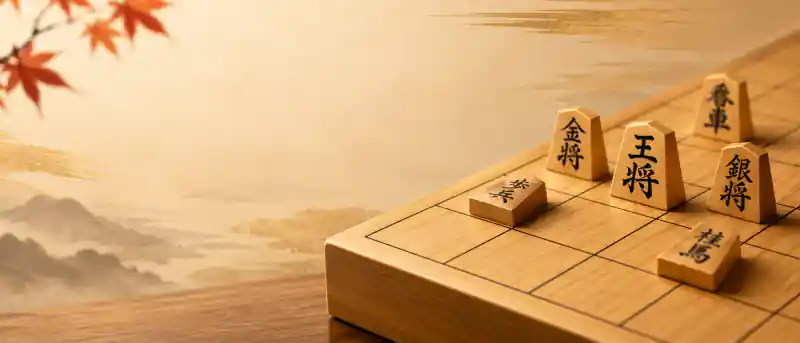
Complete Shogi (Japanese Chess) Rules
Start with what a turn allows and how the game is won.
- Board
- 9 × 9 squares
- First move
- Sente (Black)
- Character
- Captured pieces can be dropped back
- The goal is to force the opposing king into a position where check cannot be answered. A player who has no legal move at all on their turn also loses. Shogi has no stalemate, and no draw for insufficient material.
- The rook slides any distance orthogonally and the bishop any distance diagonally, neither jumping over pieces. The gold general moves one square in six directions — forward, sideways, backward, and the two forward diagonals. The silver general moves one square in five directions — straight forward and all four diagonals. The knight jumps only to the two squares two ranks forward and one file to either side, and it is the only piece that can jump. The lance slides any distance straight forward only. The pawn moves one square straight forward and captures the same way, with no diagonal capture at all.
- The promotion zone is the three ranks on your opponent's side. Any move that starts or ends inside that zone may promote. A promoted rook (dragon king) keeps its rook moves and adds one square diagonally; a promoted bishop (dragon horse) keeps its bishop moves and adds one square orthogonally; promoted silvers, knights, lances, and pawns all move exactly like a gold general. Kings and golds never promote, and a promoted piece can never revert.
- Promotion is normally optional, but a pawn or lance reaching the last rank and a knight reaching either of the last two ranks must promote, since otherwise the piece would have no legal move ever again. This page shows the "Promote?" prompt only when both choices are legal; when only one is available, it happens automatically.
- A captured piece has its promotion stripped — a dragon king becomes a rook again, a tokin becomes a pawn — and enters the capturer's hand. On any later turn you may forgo moving a piece on the board and instead drop one piece from hand onto an empty square. Dropped pieces always arrive unpromoted; you can never promote on the drop itself.
- Drops obey four restrictions. Nifu: you may not have two of your own unpromoted pawns on the same file, though pawns already promoted to tokin do not count. Dead pieces: pawns and lances may not be dropped on their last rank, and knights not on either of the last two. Uchifuzume: you may not deliver checkmate with a dropped pawn, although the identical mate delivered by pushing a pawn already on the board is perfectly legal. In addition, no drop is legal while you are in double check — only a king move can answer that.
How to Play Shogi (Japanese Chess): Your First Game
Use this order of thought to get through a complete game quickly.
- Start by learning to read piece orientation. Both sides use the same wedge-shaped pieces pointing toward the opponent, and the ones whose characters face you are yours. The same kanji for "gold" belongs to both players on the board, distinguished by direction rather than color.
- In practice Sente's first move is almost always one of two: pushing the 7th-file pawn to open the bishop's diagonal, or pushing the 2nd-file pawn to prepare a rook advance. Playing P-7f, P-2f, P-2e puts you straight into the most common static-rook opening.
- Move your king to safety before attacking. The simplest castle is the Boat: K-6h, G-7h, G-5h takes only three or four moves to get the king off the central file. For something sturdier, build the Mino: after swinging the rook to the left, walk the king K-4h, K-3h, K-2h, then add a silver on 3h and a gold on 5h.
- The Climbing Silver is the easiest attack to learn: after P-2f and P-2e, walk the silver from 3i via 3h and 2g to 2f, then push P-2d to trade pawns and pile the rook and silver onto the second file. The whole plan takes under ten moves, and when it works you usually end up holding a pawn and a silver in hand — the two most useful drops in the game.
- Every time it is your turn, check both players' hands first. If your opponent holds a gold or a silver, any empty square beside your king can be occupied instantly. If they hold a rook, any open file can suddenly be invaded from nowhere.
- Learn the most basic mate, the head gold: when the enemy king's retreat squares are blocked by its own pieces or the board edge, drop a gold directly in front of it. As long as that gold is defended by one of your pieces, it is checkmate. Note that the very same square filled by a dropped pawn instead would be illegal.
Shogi (Japanese Chess) Strategy
Move from knowing the rules to playing with a plan.
- Match your castle to your attack. Static rook pairs with the Boat or the Yagura; ranging rook — swinging the rook to the center or the left — pairs with the Mino. Mismatched formations usually leave you unable to attack and unable to defend at the same time.
- The rule of thumb is that an attack needs four attacking pieces: rook, bishop, silver, and knight. Attacks with fewer than four generally get eaten alive by the defender's golds and silvers, while an extra gold is worth more sitting next to your own king than joining the assault.
- Use cheap pieces from hand to seize the initiative. A dangling pawn dropped in front of the enemy camp threatens to promote to tokin next move; a striking pawn dropped in front of a gold or silver forces it to commit; a bottom-rank pawn dropped on your own back rank patches a rook invasion. Each spends one pawn to buy a move your opponent must answer.
- Count pieces in hand when evaluating a trade. Capturing a silver does not merely remove a silver from the board — it hands you a silver that can appear on any empty square. Nominally even exchanges in shogi usually favor the attacker, because they convert fixed material into freely placeable material.
- The endgame is a race in tempo, not in material. Count how many moves you need to mate and how many your opponent needs: if you are one move ahead, finish with consecutive checks and a tsume threat your opponent cannot escape; if you are behind, either sacrifice to slow them down or spend one move making their mate one move longer.
- The realistic escape for a losing side is entering the enemy camp. Once the king reaches your opponent's third rank, their rooks, bishops, lances, and knights mostly lose their attacking angles, and the game tends to shift toward a declaration or a long stand-off.
Shogi (Japanese Chess) Winning and Special Rules
Details that are easy to miss but can change the result.
- Checkmate, or having no legal move at all on your turn, loses the game for that side. Shogi has no stalemate, and it never draws automatically for lack of material.
- The fourth occurrence of the same position is sennichite, a draw. "Same position" means identical board placement, identical pieces in both hands, and the same side to move. However, if one side gave check on every one of its moves between those occurrences, that side loses instead of the game being drawn.
- Entering-king declaration follows the 27-point rule used in amateur tournaments and computer shogi. The Japan Shogi Association's professional rule is different: 31 points or more wins, and 24 to 30 means a replay. A declaration requires all of the following at once: it is your turn; your king is inside the opponent's three ranks; you have at least ten other pieces inside those three ranks; you are not currently in check; and your point total reaches 28 for Sente or 27 for Gote. Only your pieces inside those three ranks and your pieces in hand count: 5 each for rook, bishop, dragon king, and dragon horse, 1 for every other piece, and nothing for the king. When all conditions hold, a declaration button appears — clicking it is a win for the declaring side, not a draw.
- If the game reaches 500 moves with no check in progress at that moment, it is scored as a draw.
- The board edge is labeled 9 to 1 horizontally and a to i vertically, and the move list uses the matching Western notation: P-7f moves a pawn to square 7f, and Bx2b captures on 2b. A trailing "+" marks a promotion, "=" marks an explicit refusal to promote, and "" marks a drop from hand, as in G5b.
Common Shogi (Japanese Chess) Rules Mistakes
The traps new players fall into most often.
- Assuming pawns capture diagonally out of chess habit. A shogi pawn captures only the square straight ahead, so blocking it with a piece on the forward diagonal accomplishes nothing.
- Miscounting nifu when dropping a pawn: the file is blocked if it still contains one of your unpromoted pawns, but a pawn already promoted to tokin does not count — and the two are easy to confuse at a glance.
- Treating a dropped-pawn mate as a finisher. Mate delivered by a pawn from hand is illegal and the interface simply will not offer that square, while the identical mate produced by advancing a pawn already on the board is entirely legal.
- Building a castle without developing attackers, or the reverse — committing every gold and silver to the attack and leaving the king naked while the opponent holds a full hand of drops.
- Promoting when you should have declined. A silver that promotes to gold loses its diagonal retreats, and in many positions the unpromoted silver is the more useful piece. With knights and lances, calculate in advance so you do not push them so deep that forced promotion is the only option left.
- Judging safety from the visible pieces alone and forgetting what your opponent holds in hand. In shogi, no empty square is ever permanently safe.
The Story of Shogi (Japanese Chess)
Where it came from, and why it turned out this way.
OriginJapan; attested by the Heian period, drops settled c. 15th–16th c.
Why the pieces have no color
Notice a small thing first: both players use identical wedge-shaped wooden pieces, and ownership is shown only by which way the point faces. That is not a manufacturing shortcut — it is the physical precondition for the entire ruleset. A captured piece only has to be turned around to serve its captor. The drop rule, shogi's single most distinctive feature, became designable only because the pieces were already shaped this way.
Drops changed everything
Chaturanga reached Japan around the Heian period, and early Heian shogi had no drops at all. The rule settled somewhere in the 15th to 16th century, and from that moment shogi parted ways with every relative it had: pieces never really leave the game, exchanges no longer simplify the position, and every empty square beside your king can sprout an enemy from nowhere. A popular account ties this to the practice of defeated soldiers changing sides during the warring-states period — an appealing story, but not one supported by firm evidence.
Three drop restrictions, all cleaning up after the same rule
Nifu, dead pieces, and uchifuzume look like an arbitrary trio, but each patches a specific hole. Banning two unpromoted pawns on one file prevents building an impenetrable pawn wall. Banning pawn, lance, and knight drops onto squares they could never leave prevents manufacturing permanently frozen blockers. And banning mate delivered by a dropped pawn is a pure balance-and-aesthetics convention, since the identical mate produced by pushing a pawn already on the board is completely legal.
From the hereditary schools to Fujii
Around 1607 the Tokugawa shogunate began supporting professional players and established the title of Meijin, giving shogi three centuries of institutional continuity. The modern professional system inherited that tradition, and the eight major title matches remain among the most closely followed intellectual competitions in Japan. In 2017 the program Ponanza defeated Meijin Amahiko Sato, ending human supremacy — and, interestingly, young players then adopted engines as teachers, visibly accelerating the development of Sota Fujii's generation.
- The entering-king declaration is a finish unique to shogi: once a king reaches the far camp neither side can realistically mate, so the game is settled by counting material points instead.
- Shogi's branching factor far exceeds chess's precisely because of drops — every extra piece in hand adds dozens of legal moves at any moment.
- The Japan Shogi Association was founded in 1924, the same year as the international chess federation, and the modern rank and licence system took shape around then too.