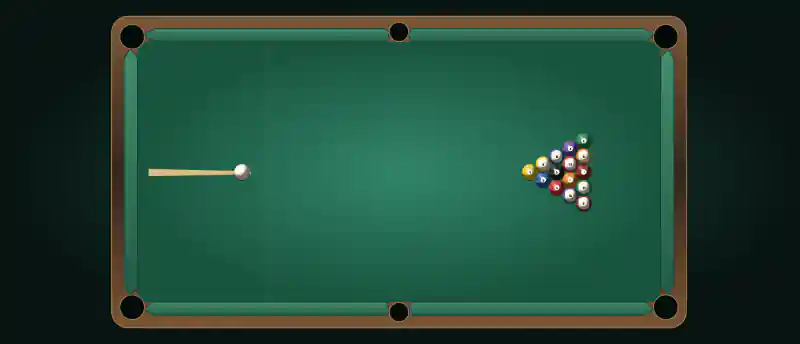
Complete 8 Ball Pool Rules
Start with what a turn allows and how the game is won.
- Table
- Six pockets, one cue ball and fifteen object balls
- Opponent
- Four computer levels or local two-player
- Controls
- Direction, power and cue-ball contact
What Is the Difference Between Chinese 8-Ball and American 8-Ball?
Both use one cue ball and the same fifteen object balls, and both end on the eight. American eight-ball asks you to call a ball and a pocket on every shot after the break, and offers a safety declaration. Chinese eight-ball — heyball — requires no called pockets, the eight included, and is played on a table with tighter pocket jaws, so the same angle is less forgiving. Group assignment after an open break and the choices available after a break foul also differ, and a Chinese break on this page requires at least 50% power.
Is 8-Ball Pool the Same Thing as Billiards?
Eight-ball is one game within pool, which is also called pocket billiards. "Billiards" is the wider term and can also mean carom billiards, played on a pocketless table, so every game of eight-ball is billiards but not every billiards game is eight-ball. This page plays eight-ball only, in its American and Chinese variants.
Do You Have to Call the Pocket on the Eight Ball?
Under American rules yes: pocketing the eight in an uncalled pocket loses the rack. Under Chinese rules no call is needed for the eight or for any other ball. In both variants the eight may only be played after your own group is cleared, and a foul while pocketing it loses the rack.
- The table remains open after the break. Potting a solid on the break does not assign solids. American rules assign groups on a subsequent legally called pot; Chinese rules use legal first contact and the balls pocketed. Solids are 1–7 and stripes are 9–15.
- On a normal shot, contact a legal object ball first. After contact, a ball must be pocketed or reach a cushion. Scratching, missing all balls or hitting an illegal ball first is a foul. Wait until all balls stop before the next shot.
- American eight-ball requires a called ball and pocket after the break; you may also declare safety. Chinese eight-ball does not require called pockets, including for the eight. Potting an opponent’s ball after legal first contact is not automatically a wrong-first foul.
- A normal foul gives the opponent ball in hand anywhere on the table. Break fouls have their own choices, including accepting the table, playing from behind the head string or re-racking. The available choices follow the selected rules.
- For ball in hand, drag the cue ball to a clear spot and release. It cannot overlap another ball, a cushion or a pocket. Behind-the-line placement is restricted to the highlighted area; directly playing a ball behind the line is restricted, with a spotting option when all legal targets are behind it.
- Play the eight only after clearing your group. An early eight, a foul while pocketing it, or pocketing it in an uncalled pocket under American rules loses the rack. A foul with the eight still on the table does not by itself lose the rack.
- A break without a pot requires at least four object balls to reach cushions. Potting the eight on the break offers special spotting or re-racking choices, rather than an immediate win. This browser version requires at least 50% power for a Chinese break.
How to Play 8 Ball Pool: Your First Game
Use this order of thought to get through a complete game quickly.
- Choose the object ball and pocket before aiming the cue ball. Tap for coarse aim; drag farther from the cue ball for finer adjustments. You can lift your finger and grab again without resetting the angle.
- Pull the cue on the right downward to select power, then release to shoot. Return it near its starting point before releasing to cancel. Begin with moderate power and watch where the cue ball stops.
- Tap the small cue ball to choose contact: top for follow, bottom for draw and left or right for sidespin. Contact returns to centre after a shot. Learn centre-ball pots before adding spin.
- A brief thin white outline marks legal first-contact targets. A red warning marks a potentially illegal first hit, not the difficulty of a pot. A/D adjust aim, W/S increase or decrease power, and Space shoots. Hold a key to keep adjusting; hold Shift for finer steps. With the table focused, arrow keys also work without scrolling the page. For ball in hand, WASD or arrows move the cue ball and Enter confirms.
8 Ball Pool Strategy
Move from knowing the rules to playing with a plan.
- Consider the eight and your final group ball before choosing the clearance order. Taking the easiest available pot every time can leave a difficult last angle.
- Power affects the cue ball’s route and stopping point. Prefer a shot that offers both a realistic pot and a useful angle on the next ball.
- Sidespin changes cushion rebounds and adds uncertainty. Practise one angle at several powers before adding follow, draw and sidespin.
- When no reliable pot is available, play a legal safety: make the required first contact and cushion contact while leaving the opponent a difficult shot. Declare safety where American rules require it.
8 Ball Pool Winning and Special Rules
Details that are easy to miss but can change the result.
- Challenges offer eight fixed, single-shot positions without timers. Use two-stage hints, watch a demo or retry. Independent clears and clears using hints or full paths are recorded separately; demos do not count. Reloading during practice returns to your match.
- Phones favour a vertical table in portrait, while wide desktop layouts use a horizontal table. Rotating the view does not change physical dimensions or collision radii.
- The variants use different pocket jaws and openings. This is a two-dimensional casual simulation with ball diameter equal to 6% of the table’s short side. Drawn and physical radii match; jump shots, balls leaving the table and elevated-cue curves are not simulated.
- Matches resume automatically. Free practice and preset drills use a temporary copy, so returning to the match preserves its position. Last-shot replay is read-only.
- The basic guide shows the first contact and short initial outgoing directions. Full paths estimate the effect of the current power and tip. A short post-contact line does not indicate the final resting position.
Common 8 Ball Pool Rules Mistakes
The traps new players fall into most often.
- Do not assign groups from a break pot. Check the player panels: an open table means neither group has been claimed yet.
- Do not pocket the eight before clearing your group, and always check whether the cue ball might scratch on the same shot.
- Under American rules, check the called ball and pocket before shooting. An uncalled pot generally does not earn continuation; an incorrectly called eight can lose the rack.
- Guides do not guarantee a pot. Pocket jaws, crowded collisions and spin shots are sensitive to pace, so leave a margin for error.
The Story of 8 Ball Pool
Where it came from, and why it turned out this way.
Variants on this pageAmerican and Chinese eight-ball
The shot after the pot
The obvious line connects an object ball to a pocket, but the cue ball determines whether the run can continue. Different power or contact can pot the same ball and leave very different positions. Planning an eight-ball rack means considering two paths together: the object ball’s route into a pocket and the cue ball’s route toward the next useful angle.
Chinese eight-ball and American eight-ball: two agreements
American eight-ball asks players to call a ball and a pocket after the break. Chinese eight-ball — heyball, as it is usually called in English — requires no called pockets, the eight included, and is played on a table whose pocket jaws are cut tighter, so the same angle leaves less room for error. Their break choices and open-table group assignment differ too, and a Chinese break on this page needs at least half power. The balls are the same fifteen in both: switching variants here starts a new rack and brings the corresponding table and referee with it.
Putting the cue under your finger
Three controls express three decisions: direction, power and cue-ball contact. A phone in portrait displays a vertical table with a power cue beside it. Pull down and release to shoot, or return the cue to its start to cancel. Rotating ball markings make rolling and spin easier to see as a shot unfolds.
- Balls 1–7 are solids, 9–15 are stripes and the eight has its own role.
- The six pockets comprise four corners and two side pockets. Mouth width and the diameter of the hole are separate dimensions.
- The computer shares the player’s physics and referee. Its aiming and placement animations do not modify the selected shot.