Complete Onitama Rules
Start with what a turn allows and how the game is won.
- Board
- 5 × 5 squares
- Pieces
- 1 master + 4 students per side
- Cards
- 5 per game: 2 each, 1 shared
- Winning conditioncapture the enemy master (the Way of the Stone) or move your own master onto the temple square where the enemy master started (the Way of the Stream). Either one wins instantly, and it makes no difference whether the enemy master still happens to be standing there. Both routes stay open the whole game, and that is the source of all the tactical tension here.
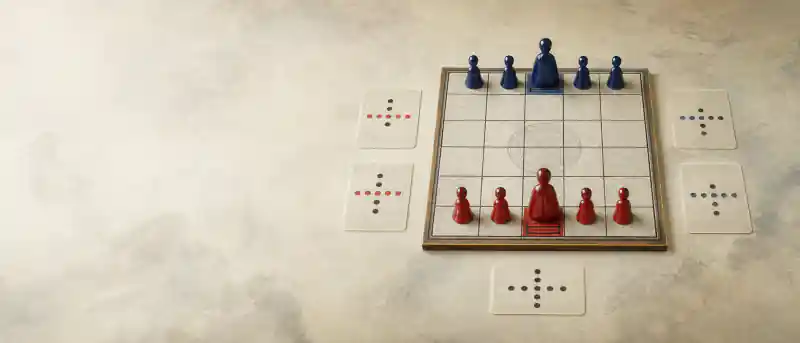
- The base deck holds sixteen movement cards, and after shuffling only five are used per game: two for Red, two for Blue, and one turned face up beside the board as the shared exchange card. The remaining eleven take no part in the game at all.
- The color of the seal in the lower-right corner of the shared card determines who moves first. The seal color is unrelated to the functional colors of the movement squares printed on the card, so you cannot infer the first player from the movement diagram.
- Blue starts on the top row and Red on the bottom, with the master on the temple square at the center of its own back row and the four students filling the other four squares of that row. Masters and students move identically; the only difference is in how the game ends.
- On your turn, choose one card from your hand, then choose any of your pieces, and move it by one of the relative offsets on that card. The card specifies only the destination — the squares in between are not a path, and pieces standing there do not block anything.
- You may not move off the board or onto one of your own pieces. Moving onto an enemy piece captures it and removes it from the game.
- Exchanging cards is a fixed part of every turn: the card you used is rotated 180 degrees and placed in the shared exchange slot, while the card that was sitting there enters your hand. So the card you play does not reach your opponent immediately — it waits in the shared slot for one turn and is picked up by your opponent only after they have acted.
- Card directions are always read relative to the player to move: forward means toward your opponent, and right means your own right hand. The same card produces effects rotated 180 degrees on screen depending on whether Red or Blue holds it.
- If either of your two cards allows any legal move with any of your pieces, you must move; you may not voluntarily skip.
- Only when neither card offers any legal destination for any of your pieces are you excused from moving — but you must still choose a card, exchange and rotate it, and pass the turn. That is a complete turn, not a null pass.
- There is no check, no obligation to respond to a threat, and no rule against exposing your master. A master may legally move onto a square where it will be captured next turn. The base rules also have no draws, no repetition rulings, and no turn limit.
How to Play Onitama: Your First Game
Use this order of thought to get through a complete game quickly.
- Read the cards before choosing a piece. Lay out mentally where each of your two cards could land, and only then decide which piece to move. Picking the piece first often leaves you with no legal destination at all.
- Blue must mentally flip everything: forward on the card means downward on screen, and right means left. When you lose track of orientation, click a piece — the interface only highlights squares the rules have already validated.
- Before playing a card, ask: two turns from now this card will be in my opponent's hand — will it let them capture my master, or step straight into my temple square?
- Learn to read all five cards at once. Your opponent's two determine what they can do right now, and the shared card determines what extra option they gain next turn. All three have to be considered together.
- You do not need to rush your master forward in the opening. Use the students to occupy the squares near the center that most cards can reach, squeezing the space your opponent's hand can land on.
Onitama Strategy
Move from knowing the rules to playing with a plan.
- Pay attention to the circulation of the cards rather than to how strong any individual card is. A card you keep holding narrows your own move set over time, while your opponent's options keep refreshing.
- The center of the board and the squares around it are covered by most cards, so controlling that area simultaneously restrains both the capture-the-master route and the temple route.
- Students are both shields and space-fillers: occupying the only usable destination of a particular card temporarily disables that card in your opponent's hand.
- Stacking a capture threat and a temple threat so your opponent can only stop one of them is usually far more effective than pushing hard along a single route.
- If a card would be more dangerous in your opponent's hand than it is useful in yours, avoid playing it — once played, it will inevitably reach them by way of the shared slot.
- In the endgame, count the exchange delay precisely: the card you play this turn is not available to your opponent on their next turn, so the real danger window opens one turn later than it feels.
Onitama Winning and Special Rules
Details that are easy to miss but can change the result.
- When the Way of the Stone and the Way of the Stream are satisfied at the same time the winner is the same either way, and this site records it as the Way of the Stone.
- A turn with no legal move still produces a complete turn tagged with the card played, and it enters the move history and undo stack — it is not a state-preserving null move.
- This site's initial release uses only the sixteen base cards and does not mix in Sensei's Path, Way of the Wind, or any other expansion, nor any hidden-information variant.
- Cards are dealt from a fixed seed per game, so the same seed always produces the same five cards and the same first player, which makes review and bug reproduction straightforward. Starting a new game reshuffles into a fresh set of five.
- Because the first player is set by the seal, choosing Red or Blue in the settings is not the same as choosing to move first — whichever color's seal appears on the shared card goes first.
Common Onitama Rules Mistakes
The traps new players fall into most often.
- Reading cards in absolute screen directions and forgetting that forward, back, left, and right are reversed between Red and Blue.
- Assuming a used card goes straight into your opponent's hand, and failing to count the turn it spends in the shared slot.
- Watching only whether your own master is capturable and missing that your opponent's master is already one move from your temple square.
- Thinking a piece in the way blocks the move. Cards specify only the destination, and neither pieces nor the temple square in between block anything.
- Assuming that having no legal move means you can simply do nothing — you must still pick a card and complete the exchange.
The Story of Onitama
Where it came from, and why it turned out this way.
DesignShimpei Sato · Japan, 2014 · published by Arcane Wonders
A game with everything face up
Onitama was designed by the Japanese designer Shimpei Sato and released in 2014, themed on a martial arts dojo where two masters and four students each contest a 5×5 mat. It is pure perfect information — no dice, no hidden cards, no random events. The only variable is which five of the sixteen movement cards are dealt at the start. The rules can be taught in two minutes, which is a large part of why it spread so quickly.
The move you play becomes your opponent's move
Onitama's one core mechanism is card circulation: the card you use is rotated 180 degrees into the shared slot, and the card that was sitting there enters your hand. Every turn is therefore a double decision — how do I want to move, and what capability am I willing to hand over? In other games the resource is pieces; here the resource is what each player can do next turn, and it keeps circulating between the two of you.
Two winning lines, both always open
The Way of the Stone (capture the enemy master) and the Way of the Stream (move your master onto the opposing temple square) are both live from the first move, and they share the same pieces and the same cards. That makes defense hard to simplify: you cannot watch only your master's safety, and you cannot merely block the temple lane. The strongest moves usually press both lines at once, so that one reply can only answer one of them.
Small board, deep calculation
Five by five, ten pieces, five cards — the state space is small enough to compute exactly, and small enough for a human to actually calculate. Onitama has become a regular in teaching and research for that reason: simple enough to search completely, tense enough not to feel thin. The real difficulty is not depth but the delay, since the card you play does not reach your opponent until the turn after next, and people routinely calculate the danger window one turn too early.
- Card directions are always read relative to the player to move, so the same card produces effects rotated 180 degrees on screen depending on which side holds it.
- Even when no piece can move at all, you must still choose a card and complete the exchange — that is a full turn, not a pass.
- Expansions such as Sensei's Path and Way of the Wind were released later; this page uses only the base sixteen cards, keeping positions reproducible.
Sources and References
The material this page's rules implementation is based on.
- Onitama RulebookArcane Wonders
Rights holder and physical editionArcane Wonders