Complete DVONN Rules
Start with what a turn allows and how the game is won.
- Board
- 49 points in rows of 9/10/11/10/9
- Components
- 23 white, 23 black, 3 red anchors
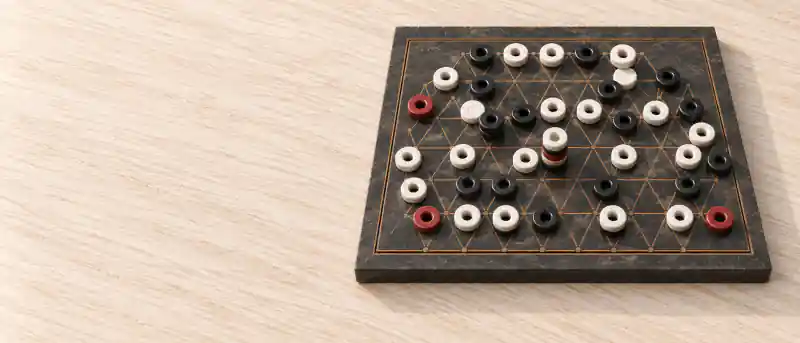
- A standard game begins on an empty board. White places the first red anchor, Black the second, and White the third. Black then places the first black piece, White places the first white piece, and they alternate until all 49 points are occupied. Placement is unrestricted: any empty point is legal, with no adjacency or connectivity requirement.
- White places the final ordinary piece and then immediately takes the first stacking move. White therefore acts twice across the phase boundary—one final placement followed by one move. This is the official turn order, not a skipped Black turn.
- A single piece is a height-one stack. The top piece determines control: a white top means White controls the whole stack, while a black top means Black controls it. A stack always moves whole; it cannot be split or reordered.
- Movement distance must equal the source stack's height. A one-piece stack moves exactly one point, a two-piece stack exactly two, and so on. Movement follows one of the six grid directions in a straight line and may not turn.
- Every crossed point counts whether it is empty or occupied. A stack may jump across gaps and across other stacks, but its destination must be an occupied point on the board. The moving stack is placed intact on top of the destination stack.
- A stack is immobile from surrounding only when all six neighboring points exist and are occupied. Missing directions beyond the board edge do not count as occupied, so an edge stack is not surrounded merely because all of its existing neighbors are filled.
- A lone red anchor cannot move. Another stack may land on it, and once the anchor is inside a stack topped by White or Black, that player may move the complete anchor stack normally according to its height.
- After the moving stack lands, resolve connectivity immediately. Start from every stack containing at least one red anchor and follow adjacent occupied points. Every occupied point unreachable from all anchors is removed as a complete stack, regardless of piece colors or which player caused the disconnection. The visual and rules order is always land first, remove disconnected stacks second.
- Each red anchor is connected to itself, so a lone isolated anchor remains in play. A stack containing an anchor is likewise a connectivity source. The three anchors do not need to remain connected to one another.
- Passing is forbidden while a legal stack move exists. A player with no move must pass, but is not eliminated: if the opponent's move restores a legal move, that player must resume play. The game ends only when neither player has a legal stack move.
- At game end, add the heights of every white-topped stack for White and every black-topped stack for Black. All layers count, including opposing colors and red anchors. The higher total wins; equal totals produce a draw.
How to Play DVONN: Your First Game
Use this order of thought to get through a complete game quickly.
- Watch the perimeter during placement. When the board first fills, interior pieces are surrounded, so the first movable stacks normally come from the edge. Too few pieces on the edge can leave your opening very passive.
- Place several ordinary pieces near anchors for safety, but do not pack every piece into one cluster. You need both anchor connections and movable top pieces in several directions.
- After selecting a stack, use the highlighted destinations. They already satisfy straight-line movement, exact height distance, board limits, and the occupied-destination rule. Intermediate gaps or stacks do not block the jump.
- Before landing, inspect the hole left at the source. You are removing an entire bridge from that point; an island that used it as its last route to an anchor will disappear immediately.
- Tall stacks carry many potential points but have fewer exact-distance destinations. Preserve some short mobile stacks for the endgame instead of merging everything as quickly as possible.
- A red anchor becomes part of a player's score only when it sits inside a white- or black-topped stack. Controlling an anchor stack can be valuable, but moving it can alter the safety of the whole board.
DVONN Strategy
Move from knowing the rules to playing with a plan.
- Evaluate three effects for every move: the control gained at the destination, the components cut by emptying the source, and whether the new taller stack will remain mobile. A move that looks like a large capture may still lose an entire island.
- Look for a single occupied point or narrow chain joining an anchor region to an anchorless region. Moving that bridge can remove far more pieces than the destination stack itself contains.
- Only the top layer controls a stack. Landing on a tall enemy stack can swing many points at once, but the resulting height may have no occupied destination at the required distance and become effectively fixed.
- Endgame mobility can matter more than the current score. Because legal moves are compulsory, your only movable stack may eventually be forced to disconnect your own lead. Making the opponent pass first often secures the final tempo.
- Anchors are not permanently fixed once covered. When the opponent controls an anchor stack, inspect every destination at its current height and which regions would lose their last anchor path if it moved.
- Anchor placement defines the connectivity skeleton. Clustering all three makes distant regions easier to sever; spreading them usually improves safety but also creates more anchor stacks the opponent may try to control.
DVONN Winning and Special Rules
Details that are easy to miss but can change the result.
- This site uses
dvonn-standard-v1, the standard empty-board game. It does not include Board Game Arena's semi-random or random full-board setup and never skips placement. - A lone red anchor is always connected to itself and is never removed for disconnection. The anchors need not connect to one another. A covered anchor moves normally with the complete controlled stack.
- A forced pass applies only to the current turn and does not eliminate that player. An opponent's move may reopen a previously surrounded stack, requiring play to resume.
- Final scoring counts all pieces inside controlled stacks—not stack count, tallest single stack, or only pieces matching the top color. Equal totals are a draw.
Common DVONN Rules Mistakes
The traps new players fall into most often.
- Treating height as a maximum range and trying to stop early. A stack must move exactly as many points as its height.
- Assuming stacks block the route, or trying to land in a gap. You may cross either gaps or stacks, but the destination must be occupied.
- Watching only the destination and overlooking the hole at the source, which may disconnect your own large region.
- Calling an edge stack surrounded. Surrounding requires six actual neighboring points, all occupied.
- Trying to move a lone anchor or removing an isolated anchor. A lone anchor cannot move but always survives; it moves only after becoming part of a controlled stack.
- Counting only your own-colored pieces or the number of stacks. Add every layer in every stack whose top color you control.
The Story of DVONN
Where it came from, and why it turned out this way.
DesignKris Burm · 2001 · fourth game of the GIPF Project
The only game in the series where whole islands vanish
DVONN is the fourth entry in Kris Burm's GIPF Project, published in 2001, and what sets it apart within the series is the three red anchors: any stack that can no longer trace a path of adjacent stacks back to a red piece leaves the board immediately and entirely. In other abstracts pieces are captured; in DVONN they disappear because their supply line was cut, and a single move can wipe more than a dozen pieces off the board at once.
The players build the board themselves
DVONN starts from an empty board, with the two players alternately placing the 3 red anchors and their own 23 pieces until all 49 points are filled, and only then does movement begin. For the first several dozen moves you are not fighting but jointly constructing a structure that is about to be dismantled. Placement carries no connectivity restriction, so the only thing you can do is anticipate which points will later become the throats of the network.
Height is both power and liability
Movement distance is exactly the height of the stack you pick up: one layer moves one point, five layers move five. Taller stacks travel further but are harder to land precisely, and they concentrate a great many pieces on a single point — cut that stack off and you lose all of them at once. DVONN's middlegame is almost entirely about weighing that: is stacking here concentrating my strength, or concentrating my risk?
Only the top piece scores
At the end, each stack scores its full height for whoever controls it, and control is determined solely by the topmost piece. Enemy pieces and red anchors buried underneath all count toward your total. Sitting on top of your opponent thereby becomes the only way to score, while the buried player cannot even move their own pieces. That scoring rule shifts the whole objective from capturing your opponent to covering them.
- The red anchors can themselves be stacked, moved, and scored — they are not neutral fixtures, and burying a red piece inside your own stack is a common advanced technique.
- DVONN won the Games Magazine award for abstract strategy game of the year in 2002 and is among the most highly regarded entries in the GIPF series.
- This site carries three GIPF games — DVONN, YINSH, and TZAAR — which share a design language while having no mechanical overlap whatsoever.
Sources and References
The material this page's rules implementation is based on.
- DVONN RulesRio Grande Games / HUCH!2017 English edition
- DVONN rulesGIPF Project (Kris Burm)
Rights holder and physical editionGIPF Project (Kris Burm)