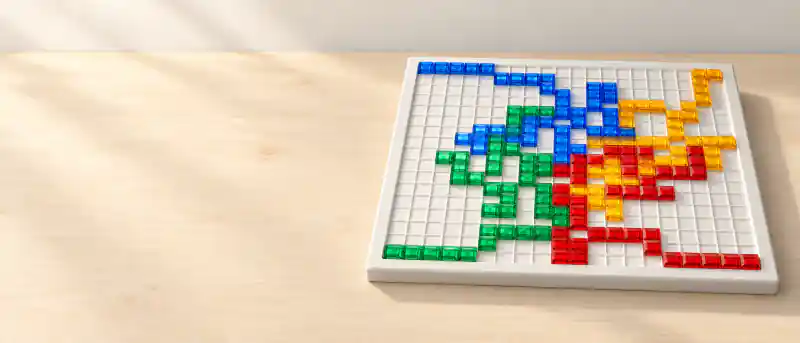
Complete Blokus Rules
Start with what a turn allows and how the game is won.
- Board
- 20 × 20 squares
- Supply
- 21 pieces / 89 squares per color
- Order
- Blue, Yellow, Red, Green
- Winning conditionthe game ends when all four colors have no legal placement, and the result is decided by advanced scoring. Each color loses 1 point per unit square still in hand; placing all 21 pieces scores +15 instead; and placing all 21 with the single-square piece last adds a further 5 for a total of +20. The highest score wins, and ties are allowed.
- Each color has the identical 21 pieces: one monomino, one domino, two triominoes, five tetrominoes, and twelve pentominoes, totaling 89 unit squares. Pieces may be rotated and flipped freely, giving 91 distinct orientations across the 21 pieces after deduplication.
- The color order is fixed as Blue, Yellow, Red, Green regardless of the number of players. The digital board fixes the four starting corners as Blue top-left, Yellow top-right, Red bottom-right, Green bottom-left.
- Each color's first piece must cover its assigned starting corner, but is otherwise completely free in shape and orientation — no particular piece is required to go first.
- Every later piece must have at least one unit square touching one of your own earlier pieces diagonally, and none of its unit squares may be orthogonally edge-adjacent to any of your own earlier pieces. Both conditions must hold at once.
- There are no contact restrictions between different colors: they may touch edges, corners, or both. The only hard constraint is that no piece may overlap a square that is already occupied.
- A color is skipped automatically only when the rules confirm it has no legal placement at all; you can never voluntarily pass a color that still has a move. Once a color has no move, it can never regain one, since the board only continues to fill up.
- A placed piece is permanent and can never be moved, rotated, or taken back. The game ends immediately when all four colors have no move, including empty supplies, with no repetition, timeout, or maximum-turn adjudications of any kind.
- Two-player mode still cycles Blue, Yellow, Red, Green: one seat controls Blue and Red, the other Yellow and Green, and each seat's two color scores are added together for the ranking.
How to Play Blokus: Your First Game
Use this order of thought to get through a complete game quickly.
- Start from your corner and reach toward the center of the board. Your territory can only grow along diagonals, so the direction of your first few pieces largely determines your sphere of influence for the whole game.
- Play the large, awkwardly shaped pentominoes while the board is still open. Those pieces are almost certain to be unplayable by the endgame, and every unplaced unit square costs a point — save the easy small pieces for last.
- Judge a placement mainly by how many usable diagonal frontier squares it creates, not by how many squares it covers. A placement leaving one frontier is easy to kill with a single block; one leaving three or four has a future.
- Develop several diagonal branches at once instead of betting everything on a single growth line. If an opponent takes your one connecting corner, that whole route stalls.
- Remember that your opponents' edges are not walls: your pieces may sit flush against another color, or squeeze entirely into the gap beside it. The only thing that actually blocks you is your own color.
- When you can, save the monomino and domino for the endgame — they slip into gaps nobody else can fill, and finishing with the single square is worth an extra 5 points.
Blokus Strategy
Move from knowing the rules to playing with a plan.
- The overall arc is expand first, fill later: push toward the center early to claim open ground, contest space along your opponents' edges in the middlegame, and only then come back to fill the gaps near your starting corner. Players who fill the corner first usually find the center already has no room for them.
- Blocking beats attackingfind the single diagonal channel through which an opponent reaches open ground and take that corner square with one of your pieces, cutting off their entire direction. Such a placement is worth far more than covering two extra squares.
- When you block an opponent's key corner, check that the route your own next color needs is still intact. The best blocking move is simultaneously an expanding move for you.
- Watch the timing of the fight for the center. It is the region all four colors can reach, and whoever arrives first restrains the other three at once — but arriving alone too early risks being surrounded from three sides, so push the center together with your own frontier.
- In two-player mode, plan Blue and Red as one side and Yellow and Green as the other: the two colors' frontiers can cover each other, and you are only truly beaten when both are sealed. Since seat scores add the two colors together, letting one color flourish while the other stalls is a poor trade — both need to be emptied.
- Calculate exactly in the endgame: count the unit squares still in your hand (one point each) and the empty spots you can still reach. At that stage, spending a pentomino to claim a spot is often worth more than conservatively placing a small piece.
Blokus Winning and Special Rules
Details that are easy to miss but can change the result.
- Advanced scoring is the default on this site and what the AI optimizes: −1 per unplaced unit square, +15 instead for placing all 21 pieces, and +5 more when all 21 are placed with the monomino last, for +20. Basic scoring, which only compares leftover squares, is used for rule testing and is not the default result.
- A pass is generated only when the rule layer confirms the current color has no legal placement; a player may never voluntarily give up a color that still has moves. One color running out of moves does not end the game early — the turn order simply skips past it.
- Two-player mode still follows the Blue, Yellow, Red, Green order: one seat controls Blue and Red, the other Yellow and Green, and the color rotation does not change with the number of seats.
- The classic three-player rule — one color each with the fourth shared in rotation and not scored — is explicitly deferred to ruleset v1.1. This site currently offers no three-player start and will not approximate it with one player permanently holding two colors.
- This site uses the classic 20×20 board and does not include the sizes or components of Blokus Duo 14×14, Trigon, 3D, Junior, or XL.
Common Blokus Rules Mistakes
The traps new players fall into most often.
- Sharing even a single full edge between two of your own pieces, which is illegal. Corner contact is legal and edge contact is not, and the two are very easy to misread in a crowded position.
- Assuming the first piece must be a particular shape. Any piece in any orientation is fine; the only requirement is covering your color's starting corner.
- Thinking you may pass because the piece you currently have selected does not fit. As long as any remaining piece can be placed you may not pass, and the interface will not offer the option.
- Saving the large pieces for last. Gaps shrink as the board fills, pentominoes become effectively unplayable, and each one left in hand is a five-point loss.
- Focusing on your own expansion and not noticing that an opponent's frontier has already curled around into the open area behind you — by the time you turn to block it, the region is gone.
The Story of Blokus
Where it came from, and why it turned out this way.
DesignBernard Tavitian · France, 2000 · later distributed worldwide by Mattel
A complete set of polyominoes
Blokus was designed by the Frenchman Bernard Tavitian and published in 2000. Its components are not an arbitrary assortment: the 21 pieces per color are exactly the complete set of free polyominoes from one to five squares — one monomino, one domino, two triominoes, five tetrominoes, and twelve pentominoes, no more and no fewer, totalling 89 unit squares. That shape set is a mathematical object in its own right, and Blokus simply adds a placement rule to it.
Corners yes, edges no — one rule holds it all up
Your own pieces may touch corner to corner and never edge to edge, and the whole game rests on that. It forces your territory to grow along diagonals, which means a piece's real value is not how many squares it covers but how many new diagonal frontiers it opens. It also produces a counter-intuitive corollary: there are no restrictions at all between different colors, so an opponent's edge is not a wall — you can sit flush against it or squeeze into the gap beside it.
The scoring table dictates the play order
Advanced scoring is simple: −1 for each unit square left in hand, +15 instead for placing all 21 pieces, and +5 more if the monomino goes last. Strategy is therefore prescribed directly by the score sheet — the big pieces must go out while the board is still open, because by the endgame they are almost certainly unplaceable, and every pentomino left in hand is five points gone. Using up the easy small pieces first is the most common way beginners lose points.
Why the two-player game controls two colors each
Blokus is fundamentally a four-color game with a fixed Blue, Yellow, Red, Green rotation. The two-player solution is not to delete two colors but to give one seat Blue and Red and the other Yellow and Green, leaving the rotation intact. All four corners still have someone growing out of them, so the structure of the spatial competition is unchanged — you simply manage two mutually covering frontiers, and the two color scores are added at the end.
- The 21 pieces have 91 distinct orientations after deduplication (four rotations times mirrored or not, minus symmetric duplicates), a number commonly used as an implementation sanity check.
- Blokus won a Mensa Select award in the United States in 2003 along with several design prizes, and it is one of the few modern abstracts widely used in educational settings.
- The classic three-player rule gives each player one color with the fourth shared in rotation and unscored; this page does not implement it and will not approximate it by having one player hold two colors.
Sources and References
The material this page's rules implementation is based on.
- Blokus instruction sheet (BJV44)Mattel2013 English edition
Rights holder and physical editionMattel