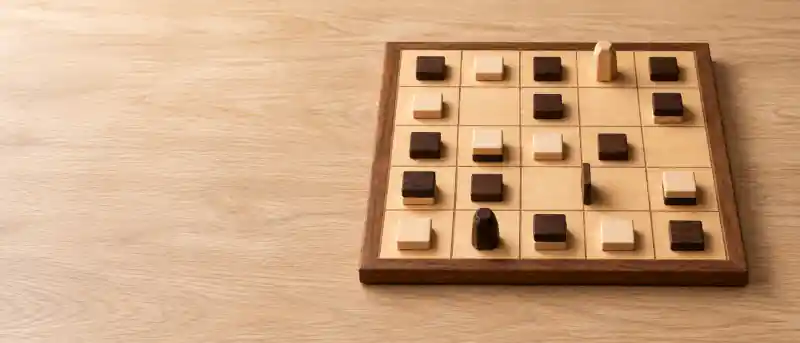
Complete Tak Rules
Start with what a turn allows and how the game is won.
- Board
- 5 × 5 squares
- Reserve
- 21 stones + 1 capstone per player
- Winning conditionbuild a connected road of your own flat stones and capstone, using up, down, left, and right adjacency, joining two opposite edges of the board. Only the top of each stack counts — pieces buried in a stack and standing walls on top count for nothing. If nobody completes a road, the game is settled by counting flat stones on top of stacks.
- The game uses a swap opening: on the first move Light places a dark flat stone on any empty square, and on the second move Dark places a light flat stone. Both of these place the opponent's color, and both draw from the reserve of the color being placed. Neither may be a standing wall or capstone, and neither may move an existing piece. From move three onward each player uses and depletes their own reserve.
- From move three onward each turn is one of two actions, with no passing: place one of your own flat stones, standing walls, or capstones from reserve on an empty square, or move a stack whose top piece is yours. New pieces can only go on empty squares and can never be stacked directly onto an existing stack.
- A flat stone is an ordinary stone laid flat, and it is the only ordinary form that counts for roads and for the final flat count. A standing wall is the same ordinary stone stood on edge: it blocks movement and cannot be covered by ordinary pieces, but it counts neither as road nor in the flat count. Each player has exactly one capstone, tracked in its own reserve; it counts as road, can never be covered by anything, and is the only piece that can flatten a wall.
- Stack control depends only on the top piece: if the top piece is yours, you control the stack, and however many of your pieces are buried inside changes nothing. You may pick up at most 5 pieces from the top of a stack — this carry limit equals the board's edge length — and the stack itself may be taller, but you can never pick up more than its height.
- After picking up, choose up, down, left, or right and keep that direction for the whole move: no turning, no diagonals, no skipping squares. You must drop at least one piece from the bottom of the carried batch on each square you pass, so passing n squares splits the batch into n portions of at least 1 each, summing to what you picked up, with the vertical order of the pieces preserved throughout.
- You may cover a square that is empty or whose top piece is a flat stone, and the dropped pieces stack onto the target in their original order. Standing walls and capstones can be neither covered nor passed over, so they cut a spreading move short.
- The single exception is the capstone flattening a wall: the wall square must be the last square of the move, the portion dropped there must be exactly 1 piece, and that piece must be the capstone. The capstone may come from a larger batch, but every other piece in that batch must already have been dropped on earlier squares. The flattened wall becomes a flat stone of the same ownership in place, with the capstone on top — and the capstone may flatten either side's wall, including your own.
- A road win looks only at each square's top piece: tops belonging to one player that are flat stones or the capstone, connected via up/down/left/right adjacency, and touching both the left and right edges or both the top and bottom edges. The road may bend and branch and need not be straight; diagonal contact does not connect, and standing walls on top and pieces buried in stacks take no part.
- With no road, the flat count triggers in two situations: all 25 squares are non-empty, or either player's ordinary stone reserve and capstone reserve both hit zero (regardless of whose turn it is). The count includes only flat stones on top of stacks — top capstones, top walls, and buried pieces are all excluded — and the larger count wins, with an equal count a draw.
How to Play Tak: Your First Game
Use this order of thought to get through a complete game quickly.
- The first two moves are the easiest thing to get wrong: you place a flat stone of your opponent's color, effectively opening a piece on the board for them. Since it belongs to your opponent, put it somewhere slightly off-center that you would not particularly want yourself, rather than on the best square.
- Flat and standing are the same ordinary stone, and which one you use is decided on the spot — they are not two separate reserves. Place a flat stone to advance a road and a standing wall to cut your opponent off, but every wall you stand up is one fewer stone that can score.
- On an ordinary turn, just click a stack you control (stacks you can move glow softly underneath). Everything you can carry lifts at once and a column opens beside it; to carry fewer, click a piece in that column and you carry from that piece up. Resting the mouse on any stack, or holding a finger on it, opens the same column so you can read the whole stack from bottom to top.
- Then click an adjacent square to drop one piece there; the first drop sets the direction. Click the same square again to drop another, or the next square on to move along. The move is done when your hand is empty, and it completes by itself when only one way is left. With a finger, the last piece waits in place until you press Place. Clicking the starting square puts everything back.
- In the opening, use flat stones to lay a low skeleton across the middle three rows and columns rather than rushing to build tall stacks. An isolated tall stack can travel far in one move, but it also buries a large number of your own pieces under your opponent's top piece.
- Before every move, do two things: count how many squares you still need for a connection, and look at where a single standing wall from your opponent would block the greatest number of your routes.
Tak Strategy
Move from knowing the rules to playing with a plan.
- Develop road skeletons horizontally and vertically at the same time. One wall from your opponent can only seal one direction, and a two-headed threat is usually much harder to answer than a single deeply dug line.
- The price of a blocking wall is that it does not score. As the position approaches a flat count, every additional wall is one fewer flat stone, and the player who is ahead is usually reluctant to keep standing them up.
- Tall stacks are both a reserve and a liability: moving the top layer exposes the colors underneath, and one spreading move can change the ownership of every square along its path. Before confirming, work out the new top color of each square after the spread.
- The capstone both travels on roads and flattens walls, making it the most flexible piece on the board. Nailing it into a corner early wastes its mobility — it is usually worth more held back until your opponent has to block with a wall.
- When your opponent walls off a route, you can flatten the wall instead of going around it — but you must move the capstone to the square directly behind the wall in advance, and make sure the final square receives only that single capstone.
- Near the end, watch both players' reserves. Either reserve hitting zero triggers immediate scoring, so the player with fewer pieces left often needs to complete a road before the count rather than competing on flat stones.
Tak Winning and Special Rules
Details that are easy to miss but can change the result.
- If one move forms roads for both players simultaneously, the player who made the move wins.
- Roads take priority over the flat count: if a move both completes a road and fills the board or exhausts a reserve, it is scored as a road win and the flat count never happens.
- The flat count trigger ignores whose turn it is. As soon as either player's ordinary stones and capstone both reach zero, the game ends and is counted, even if the other player is on move.
- This site uses ruleset tak-5x5-standard-v1: no komi, no other board sizes, no repetition draw, and no community opening restrictions.
- No piece carries any text: lying flat, standing on edge, the capstone silhouette, stack height, and the reserve labels beside the board together express the whole state.
Common Tak Rules Mistakes
The traps new players fall into most often.
- Treating the first two moves as your own opening and trying to place your own color, or a wall, or a capstone.
- Assuming you can move a stack because your pieces are buried in it. Control depends only on the top.
- Picking up more than 5 pieces, dropping nothing on a square you pass, turning mid-move, or trying to skip a square occupied by a standing wall.
- Trying to flatten a wall with a flat stone or with several pieces at once, or scheduling the capstone's flatten on a mid-route square rather than the last one.
- Counting diagonal contact as road, or letting a standing wall on top participate in connectivity.
- Including capstones, standing walls, or buried flat stones in the final flat count.
The Story of Tak
Where it came from, and why it turned out this way.
DesignJames Ernest and Patrick Rothfuss · 2016 · from a game invented in a novel
The novel came first, the game second
Tak's origin is nearly unique in board game history: it began as fiction. In his 2011 novel The Wise Man's Fear, Patrick Rothfuss described a game called Tak — characterizing it only as "a beautiful game," one about playing well rather than merely winning — and gave no rules at all. The designer James Ernest accepted what amounts to an impossible commission: reverse-engineer a rule set for a game that existed only as a description. It was crowdfunded and published in 2016.
Why it turned out to be a connection game
Ernest's solution was to make it a road-building game: lay flat stones to connect two opposite edges. That was a shrewd choice, because connection games are naturally attractive to look at — a winding road has visual appeal in itself, which fits the novel's insistence on beauty. The stacking mechanism then supplies the depth: you pick up a stack you control and spread it square by square, potentially rewriting ownership all along the way.
Three forms, one stone
Flat stones, standing walls, and the capstone look like three piece types, but flat and standing are two ways of placing the same ordinary stone, decided in the moment. That turns attack versus defense into a live trade-off: lay it flat to advance a road, stand it up to cut your opponent off — but a wall counts neither as road nor in the final flat count. Every wall you stand up is one fewer stone that can score.
The opening makes you play for your opponent
Tak's first two moves are a swap opening: on move one you place a flat stone of your opponent's color, and on move two they place yours. It is a minimal balancing device — since moving first is an advantage, make the first player open a piece for the other side. Your instinct is to put that stone somewhere useless, and working out where that actually is becomes the first real judgment of the game.
- The Tak of the novel has no board size, no piece types, and no victory condition; the only thing Ernest had to work from was the phrase "beautiful game."
- This page implements the 5×5 standard game with 21 ordinary stones and 1 capstone per player; the capstone is the only piece that can flatten a wall and the most flexible piece on the board.
- The carry limit equals the board's edge length: on 5×5 you may lift at most 5 pieces from the top of a stack, and the number scales with board size.
Sources and References
The material this page's rules implementation is based on.
- How To Play TakUS Tak Association
- Tak rulebookCheapass Gamescredited to James Ernest and Patrick Rothfuss
Rights holder and physical editionCheapass Games