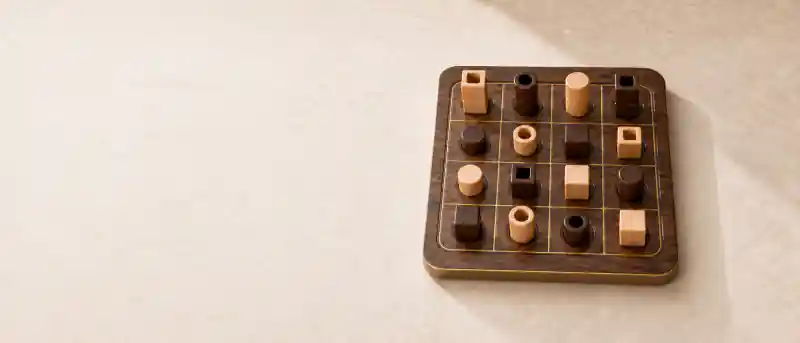
Complete Quarto Rules
Start with what a turn allows and how the game is won.
- Board
- 4 × 4, 16 squares
- Pieces
- 16 shared, four binary attributes
- Winning conditionmake the four pieces on a winning line share at least one attribute, and declare QUARTO before handing over the next piece. Because pieces belong to no one, that line can be built by both players together — you may well win on a piece your opponent placed, and you may equally hand the game away with a piece you just placed yourself.
- Each piece takes one value from each of four binary attributes — tall/short, dark/light, square/round, solid/hollow — and the sixteen pieces cover all sixteen combinations exactly once with no duplicates. Pieces have no owner; both players share the same set.
- The opening player does not place anything: they simply pick one of the sixteen pieces and hand it to the opponent. From then on every complete turn has two fixed steps: place the piece your opponent handed you on any empty square, then pick one of the pieces still off the board and hand it to them.
- You can never choose the piece you are about to place, and you may not refuse or exchange it. Placed pieces never move and are never taken back.
- There are exactly ten winning lines: four rows, four columns, and the two full diagonals. The four pieces on a line need only share at least one attribute — they do not have to be identical, and they do not have to have been placed by the same player.
- A line may share several attributes at once, but it still counts as only one win.
- Victory requires a declaration. After completing a valid line, the player who placed the piece may press the QUARTO declaration button to win — but only before handing over the next piece.
- Missed declarations work like this: if the placing player hands over the next piece without declaring, the declaration was missed, and the opponent receiving that piece gets one immediate declaration window before placing it — declaring there wins the game for the opponent. Once the opponent places the piece in hand, that old line is permanently void and can never win again.
- Later placements that complete new lines create new declaration windows. Detection only scans lines through the current placement square that this move just completed; lines that have already expired never come back.
- The classic rules do not recognize 2 × 2 squares. Four pieces sharing an attribute packed into a small block does not win — that is an advanced variant, which this site does not enable.
- If all sixteen pieces are placed with no valid declaration, the game is a draw. If the last piece forms a line, its placer still has that one declaration opportunity; since no pieces remain off the board, no opponent claim step follows, and declining to declare simply draws the game.
How to Play Quarto: Your First Game
Use this order of thought to get through a complete game quickly.
- Read each piece as a four-bit attribute code rather than as an overall visual impression. The four attributes are independent, and the one most often missed is solid versus hollow, with tall versus short a close second.
- When you receive a piece, scan all ten lines first: which of them already hold three pieces sharing an attribute, and would this piece complete a fourth? If one does, place it and declare.
- Handing over a piece is the part of the turn that actually requires calculation. Before you give a piece away, check it against every three-in-a-line on the board that already shares an attribute — if it completes any of them, pick a different one.
- After placing, confirm whether you have created a new line before clicking any remaining piece. Handing the piece over too quickly transfers the declaration right to your opponent.
- In the early moves, deliberately keep the attributes on any given line as varied as possible, which reduces the chance of being forced to hand over a winning piece in the middlegame.
Quarto Strategy
Move from knowing the rules to playing with a plan.
- Safe pieces run out over time. Before each handover, count how many pieces are still safe to give; whoever's count reaches zero first is forced to hand the game away.
- Building two three-in-a-line threats that require different completing pieces collapses your opponent's safe set very quickly. The strongest move is one that leaves you winning no matter which piece they hand you.
- The four central squares belong to a row, a column, and a diagonal at once, giving them the highest threat density — and equally, they tighten your own handover freedom the fastest.
- Because placement and handover are two layers of choice, the endgame can be enumerated directly: remaining pieces times empty squares is usually a small enough product to calculate exhaustively.
- Attributes are symmetricthree tall pieces on a line is a threat, and so is three short. Check both poles of every attribute rather than only the one you happen to be tracking.
Quarto Winning and Special Rules
Details that are easy to miss but can change the result.
- The declaration is a rule action, not interface decoration. This site keeps the official declaration and missed-declaration mechanics, and the AI declares immediately whenever a legal declaration exists, so it never offers you a claim.
- When your opponent misses a declaration, a QUARTO button appears on your panel — but it works only before you place the piece in your hand, and it closes the moment you place.
- There are only two endings: a valid declaration wins, or all sixteen pieces are placed and the game is drawn. No other adjudication exists.
- The interface shows the piece your opponent assigned you — the one you must place — separately from the pieces still off the board, so the handover step is never mistaken for an ordinary alternating piece selection.
Common Quarto Rules Mistakes
The traps new players fall into most often.
- Misreading the goal as four identical pieces. Sharing any single attribute is already enough.
- Treating a 2 × 2 square as a win, which is an advanced variant that is not enabled here.
- Handing over the next piece out of habit right after placing, forgetting to declare the line you just completed.
- Focusing on the line you are building and handing your opponent the exact piece their other line was missing.
- Assuming a missed line can be claimed later. It becomes permanently void the moment your opponent places their piece.
The Story of Quarto
Where it came from, and why it turned out this way.
DesignBlaise Müller · Switzerland, 1991 · published by Gigamic
Handing the choice of piece to your opponent
Quarto was designed in 1991 by the Swiss mathematician Blaise Müller and published by Gigamic in France. Its single innovation is enough to restructure the whole game: pieces belong to no one, and the piece you place was chosen for you by your opponent. Every turn splits in half — place the piece you were handed, then pick one of the remaining pieces to hand over. The half that actually demands calculation is usually the second one.
Four binary digits, sixteen unique pieces
The sixteen pieces take values across four attributes — tall or short, dark or light, square or round, solid or hollow — covering all 2⁴ = 16 combinations exactly once, no more and no fewer. That is not decoration but the skeleton of the design: a winning line needs only four pieces sharing at least one attribute, so every piece lives simultaneously in four dimensions. Reading a piece as a four-bit code rather than as an overall silhouette is the dividing line between a novice and a beginner who understands the game.
Declaration means missing it has a price
Quarto keeps a rule you rarely see: completing a valid line does not win automatically — you must declare before handing over the next piece. Forget, and the chance passes to your opponent, who gets one immediate claim window before placing the piece in their hand. Once they place it, the old line is void forever. The rule turns noticing into a skill in its own right, and means the board may at any moment hold a dead line nobody spotted.
A small board with a known answer
A 4×4 board puts Quarto within reach of full solution. Luc Goossens completed that solution in 1998, and the answer is a draw with best play from both sides. This matters little in practice — no human plays flawlessly across sixteen pieces, sixteen squares, and an extra layer of piece selection — but it does explain why draws are noticeably common in strong play.
- The classic rules do not recognize 2×2 squares as a win, which is a common advanced variant; this page implements the classic version, counting only four rows, four columns, and the two diagonals.
- The number of safe pieces to hand over decreases monotonically as the game proceeds, and whoever's safe set reaches zero first must hand over the game — the most practical way to assess the position.
- Gigamic's wooden edition is a design classic in itself, and Quarto was among the first abstract games to reach museum shops and design awards.
Sources and References
The material this page's rules implementation is based on.
- QUARTO Classic rulesGigamicrulebook header 11-2016F
Rights holder and physical editionGigamic