Complete Euchre Rules
Start with what a turn allows and how the game is won.
- Deck
- 24 cards, 9/10/J/Q/K/A per suit
- Hand
- 5 cards each, 5 tricks
- Game ends
- First partnership to 10
- Four players in fixed partnerships. Five cards each, dealt clockwise from the dealer's left in two packets of three then two. The remaining four form a stock, and its top card is turned face up for everyone to see.
- Round one of bidding starts at the dealer's left. Each player either orders it up — accepting the turned card's suit as trump for this hand — or passes. The first player to order it up ends the bidding, and the dealer takes the turned card into hand and discards one face down.
- Round two happens only if all four pass. Each player may now name any suit as trump except the turned card's suit, which all four have just rejected. The turned card is then set aside and out of the hand.
- The dealer may not pass in round two. If the first three pass, the dealer must name a suit. Consequently there is never a thrown-in hand and never a redeal.
- Going aloneonly the player who named trump may declare it. Their partner then sets their hand aside and takes no part, so the hand is played by three players with three cards to a trick.
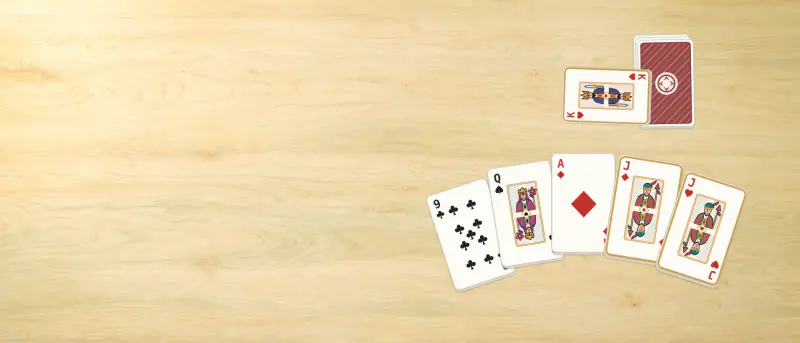
- Once trump is set the ranking changes: the jack of trump is highest (the right bower), and the jack of trump's colour partner is second (the left bower), followed by the ace, king, queen, ten and nine of trump, and only then the other suits.
- The left bower counts as trump for every purpose — following suit, being beaten, discarding and void inference alike. So trump holds 7 cards this hand while the suit sharing trump's colour holds only 5.
- Five tricks are played. The dealer's left leads the first. You must follow the suit led if you can, otherwise play anything. There is no restriction on leading trump — unlike breaking hearts, trump may be led at any time.
- A trick goes to the highest trump if any was played, otherwise to the highest card of the suit led. The winner leads the next.
- Scoringmakers taking 3–4 tricks score 1, all 5 scores 2. Going alone, 3–4 still scores 1 but all five scores 4. Makers falling short of 3 give the defenders 2. First to 10 wins, with no requirement to win by two.
How to Play Euchre: Your First Game
Use this order of thought to get through a complete game quickly.
- Learn the left bower first. With hearts as trump, the jack of diamonds is a heart: you must play it when hearts are led, and you may not play it when diamonds are led. This is not a bug — it is the central rule of the game.
- When counting strength, put both jacks first: the right bower wins almost always, the left bower loses only to the right, and the ace of trump comes after those. Never discard the left bower as though it were a small card — that is the most expensive beginner mistake here.
- The bar for bidding is roughly three tricks you can see. Count an ace as one, a protected king as one, each trump beyond the third as one, and add half for each void. Reach three and you can bid.
- Before ordering it up, note one thing: the turned card goes into the dealer's hand. If the dealer is your partner that is a free trump for your side; if not, you are arming an opponent. The same hand can therefore be worth bidding from one seat and worth passing from another.
- Go alone sparingly. Four points for all five tricks is tempting, but failing hands the opponents 2 and your partner's entire hand sits out. It is only worth it when your trumps are both numerous and high enough to take five yourself.
- As a maker, lead trump to draw the opponents' trumps out — the contract is about the count of tricks, not about saving good cards. As a defender do the opposite: cash an off-suit ace rather than help clear trump.
- When your partner has already won the trick, play your lowest. In a five-trick hand every high card matters.
Euchre Strategy
Move from knowing the rules to playing with a plan.
- Bidding is where this game lives. With five tricks, three is the contract, so the line between bidding and passing is razor thin — one card decides it. And because hands are short, a misjudgement settles immediately rather than leaving room to recover the way thirteen tricks would.
- The left bower changes more than card strength; it changes void inference. With hearts as trump there are only five diamonds, so when somebody fails to follow diamonds you must reason from five rather than six. Experienced players forget this too.
- Stick the Dealer makes the dealer's seat awkward: if the first three pass, they must name something. Anticipate it — with a poor hand it is often better to order up a tolerable suit in round one than to pass into being forced.
- Sitting at the dealer's left, your pass is a tool for applying that pressure. With a middling hand, passing gives the dealer a chance to be forced in round two, which beats bidding thinly yourself.
- Whether to go alone depends on the score as much as the cards. Four or more points behind, going alone gains expected value sharply — four points closes a gap in one hand. Ahead, the reverse holds: a safe 1 beats a gambled 4.
- Defenders should watch the dealer's discard. You cannot see what it was, but the fact that they discarded at all means they held something not worth keeping, and that is information in itself.
- Five tricks can be counted through exactly. Trump holds seven cards this hand — track how many have appeared and you will know whether your ten of trump has become a certain trick.
Euchre Winning and Special Rules
Details that are easy to miss but can change the result.
- We play Stick the Dealer: in round two the dealer may not pass and must name a suit. Both rule sources list this as a variant rather than the standard, so this is our product adjudication. The gain is eliminating the thrown-in hand entirely — without it, the rule layer, UI and AI would each need an extra 'nobody bid, redeal' branch. If you know the traditional rules and notice the dealer has no pass button, that is deliberate.
- Only the player who named trump may go alone. Some circles let defenders go alone too; we do not — the primary source (Bicycle's official rules) restricts it to the maker, and it keeps both the scoring and the AI model markedly simpler.
- We do not use the 'dealer's partner ordering up must go alone' rule. That is a regional variant found in Australia, England and Canada; here the dealer's partner ordering up is an ordinary bid.
- Dealing is fixed at 3+2. Tradition allows 3+2 or 2+3 so long as a hand is consistent; a digital implementation fixes one for reproducibility.
- Played cards cannot be taken back. Our digital adjudication for hidden-information games rather than a traditional rule.
- The deck is 24 cards with no jokers. That is the North American standard. Bicycle's official rules permit 32, 28 or 24 and list jokers as optional; we follow the North American form.
- All five tricks scores 2 when playing normally and 4 only when going alone — two numbers that are easy to confuse.
Common Euchre Rules Mistakes
The traps new players fall into most often.
- Discarding the left bower as an ordinary card. With hearts as trump, that jack of diamonds is the second-highest card in the hand; throwing it away throws away a trick, and it is the single most expensive error in the game.
- Trying to follow a diamond lead with the jack of diamonds. Under hearts it is no longer a diamond and the rules will stop you — though the more common version is the reverse: hearts are led, you assume you are void, and in fact that jack of diamonds is a heart you are required to play.
- Counting six cards in the suit sharing trump's colour when inferring voids. It holds only five, and one extra card skews the whole inference.
- Passing as dealer all the way into round two and then being forced by Stick the Dealer to name a suit on a bad hand. With poor cards, ordering up a tolerable suit in round one is often better.
- Going alone casually for the four points. Failing gives away 2 and wastes your partner's whole hand — it needs a hand that takes five by itself, not one that probably takes four.
- Holding cards back on a thirteen-trick rhythm. The hand is far too short; a high card that should win a trick must be spent now, because saving it for the fifth trick usually means never using it.
- Mixing up the sweep scores: five tricks is 2 normally, and 4 only when alone.
The Story of Euchre
Where it came from, and why it turned out this way.
LineageReached America in the 1830s–40s · descended from the German Juckerspiel
The game that put a word into English
Euchre arrived in America with German-speaking immigrants in the 1830s and 1840s, descended from Juckerspiel. Its mark on the language outlasts its present fame: bower comes from the German Bauer, 'farmer', and the verb euchre — to defeat someone, to leave them short of what they undertook — passed straight into everyday English. Through the middle of the nineteenth century it was the most popular card game in the United States, occupying roughly the place Bridge would later hold. Even the pair of jokers in a modern deck traces back to it: they began as an extra top bower for Euchre.
Twenty-four cards, five tricks: why so short
Euchre uses only nine through ace in each suit, and a hand of five tricks is over in minutes. That is a design choice rather than a simplification, because a short hand makes bidding the whole game. Over thirteen tricks a bad bid leaves a dozen cards to recover through; over five, three tricks are the contract and a one-card misjudgement settles at once. The technical density of Euchre therefore sits in the opening seconds: is this hand worth three? Whose hand does the turned card strengthen? Is it worth going alone?
The left bower: a rule that changes what a card is
The most counter-intuitive and most elegant rule in the game: once trump is set, the jack of trump's colour partner joins the trump suit. With hearts as trump the jack of diamonds is a heart — it follows hearts, is beaten by hearts, and can no longer be discarded as a diamond. Trump therefore holds seven cards this hand while its colour partner holds five, and even the arithmetic of void inference has to change. In nearly every other card game a suit is an intrinsic property of a card; Euchre makes it something decided afresh each hand. Our rule layer consequently has exactly one place where suit is judged, and every follow, trick and void goes through it — otherwise this rule would seep into every corner of the code.
Going alone, and one rule we added ourselves
Going alone is the game's high point: the maker sends their partner's hand out of play and takes on three opponents, and all five tricks score 4 — a quarter of the race in one hand. It belongs to the same family as shooting the moon in Hearts and Nil in Spades: an outlet that magnifies the reward for a strong holding.
One thing here is our own adjudication: we play Stick the Dealer, meaning the dealer may not pass in round two and must name a suit. Both rule sources treat that as a variant, but it removes the 'nobody bid, redeal' state and so removes a branch from the rule layer, the interface and the AI alike. The cost is that the dealer's seat becomes uncomfortable — which turns out to be the tensest bit of play in the game: will the three ahead of them pass deliberately, to force a bid out of a bad hand?
- The jokers in a deck of playing cards began as a top bower devised for Euchre; American manufacturers started including them in the 1860s, and other games borrowed them later.
- 'Euchre' survives as an English verb meaning to leave somebody short of what they undertook — still in use, mostly by speakers who do not know it came from a card game.
- The North American standard is 24 cards without jokers; Bicycle's official rules permit 32, 28 or 24 and list jokers as optional, and we follow the North American form.